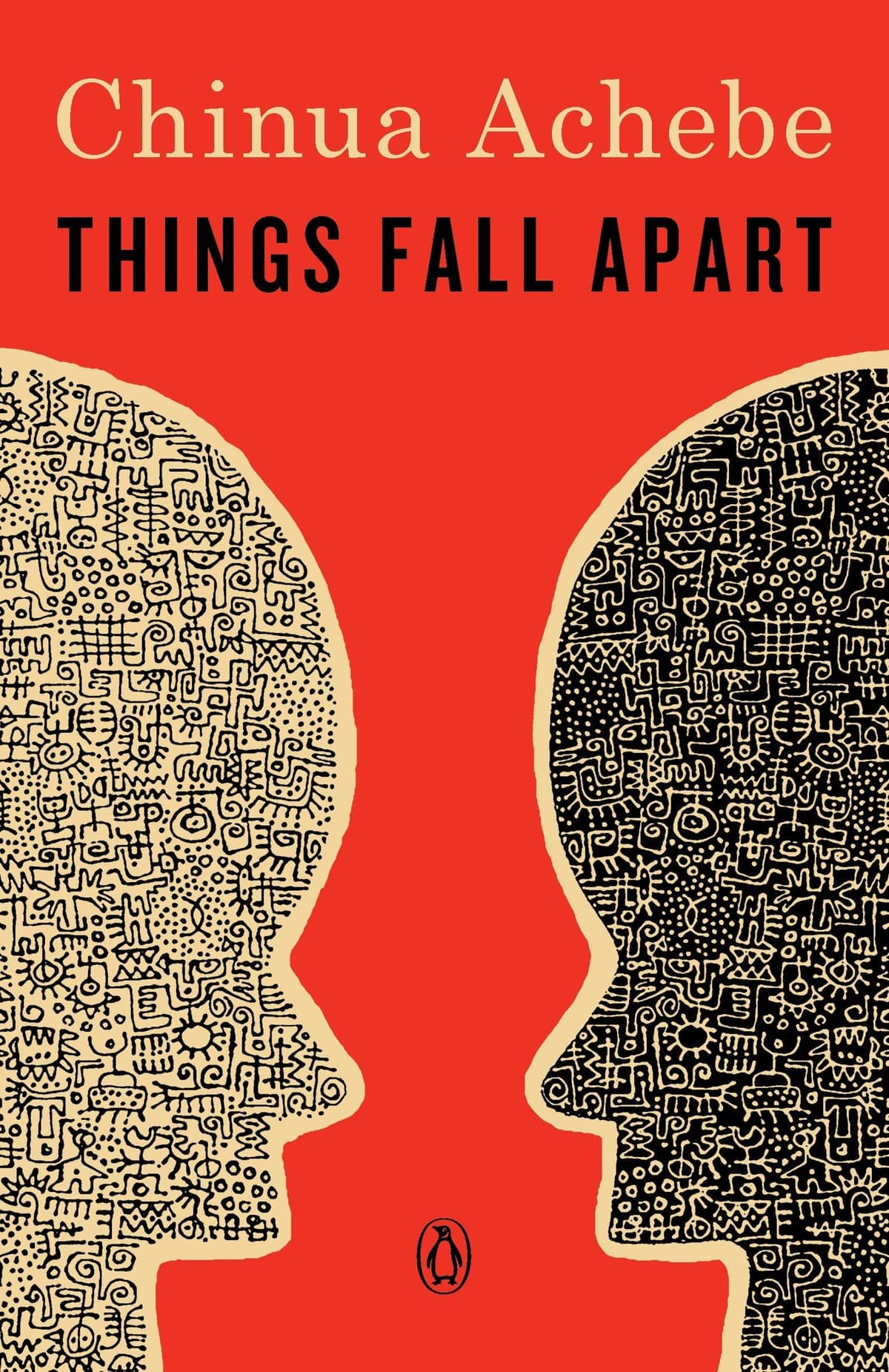
Things Fall Apart
“The white man is very clever. He came quietly and peaceably with his religion. We were amused at his foolishness and allowed him to stay. Now he has won our brothers, and our clan can no longer act like one.”
Things Fall Apart Summary
In the Igbo village of Umuofia, Okonkwo is a man of iron will who has built his life in deliberate opposition to his gentle, debt-ridden father. He is a champion wrestler, a prosperous farmer, and a warrior of renown—a man who equates masculinity with strength and tenderness with weakness. When an accidental killing forces him into seven years of exile, he returns to find that white missionaries and colonial administrators have arrived, and the world he fought so hard to dominate has begun to dissolve.
Achebe's prose is deceptively simple, infused with the proverbs, rhythms, and oral traditions of Igbo culture. Things Fall Apart gives full, vivid life to a pre-colonial African society—its justice system, its religious beliefs, its complex social hierarchies—before showing, with devastating restraint, how colonialism dismantled it. This is not a novel of villains and victims but of irreconcilable worlds, told with the quiet authority of a writer reclaiming his people's story.
Why Read Things Fall Apart?
Things Fall Apart is the novel that talked back to empire. For generations, Africa had been written about by Europeans—as a dark continent, a blank space on the map, a backdrop for white adventure. Achebe, in barely two hundred pages, overturned the entire tradition. He showed that the Africa that colonialism destroyed was not a wilderness but a civilization, with its own laws, art, philosophy, and contradictions.
What makes the novel a masterpiece rather than a polemic is its refusal to idealize. Okonkwo is heroic but also brutal; Igbo society is rich but also capable of cruelty. Achebe does not ask you to choose sides—he asks you to see. And in the novel's devastating final paragraph, when the District Commissioner reduces Okonkwo's entire life to a footnote in a colonial report, you understand exactly what is at stake when one culture presumes to narrate another.
About Chinua Achebe
Chinua Achebe (1930–2013) was born in Ogidi, Nigeria, and educated at the University of Ibadan, where he rejected his baptismal name, Albert, in favor of his Igbo name. He wrote Things Fall Apart at twenty-eight, partly in response to the patronizing depictions of Africa in European literature—particularly Joseph Conrad's Heart of Darkness.
The novel has sold more than twenty million copies and been translated into over sixty languages, making it the most widely read work of African literature. Achebe went on to write four more novels, along with essays and poetry, and became the moral conscience of Nigerian letters. He turned down Nigeria's national honor twice in protest against government corruption. He was, in every sense, a man who refused to be written by others.
Reading Guide
Ranked #62 among the greatest books of all time, Things Fall Apart by Chinua Achebe has earned its place in the literary canon. Originally written in English and published in 1958, this accessible read from Nigeria continues to resonate with readers today.
This book belongs to our Society & Satire collection, where you can discover more books that share its spirit and themes.
If you enjoy accessible reads like this one, you might also like The Great Gatsby, The Catcher in the Rye, or Pride and Prejudice.
From the Society & Satire Collection
If you enjoyed Things Fall Apart, discover more masterpieces that share its spirit.
 #9View Book
Don Quixote
Miguel de Cervantes
High•35-40 hours #12View Book
Pride and Prejudice
Jane Austen
Accessible•10-12 hours #22View Book
Madame Bovary
Gustave Flaubert
Moderate•12-15 hours #30View Book
Middlemarch
George Eliot
High•30-35 hours
Browse more collections