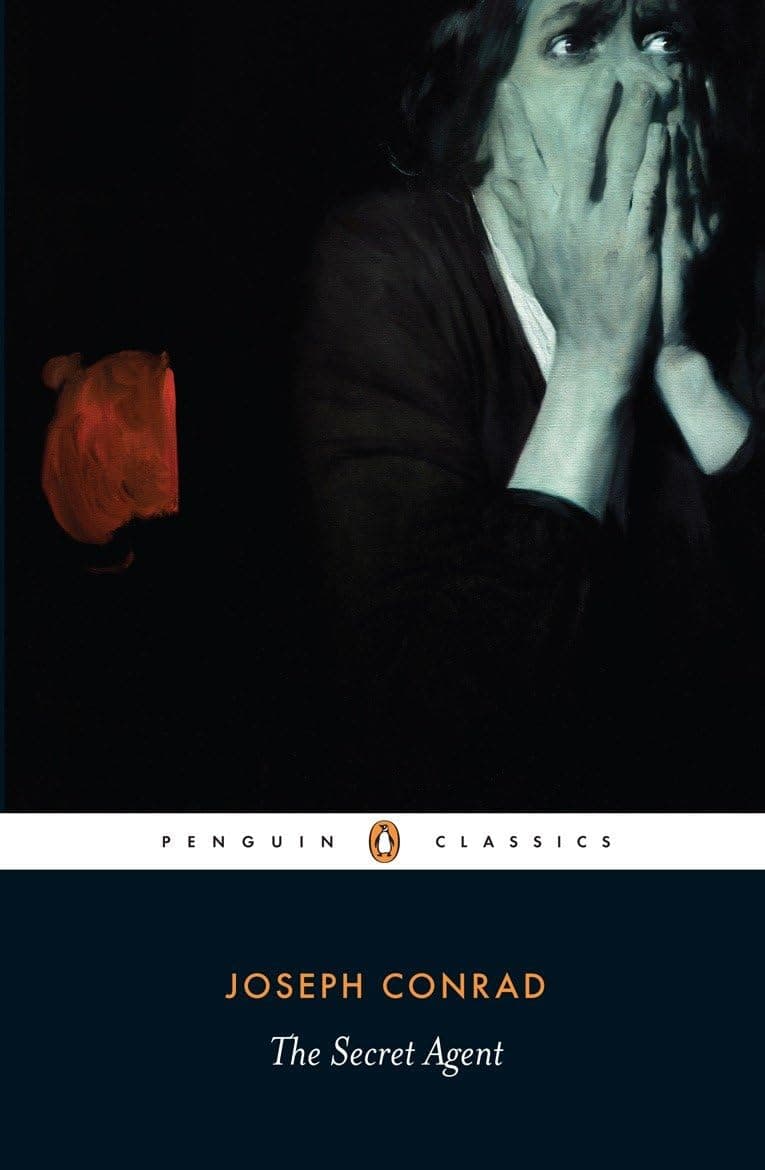
The Secret Agent
“The way of even the most justifiable revolutions is prepared by personal impulses disguised into creeds.”
The Secret Agent Summary
Adolf Verloc is a shopkeeper in Soho who sells pornographic materials as a cover for his real occupation: he is a secret agent employed by a foreign embassy, likely Russian, to act as a provocateur among London's community of anarchists. Verloc has been living comfortably in this double role for years, attending anarchist meetings and filing reports, doing as little as possible to earn his retainer. But when his handler, the ruthlessly pragmatic Mr. Vladimir, demands that Verloc commit an act of terrorism, specifically an attack on the Greenwich Observatory designed to shock the bourgeoisie and provoke a crackdown on political radicals, Verloc is forced into action. The plan goes horrifically wrong: instead of carrying out the bombing himself, Verloc sends his wife Winnie's intellectually disabled brother Stevie to plant the device, and Stevie trips and is blown to pieces. The discovery of this betrayal transforms Winnie Verloc from a passive, enduring wife into something terrifying, and the novel's final act is a devastating portrait of grief, rage, and the collapse of a marriage built on mutual silence and self-deception.
Joseph Conrad called The Secret Agent a simple tale, but the simplicity is deceptive. Beneath its surface of dark comedy and domestic tragedy lies one of the most corrosive studies of political violence and institutional hypocrisy in the English language. Conrad treats anarchists, police, diplomats, and politicians with equal contempt, exposing each as self-serving performers playing roles in a system that grinds the innocent to dust. The novel's tone is bitterly ironic, its narration deliberately ponderous and suffocating, mirroring the stifling moral atmosphere of a world in which everyone is complicit. Stevie, the only genuinely innocent character, is literally destroyed, and his destruction exposes the emptiness of every ideology and institution in the novel. Written in 1907, The Secret Agent remains one of the most prescient novels about terrorism, state power, and the human cost of political abstraction ever written.
Why Read The Secret Agent?
The Secret Agent was written in 1907 and has never stopped being relevant. Every time a terrorist act shocks the world, every time politicians exploit fear to expand surveillance and curtail freedom, every time the machinery of the state grinds up the vulnerable in the name of order, Conrad's novel speaks directly to the moment. What makes it exceptional is not its prescience but its refusal to offer comfort from any direction. Conrad does not romanticize the anarchists, celebrate the police, or sentimentalize the victims. He shows you a world in which every institution, from the embassy to the police station to the anarchist cell, operates on cynicism, self-interest, and indifference to human suffering, and he dares you to identify the villain.
But the novel's deepest power lies not in its politics but in its portrait of the Verloc marriage, one of the most devastating depictions of domestic life in all of fiction. Winnie Verloc's transformation from passive wife to avenging fury is as shocking and as inevitable as anything in Greek tragedy. Conrad understood that political violence is never abstract, that it always comes home, and that the true cost is always paid by those who had no voice in the decisions that destroyed them. If you want to understand the human reality behind the headlines, The Secret Agent is an indispensable book.
About Joseph Conrad
Jozef Teodor Konrad Korzeniowski was born in 1857 in Berdychiv, in what is now Ukraine, to Polish parents who were political exiles. Orphaned by the age of eleven, he was raised by his uncle and at seventeen left for Marseilles to begin a career at sea. He spent twenty years as a merchant sailor, rising to the rank of captain in the British Merchant Navy, and did not begin writing fiction in English, his third language after Polish and French, until he was in his mid-thirties. His experiences at sea provided the material for many of his greatest works.
Conrad's literary output ranks among the most remarkable achievements in the English language, all the more extraordinary for having been produced by a non-native speaker who did not begin writing prose until relatively late in life. Heart of Darkness, Lord Jim, Nostromo, and The Secret Agent are cornerstones of modern literature, works that pioneered techniques of narrative complexity and psychological depth that influenced virtually every major novelist of the twentieth century. Conrad's vision was dark, skeptical of progress and civilization, attuned to the corruptions of power and the fragility of moral order. He died in 1924 in Kent, England, and his reputation, which fluctuated during his lifetime, has only grown in the decades since, securing his place as one of the greatest novelists in the English language.
Reading Guide
Ranked #452 among the greatest books of all time, The Secret Agent by Joseph Conrad has earned its place in the literary canon. Originally written in English and published in 1907, this moderate read from United Kingdom continues to resonate with readers today.
This book belongs to our Society & Satire and Gothic & Dark collections, where you can discover more books that share its spirit and themes.
If you enjoy moderate reads like this one, you might also like One Hundred Years of Solitude, Nineteen Eighty-Four, or Wuthering Heights.
From the Society & Satire Collection
If you enjoyed The Secret Agent, discover more masterpieces that share its spirit.
 #9View Book
Don Quixote
Miguel de Cervantes
High•35-40 hours #12View Book
Pride and Prejudice
Jane Austen
Accessible•10-12 hours #22View Book
Madame Bovary
Gustave Flaubert
Moderate•12-15 hours #30View Book
Middlemarch
George Eliot
High•30-35 hours
Browse more collections