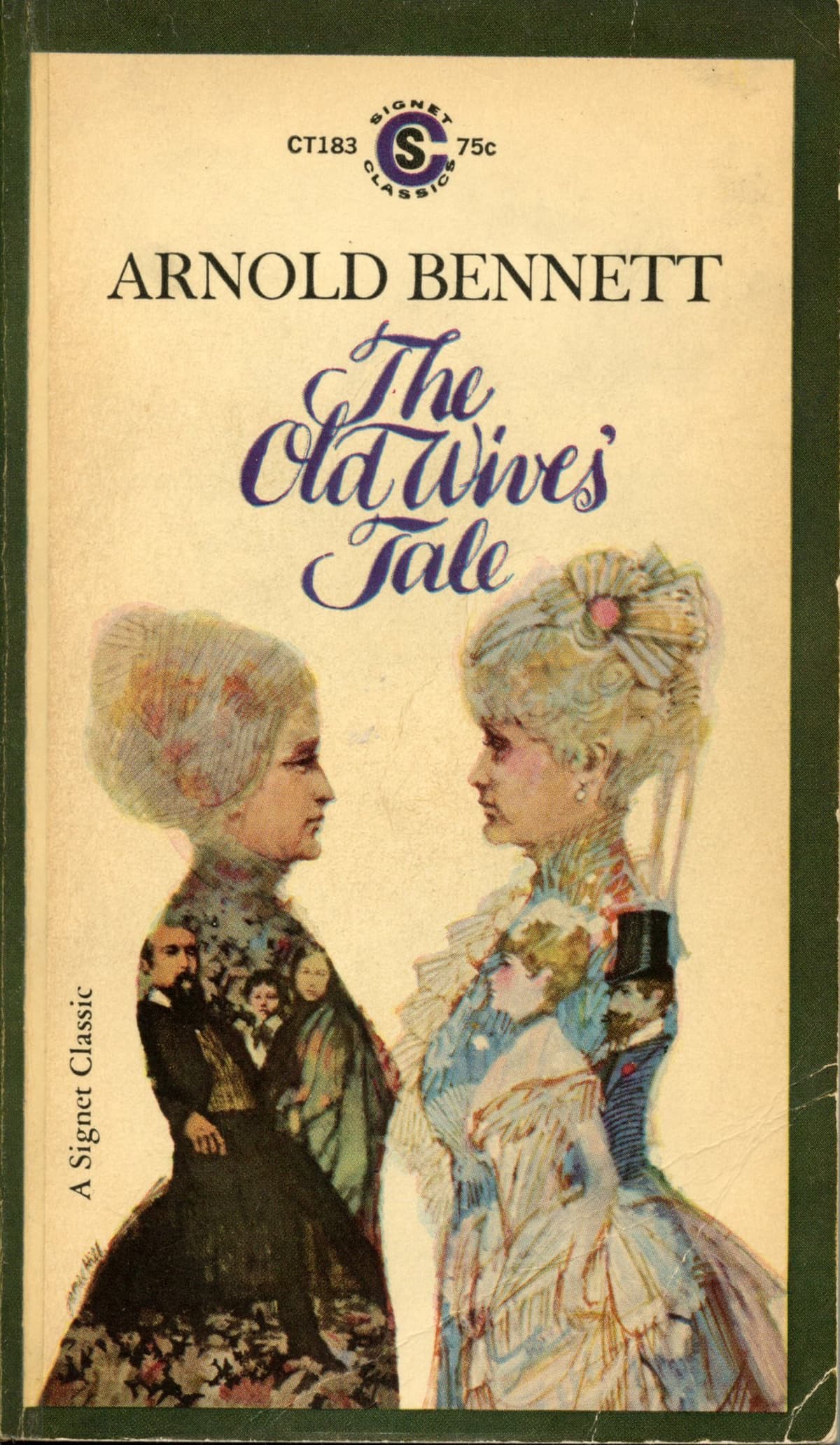
The Old Wives' Tale
“The secret of contentment lay in paying full attention to what was happening at the moment.”
The Old Wives' Tale Summary
The Old Wives' Tale traces the entire lives of two sisters, Constance and Sophia Baines, from their girlhood in the 1860s above their father's draper's shop in Bursley—one of Bennett's "Five Towns" in the industrial English Midlands—through old age and death in the early twentieth century. Constance, the dutiful elder sister, marries Samuel Povey, her father's shop assistant, and lives out her life in the same town, the same shop, the same routines, her world narrowing with each decade yet filled with the quiet dramas of marriage, motherhood, widowhood, and the small stubborn battles of provincial existence. Sophia, the beautiful, restless younger sister, elopes to Paris with the dashing Gerald Scales, who proves to be a weak, faithless man. Abandoned in Paris, Sophia survives through intelligence and iron will, building a successful career as a pension-keeper through the Franco-Prussian War and the Siege of Paris. The novel follows both sisters across decades with unflinching honesty, charting the slow, inexorable process by which youth, beauty, ambition, and passion are worn down by time into resignation, habit, and the final indignity of physical decline.
Arnold Bennett's masterpiece is one of the great realist novels in English, a work that achieves its devastating power through the accumulation of ordinary detail rather than dramatic incident. Bennett's method is democratic and compassionate: he grants the same weight and dignity to Constance's quiet life of provincial routine as to Sophia's adventures in Paris, insisting that every human life, however outwardly uneventful, contains its own drama and pathos. The novel's unforgettable final pages, in which the surviving sister contemplates the body of the other and is struck by the terrible swiftness with which an entire life has passed, achieve a gravity that rivals Tolstoy. The Old Wives' Tale is a profound meditation on time, change, and the courage required simply to endure.
Why Read The Old Wives' Tale?
The Old Wives' Tale is one of the most quietly devastating novels ever written. Bennett does not rely on melodrama, coincidence, or grand gestures; instead, he achieves his effects through the patient, compassionate accumulation of ordinary moments—a shop sale, a family dinner, a letter received, a husband's illness—that together compose the fabric of a human life. The result is a reading experience that sneaks up on you: you begin by thinking this is a modest domestic chronicle, and you end with tears in your eyes, confronted by the enormity of what it means for time to pass, for youth to become age, for possibility to harden into fact. No novel captures the texture of lived time with greater fidelity or greater emotional power.
The two sisters represent two paths through life—one domestic and rooted, the other adventurous and cosmopolitan—and Bennett refuses to judge either as superior. Constance's small provincial world is rendered with the same richness and respect as Sophia's dramatic Parisian exile. This even-handedness is the novel's moral achievement: it insists that every life matters, that the quiet heroism of endurance is as worthy of literature as the grand gestures of rebellion. If you have ever looked at an elderly person and wondered what fires once burned within them, The Old Wives' Tale answers that question with devastating completeness.
About Arnold Bennett
Arnold Bennett was born in 1867 in Hanley, one of the six pottery-manufacturing towns in Staffordshire that he would immortalize as the "Five Towns" in his fiction. The son of a self-made solicitor, he left the Potteries for London at twenty-one to pursue a literary career, working first as a solicitor's clerk and then as a journalist before devoting himself to fiction. He lived in Paris for nearly a decade, where his immersion in French realist fiction—particularly Flaubert, Maupassant, and the Goncourt brothers—shaped his literary method.
The Old Wives' Tale, published in 1908, was directly inspired by Bennett's determination to write a novel about the passage of time that would rival Maupassant's Une Vie. It established him as one of the leading English novelists of his generation, alongside H. G. Wells and John Galsworthy. His other major Five Towns novels include Clayhanger, Hilda Lessways, and These Twain, while his later London novels, including Riceyman Steps, demonstrated his continued mastery. Bennett was also a prolific journalist, playwright, and man of letters who exercised enormous influence on literary taste and publishing. Virginia Woolf's famous attack on him in her essay "Mr. Bennett and Mrs. Brown" paradoxically secured his reputation as the exemplar of a tradition she wished to overthrow. Bennett died in 1931 of typhoid fever contracted, it is said, from drinking tap water in Paris to prove it was safe. His stock has risen steadily in recent decades, and The Old Wives' Tale is now widely regarded as one of the finest English novels of the twentieth century.
Reading Guide
Ranked #375 among the greatest books of all time, The Old Wives' Tale by Arnold Bennett has earned its place in the literary canon. Originally written in English and published in 1908, this moderate read from United Kingdom continues to resonate with readers today.
This book belongs to our Society & Satire and Love & Loss collections, where you can discover more books that share its spirit and themes.
If you enjoy moderate reads like this one, you might also like One Hundred Years of Solitude, Nineteen Eighty-Four, or Wuthering Heights.
From the Society & Satire Collection
If you enjoyed The Old Wives' Tale, discover more masterpieces that share its spirit.
 #9View Book
Don Quixote
Miguel de Cervantes
High•35-40 hours #12View Book
Pride and Prejudice
Jane Austen
Accessible•10-12 hours #22View Book
Madame Bovary
Gustave Flaubert
Moderate•12-15 hours #30View Book
Middlemarch
George Eliot
High•30-35 hours
Browse more collections