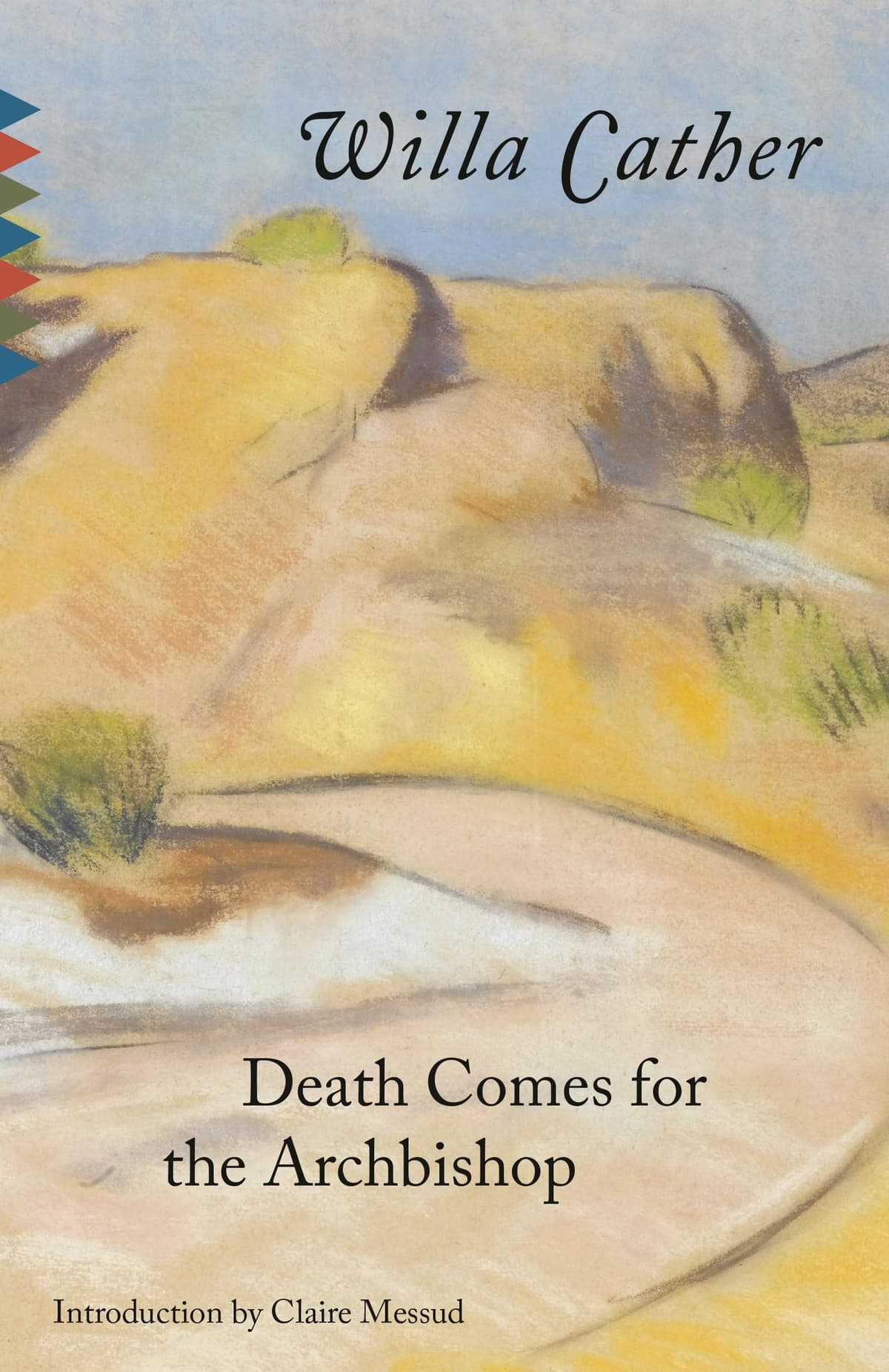
Death Comes for the Archbishop
“The Miracles of the Church seem to me to rest not so much upon faces or voices or healing power coming suddenly near to us from afar off, but upon our perceptions being made finer, so that for a moment our eyes can see and our ears can hear what is there about us always.”
Death Comes for the Archbishop Summary
In the vast, sun-scorched landscapes of the American Southwest, two French Catholic priests undertake a mission that seems almost impossible: to establish a diocese in the newly acquired territory of New Mexico. Father Jean Marie Latour and his vicar Joseph Vaillant traverse deserts, mesas, and ancient pueblos, encountering a world where Spanish colonial Catholicism has fused with Native American spirituality into something unrecognizable to Rome. Cather renders their journey not as a conventional narrative arc but as a series of luminous episodes—a night spent lost in a snowstorm, the discovery of a hidden cave cathedral, a confrontation with a corrupt Mexican priest living in open scandal—each one a small jewel of observation and feeling. The landscape itself becomes a central character: the red hills of Santa Fe, the golden light on adobe walls, the silence of the desert that presses in on the soul like a physical weight.
Death Comes for the Archbishop is Willa Cather's most formally daring novel, a work that abandons plot in favor of something closer to fresco painting or hagiography. Drawing on the real lives of Archbishop Jean Baptiste Lamy and Father Joseph Projectus Machebeuf, Cather created a meditation on faith, friendship, and the encounter between civilizations that is remarkable for its restraint and generosity of spirit. The prose achieves a crystalline clarity that mirrors the desert air, and Cather's treatment of Native American and Hispanic cultures, while inevitably shaped by her era, is marked by genuine curiosity and respect. The novel stands as one of the great American works about landscape, vocation, and the quiet heroism of daily devotion.
Why Read Death Comes for the Archbishop?
Death Comes for the Archbishop offers you something rare in American fiction: a novel that finds the sacred in the everyday without ever becoming preachy or sentimental. Cather writes about faith as a lived experience rather than a theological argument, and her two priests are among the most endearing characters in all of literature—flawed, devoted, and bound by a friendship that spans decades and continents. The novel's episodic structure gives it the feel of a long, contemplative journey, each chapter a clearing in the desert where you can pause and see the world with renewed clarity.
But the real reason to read this book is the prose. Cather's sentences have the luminous simplicity of the landscape she describes—spare, sunlit, and quietly devastating. She captures the American Southwest with a painter's eye and a mystic's sensibility, making you feel the heat of the mesa, the coolness of an adobe church, the vast silence of a land that dwarfs all human ambition. If you have ever stood in open country and felt both insignificant and strangely at peace, this novel will speak to you directly. It is one of the most beautiful books ever written about America.
About Willa Cather
Willa Cather was born in 1873 in Virginia's Shenandoah Valley but moved at age nine to the Nebraska prairie, a landscape that would shape nearly everything she wrote. She studied classics at the University of Nebraska, worked as a journalist and editor in Pittsburgh and New York, and spent a decade at McClure's Magazine before devoting herself entirely to fiction. Her personal life was deeply private; she lived for nearly forty years with her companion Edith Lewis and fiercely guarded her correspondence, ordering much of it destroyed after her death.
Cather is one of the supreme prose stylists in American literature. Her major works—O Pioneers!, The Song of the Lark, My Antonia, A Lost Lady, The Professor's House, and Death Comes for the Archbishop—chronicle the settling of the American frontier with a lyricism and emotional precision that have few equals. She won the Pulitzer Prize for One of Ours in 1923. Her fiction is distinguished by its economy, its reverence for landscape, and its ability to find grandeur in ordinary lives. Cather died in 1947, and her reputation, after a period of neglect, has risen steadily. She is now recognized as one of the greatest American novelists of the twentieth century.
Reading Guide
Ranked #376 among the greatest books of all time, Death Comes for the Archbishop by Willa Cather has earned its place in the literary canon. Originally written in English and published in 1927, this accessible read from United States continues to resonate with readers today.
This book belongs to our American Spirit and Philosophy & Faith collections, where you can discover more books that share its spirit and themes.
If you enjoy accessible reads like this one, you might also like The Great Gatsby, The Catcher in the Rye, or Pride and Prejudice.
From the American Spirit Collection
If you enjoyed Death Comes for the Archbishop, discover more masterpieces that share its spirit.
 #3View Book
The Great Gatsby
F. Scott Fitzgerald
Accessible•5-6 hours #4View Book
The Catcher in the Rye
J. D. Salinger
Accessible•6-8 hours #13View Book
Lolita
Vladimir Nabokov
Challenging•12-15 hours #17View Book
To Kill a Mockingbird
Harper Lee
Accessible•8-10 hours
Browse more collections