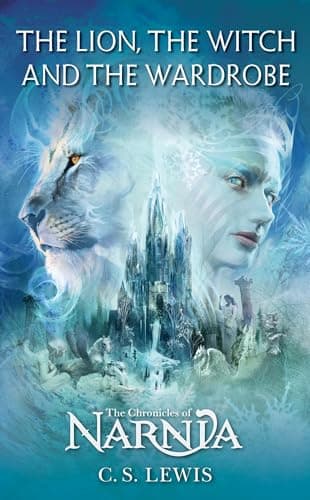
The Lion, the Witch and the Wardrobe
“Wrong will be right, when Aslan comes in sight.”
The Lion, the Witch and the Wardrobe Summary
The Lion, the Witch and the Wardrobe begins with four children—Peter, Susan, Edmund, and Lucy Pevensie—evacuated from wartime London to the rambling country house of Professor Kirke. During a game of hide-and-seek, the youngest, Lucy, steps through an old wardrobe and finds herself in Narnia, a magical land of talking animals and mythical creatures, frozen in perpetual winter by the tyranny of the White Witch, who has made it "always winter and never Christmas." Edmund, lured by the Witch's enchanted Turkish Delight and promises of power, betrays his siblings, while Lucy befriends the faun Mr. Tumnus. When all four children enter Narnia, they discover that an ancient prophecy foretells their role in breaking the Witch's spell—but only with the help of Aslan, the great Lion, whose return signals the coming of spring. The story builds to Aslan's sacrificial death on the Stone Table and his triumphant resurrection, culminating in a final battle that restores Narnia and crowns the children as its kings and queens.
C. S. Lewis's beloved fantasy is a work of deceptive simplicity that operates on multiple levels simultaneously. On its surface, it is a thrilling adventure story of children discovering a magical world and fighting against evil. Beneath that surface lies a Christian allegory—Aslan's sacrifice and resurrection echo the Passion of Christ—rendered with such narrative conviction that it moves even readers who are unaware of or indifferent to its theological dimensions. Lewis's genius lies in the warmth and vividness of his imagining: the crunch of snow underfoot, the taste of tea in Mr. Tumnus's cave, the terrible beauty of Aslan. The novel launched the seven-volume Chronicles of Narnia and has become one of the most widely read and cherished works of children's literature, a gateway to both fantasy and faith for generations of readers.
Why Read The Lion, the Witch and the Wardrobe?
The Lion, the Witch and the Wardrobe possesses a quality that the finest children's literature shares with the greatest myths: it speaks to something deep and permanent in the human imagination. The moment Lucy pushes through the fur coats and feels snow beneath her feet is one of the most iconic thresholds in all of fiction—a passage from the ordinary into the numinous that readers of every age recognize and remember. Lewis understood that the best way to convey spiritual truths is not through argument but through story, and Narnia is a world so vividly imagined that its lessons arrive not as instruction but as experience. You do not think about sacrifice and redemption; you feel them, in the terrible silence of the Stone Table and the wild joy of Aslan's return.
Whether you read it as a child or come to it for the first time as an adult, this book delivers something that much of contemporary fiction has forgotten how to offer: wonder. Lewis writes with the directness and clarity of someone who has complete confidence in the power of his story, and the result is a narrative of startling emotional force. The image of a lamppost burning in a snowy forest, a faun carrying parcels, and a great Lion breathing warmth into a frozen world—these have become part of our collective imagination. If you have ever believed that there might be more to the world than what is visible, The Lion, the Witch and the Wardrobe is the book that says: there is, and here is the door.
About C. S. Lewis
Clive Staples Lewis was born in 1898 in Belfast, Northern Ireland. His mother's death when he was nine shaped his lifelong preoccupation with loss, joy, and the longing he called Sehnsucht—an inconsolable desire for something beyond the world. He was wounded in World War I, studied and then taught at Oxford, where he became a Fellow of Magdalen College, and later held the Chair of Medieval and Renaissance English at Cambridge. His conversion from atheism to Christianity in 1931, influenced by his friendship with J. R. R. Tolkien, transformed his life and work.
Lewis became one of the twentieth century's most influential Christian writers, producing works of theology (Mere Christianity, The Screwtape Letters), literary criticism (The Allegory of Love, A Preface to Paradise Lost), science fiction (the Space Trilogy), and the seven Chronicles of Narnia, which have sold over 100 million copies worldwide. His late marriage to the American writer Joy Davidman and her death from cancer became the subject of his searingly honest memoir A Grief Observed. Lewis died on November 22, 1963—the same day as John F. Kennedy and Aldous Huxley—a coincidence that has become part of literary legend. His capacity to combine rigorous intellect with childlike wonder, theological depth with narrative enchantment, has made him one of the most widely read and beloved authors of the modern era.
Reading Guide
Ranked #374 among the greatest books of all time, The Lion, the Witch and the Wardrobe by C. S. Lewis has earned its place in the literary canon. Originally written in English and published in 1950, this accessible read from United Kingdom continues to resonate with readers today.
This book belongs to our Philosophy & Faith collection, where you can discover more books that share its spirit and themes.
If you enjoy accessible reads like this one, you might also like The Great Gatsby, The Catcher in the Rye, or Pride and Prejudice.
From the Philosophy & Faith Collection
If you enjoyed The Lion, the Witch and the Wardrobe, discover more masterpieces that share its spirit.
 #11View Book
Crime and Punishment
Fyodor Dostoevsky
High•20-25 hours #18View Book
The Bible
Various
Variable•60-80 hours #19View Book
The Brothers Karamazov
Fyodor Dostoevsky
Very High•35-40 hours #21View Book
The Stranger
Albert Camus
Moderate•3-4 hours
Browse more collections