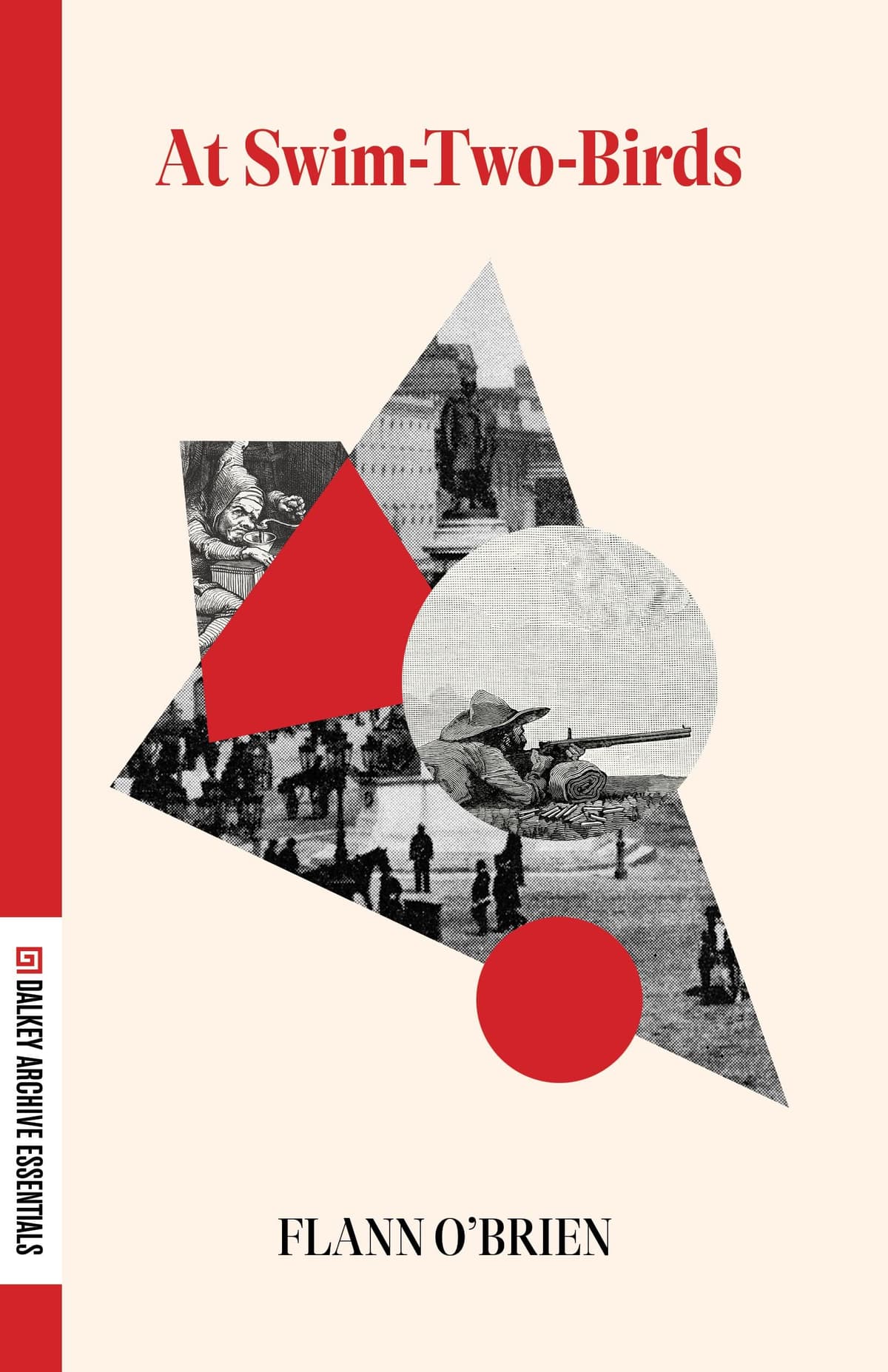
At Swim Two-Birds
“The novel, in the hands of an unscrupulous writer, could be made a powerful weapon.”
At Swim Two-Birds Summary
At Swim-Two-Birds opens with a nameless Dublin university student, lazy, dissolute, and obsessed with literature, who is writing a novel about a man named Dermot Trellis, a publican who is also writing a novel. Trellis's characters—drawn from Irish myth, the American Western, and Dublin street life—rebel against their author, drugging him to sleep so they can live their own lives free from his tyrannical plot-making. Among the cast are Finn MacCool, the ancient Irish hero who narrates his legends in ornate bardic prose; the Pooka MacPhellimey, a philosophical devil of modest ambitions; John Furriskey, a character created by Trellis fully formed in a hotel room; and the cowboys Slug Willard and Shorty Andrews. When Trellis's characters put him on trial for the torments he has inflicted upon them, they commission Orlick Trellis, Trellis's own son (also a character), to write a novel in which Trellis is subjected to increasingly bizarre and savage punishments. The nested narratives spiral into glorious chaos, held together by the student narrator's deadpan commentary on his own creative process, his avoidance of lectures, and his uncle's exasperated observations on his idleness.
Flann O'Brien's debut novel is one of the supreme comic achievements of the twentieth century and a dazzlingly original work of metafiction that anticipates postmodernism by decades. Its structure—a novel within a novel within a novel, incorporating multiple literary registers from Gaelic saga to cowboy yarn to Dublin pub talk—is at once wildly anarchic and architecturally precise. O'Brien's comic genius lies in the deadpan juxtaposition of the sublime and the mundane, the mythic and the squalid, producing a book that is simultaneously a love letter to Irish storytelling traditions and a demolition of literary authority. At Swim-Two-Birds is the great Irish comic novel, a book that makes you laugh on every page while posing radical questions about the nature of fiction itself.
Why Read At Swim Two-Birds?
At Swim-Two-Birds is the funniest serious novel you will ever read—or possibly the most serious funny novel. O'Brien's conceit of characters rebelling against their author and putting him on trial is not merely clever; it is a profound meditation on the relationship between creator and creation, storyteller and story, that anticipates by decades the metafictional experiments of Borges, Calvino, and Barth. But where those writers can sometimes feel cold or cerebral, O'Brien is gloriously, riotously alive. The book overflows with the pleasure of language itself—from the ornate rhythms of Gaelic saga to the flat deadpan of Dublin pub conversation—and its comedy is rooted in a deep love for the absurdity and richness of the Irish storytelling tradition.
This is also a perfect antidote to the solemnity that sometimes attends literary fiction. O'Brien proves that a novel can be formally revolutionary and intellectually daring while also being fall-off-your-chair funny. The image of Finn MacCool, ancient hero of Ireland, sitting in a Dublin pub alongside cowboys and philosophical devils, telling his legends to an audience of bored drinkers, is one of the great comic inventions in literature. If you love Beckett, Joyce, or the Monty Python school of intellectual absurdity, At Swim-Two-Birds will feel like coming home to a place you never knew existed.
About Flann O'Brien
Brian O'Nolan, who wrote under the pen names Flann O'Brien and Myles na gCopaleen, was born in 1911 in Strabane, County Tyrone, into a large Irish-speaking family. He studied at University College Dublin, where he became known for his sharp wit and elaborate literary hoaxes. At Swim-Two-Birds, published in 1939 when he was just twenty-seven, received enthusiastic praise from James Joyce and Graham Greene but sold poorly, its publication overshadowed by the outbreak of World War II. O'Brien spent most of his working life as a civil servant in the Irish Department of Local Government.
Alongside his civil service career, O'Brien produced an extraordinary body of work across multiple identities. As Myles na gCopaleen, he wrote the legendary "Cruiskeen Lawn" column for The Irish Times for over twenty-five years, one of the great sustained performances of comic journalism in any language. His third novel, The Third Policeman—a nightmarish comic masterpiece about a murderer trapped in a surreal rural hell—was rejected by publishers during his lifetime and published posthumously to wide acclaim. His other works include the Irish-language novel An Beal Bocht (The Poor Mouth) and the later novels The Hard Life and The Dalkey Archive. O'Brien died in 1966, on April Fools' Day—a coincidence he would have appreciated. His reputation has grown steadily, and he is now recognized, alongside Joyce and Beckett, as one of the three great Irish writers of the twentieth century.
Reading Guide
Ranked #373 among the greatest books of all time, At Swim Two-Birds by Flann O'Brien has earned its place in the literary canon. Originally written in English and published in 1939, this challenging read from Ireland continues to resonate with readers today.
This book belongs to our Society & Satire and Modern Mind collections, where you can discover more books that share its spirit and themes.
If you enjoy challenging reads like this one, you might also like Ulysses, Moby-Dick, or Lolita.
From the Society & Satire Collection
If you enjoyed At Swim Two-Birds, discover more masterpieces that share its spirit.
 #9View Book
Don Quixote
Miguel de Cervantes
High•35-40 hours #12View Book
Pride and Prejudice
Jane Austen
Accessible•10-12 hours #22View Book
Madame Bovary
Gustave Flaubert
Moderate•12-15 hours #30View Book
Middlemarch
George Eliot
High•30-35 hours
Browse more collections