The Jungle
“To do that would mean, not merely to be defeated, but to acknowledge defeat—and the difference between these two things is what keeps the world going.”
The Jungle Summary
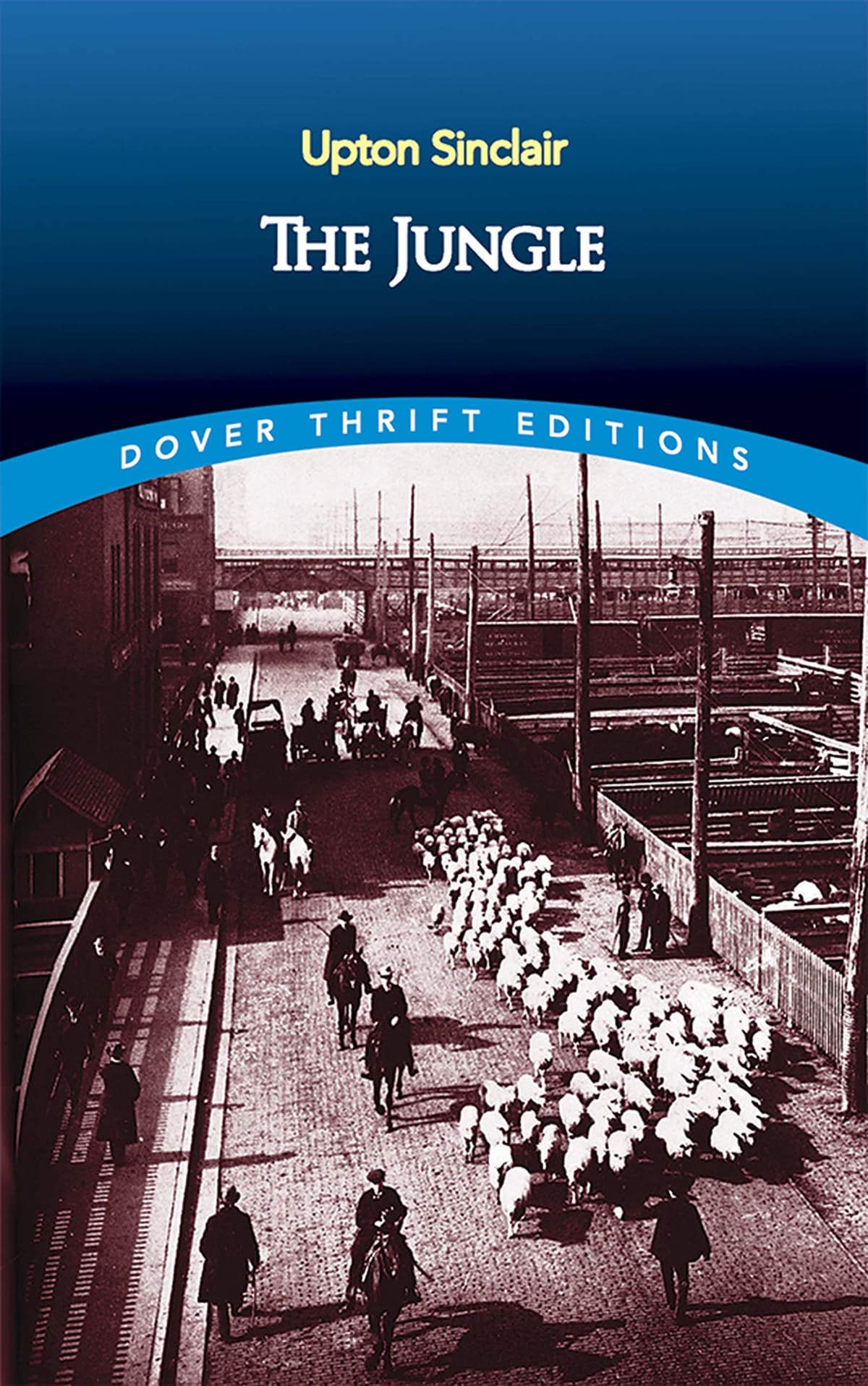
Jurgis Rudkus arrives in Chicago at the turn of the twentieth century with the strength of a young Lithuanian ox and the unshakable faith that hard work in America will deliver his family from poverty. He finds employment in the stockyards of Packingtown—the meatpacking district—and what follows is a merciless catalogue of exploitation, degradation, and despair. The working conditions are nightmarish: men fall into rendering vats, diseased cattle are processed into food, wages are stolen through byzantine schemes of graft and corruption. Jurgis watches his wife Ona destroyed by a predatory foreman, his children lost to poverty, his own body broken by industrial labor, and his faith in the American Dream ground to dust beneath the machinery of unchecked capitalism.
Upton Sinclair intended The Jungle as a socialist manifesto—a cry for workers' rights and economic justice—but America read it as an exposé of the meatpacking industry. "I aimed at the public's heart," Sinclair famously said, "and by accident I hit it in the stomach." The novel's graphic descriptions of food contamination led directly to the passage of the Pure Food and Drug Act and the Meat Inspection Act of 1906, making it one of the most politically consequential novels ever written. Its power endures not because of its politics but because of its unflinching portrayal of what happens to human beings when they are treated as raw material in the machinery of profit.
Why Read The Jungle?
Few novels have changed the world as directly as this one. Within months of its publication, The Jungle prompted federal legislation that transformed the American food industry and established the regulatory framework we still live under today. But the book's power goes far beyond its historical impact. Sinclair drops you into the inferno of early twentieth-century industrial capitalism with such visceral force that you can smell the stockyards, feel the cold of a Chicago winter, and taste the desperation of workers trapped in a system designed to consume them.
What makes The Jungle essential reading is its compassion. Jurgis Rudkus is one of literature's great everyman figures—a man of enormous strength and goodwill who is systematically destroyed not by his own failings but by a system that values profit over human life. The novel asks you to look at the hidden costs of the things you consume and the people who produce them—a question as urgent now as it was in 1906. It is a brutal, exhausting, and ultimately galvanizing book that reminds you of literature's power to change not just minds but laws.
About Upton Sinclair
Upton Sinclair (1878–1968) was born in Baltimore into a family that oscillated between poverty and genteel respectability—a contrast that fueled his lifelong crusade against economic inequality. He attended the City College of New York and Columbia University, supporting himself by writing dime novels, before committing his pen to social reform. In 1904, the socialist newspaper Appeal to Reason commissioned him to investigate conditions in Chicago's meatpacking industry; the result, published in 1906, was The Jungle.
The novel made Sinclair famous overnight and established him as America's most prominent muckraking novelist. Over the following six decades, he produced nearly one hundred books, including the Lanny Budd series (which won the Pulitzer Prize for Dragon's Teeth in 1943), Oil!, and The Brass Check. He ran for governor of California in 1934 on his End Poverty in California platform, narrowly losing in a campaign marked by unprecedented corporate opposition. Sinclair remained a tireless advocate for workers' rights, social justice, and democratic socialism until his death at the age of ninety.
Reading Guide
Ranked #174 among the greatest books of all time, The Jungle by Upton Sinclair has earned its place in the literary canon. Originally written in English and published in 1906, this moderate read from United States continues to resonate with readers today.
This book belongs to our Society & Satire and American Spirit collections, where you can discover more books that share its spirit and themes.
If you enjoy moderate reads like this one, you might also like One Hundred Years of Solitude, Nineteen Eighty-Four, or Wuthering Heights.
From the Society & Satire Collection
If you enjoyed The Jungle, discover more masterpieces that share its spirit.
 #9View Book
Don Quixote
Miguel de Cervantes
High•35-40 hours #12View Book
Pride and Prejudice
Jane Austen
Accessible•10-12 hours #22View Book
Madame Bovary
Gustave Flaubert
Moderate•12-15 hours #30View Book
Middlemarch
George Eliot
High•30-35 hours
Browse more collections