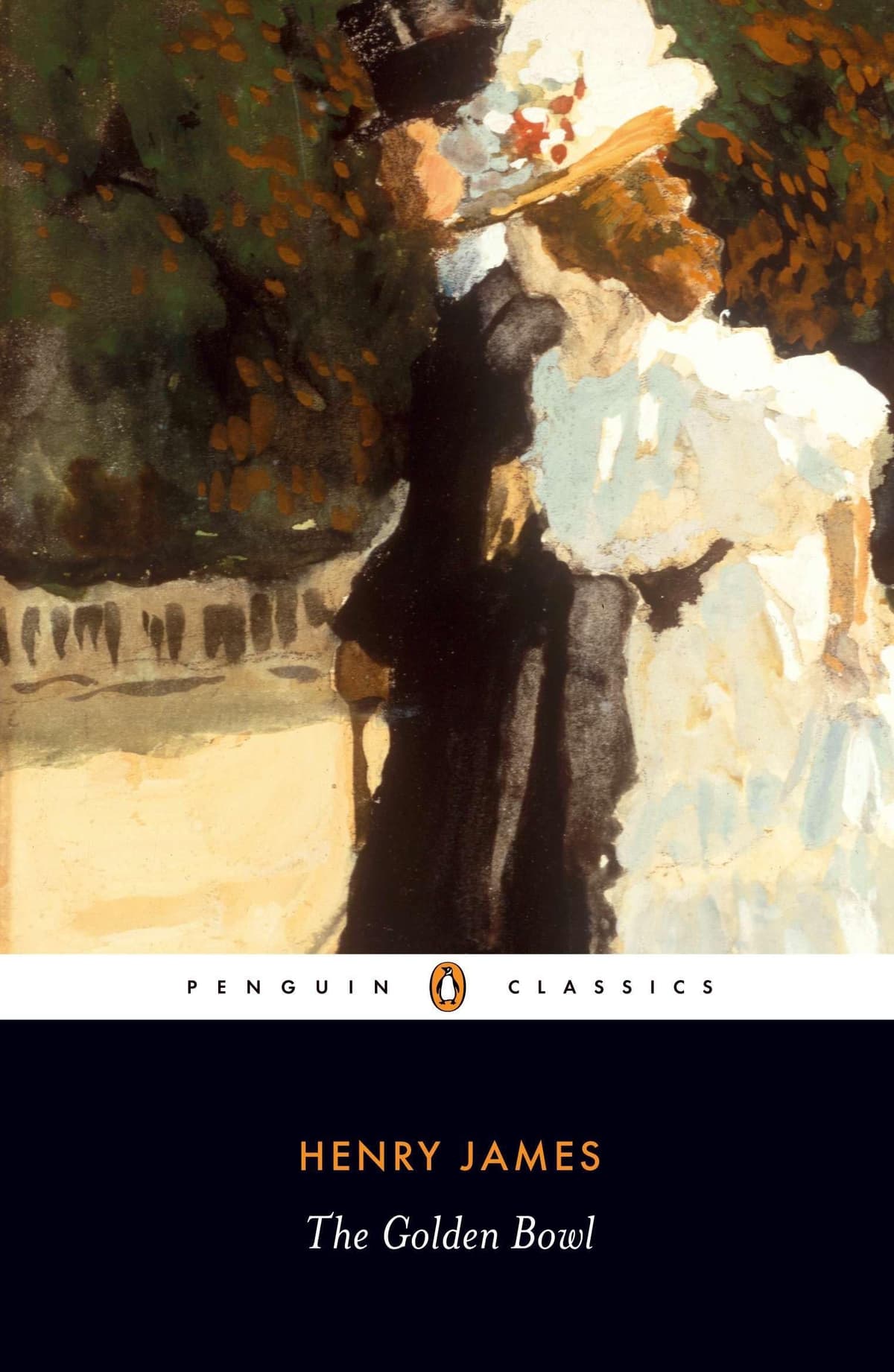
The Golden Bowl
“Everything is terrible, cara, in the heart of man.”
The Golden Bowl Summary
The Golden Bowl centers on the intertwined fates of four people bound together by marriage, money, and a concealed adulterous affair. Maggie Verver, a young American heiress devoted to her widowed father Adam, marries Prince Amerigo, a charming but impoverished Italian aristocrat. To keep her father company, Maggie encourages his marriage to her friend Charlotte Stant, unaware that Charlotte and the Prince were once lovers. With both marriages accomplished, the former lovers find themselves drawn back together, carrying on an affair facilitated by the very closeness of the family arrangement. The novel's title refers to a gilded crystal bowl that Charlotte and the Prince once considered as a wedding gift for Maggie but rejected because of a hidden crack. When Maggie later purchases the bowl and discovers the truth it symbolizes, she must decide how to reclaim her husband without destroying her father or the fragile social structure that holds them all together.
James's final completed novel represents the summit of his late style, a prose of extraordinary density and sinuosity that renders the subtlest movements of consciousness with unparalleled precision. The novel is divided into two halves: the first seen largely through the Prince's perspective, the second through Maggie's, creating a structural mirror that reflects the shift of power between them. What makes The Golden Bowl so remarkable and so challenging is its refusal to reduce moral complexity to simple judgments. Maggie's campaign to recover her marriage is both an act of love and a ruthless exercise of the power that wealth confers. James explores how knowledge, once acquired, transforms relationships irrevocably, and how the maintenance of civilized surfaces can be both a form of cruelty and a form of grace. The novel stands as one of the great meditations on marriage, money, and the American encounter with European culture, its difficulty rewarded by insights into human nature that few other novels achieve.
Why Read The Golden Bowl?
If you are willing to immerse yourself in prose that demands and rewards your closest attention, The Golden Bowl offers an experience unlike any other in fiction. James's late style is notorious for its complexity, but within those elaborate sentences lies an almost uncanny sensitivity to the way human beings negotiate desire, loyalty, and power. You will find yourself drawn into Maggie Verver's consciousness as she discovers the truth about her husband and her closest friend, and you will feel the weight of every decision she makes in response. The novel treats adultery not as melodrama but as a problem of knowledge, tact, and moral courage, and its resolution is more ambiguous and haunting than any simple outcome could be.
Reading The Golden Bowl also gives you access to one of the supreme achievements of the novel form. James pushed the possibilities of narrative consciousness further than any writer before him, and this final novel represents the culmination of that lifelong experiment. You will encounter characters whose inner lives are rendered with a richness that anticipates Proust and Woolf, and a plot that unfolds with the precision of a chess game. If you value fiction that treats its readers as intelligent adults capable of holding multiple perspectives simultaneously, this novel will become one of your most treasured reading experiences.
About Henry James
Henry James was born in 1843 in New York City into a wealthy and intellectually distinguished family. His father was a prominent theologian and philosopher, and his brother William became America's foremost psychologist and pragmatist philosopher. James was educated in New York, London, Paris, and Geneva, absorbing the transatlantic culture that would become his great literary subject. He began publishing fiction and criticism in his twenties and settled permanently in England in 1876, eventually taking British citizenship in 1915. Over a career spanning five decades, he produced an extraordinary body of work encompassing novels, novellas, short stories, plays, criticism, and travel writing, evolving from the relatively accessible realism of his early work through the experimental density of his late masterpieces.
James is widely regarded as one of the greatest novelists in the English language and a pivotal figure in the development of literary modernism. His exploration of consciousness, his refinement of point of view as a narrative technique, and his insistence on the novel as a serious art form transformed the possibilities of fiction. Works such as The Portrait of a Lady, The Wings of the Dove, The Ambassadors, and The Golden Bowl represent landmarks in the history of the novel, each pushing further into the complexities of perception, morality, and human connection. His critical essays, particularly the prefaces to the New York Edition of his collected works, remain foundational texts in the theory of fiction. James died in London in 1916, leaving behind a legacy that continues to challenge and inspire readers and writers who believe in the novel's capacity to illuminate the deepest workings of the human mind.
Reading Guide
Ranked #466 among the greatest books of all time, The Golden Bowl by Henry James has earned its place in the literary canon. Originally written in English and published in 1904, this very high read from United States continues to resonate with readers today.
This book belongs to our Love & Loss and Society & Satire collections, where you can discover more books that share its spirit and themes.
If you enjoy very high reads like this one, you might also like The Sound and the Fury, War and Peace, or The Brothers Karamazov.
From the Love & Loss Collection
If you enjoyed The Golden Bowl, discover more masterpieces that share its spirit.
 #3View Book
The Great Gatsby
F. Scott Fitzgerald
Accessible•5-6 hours #10View Book
Anna Karenina
Leo Tolstoy
High•30-35 hours #12View Book
Pride and Prejudice
Jane Austen
Accessible•10-12 hours #15View Book
Wuthering Heights
Emily Brontë
Moderate•10-12 hours
Browse more collections