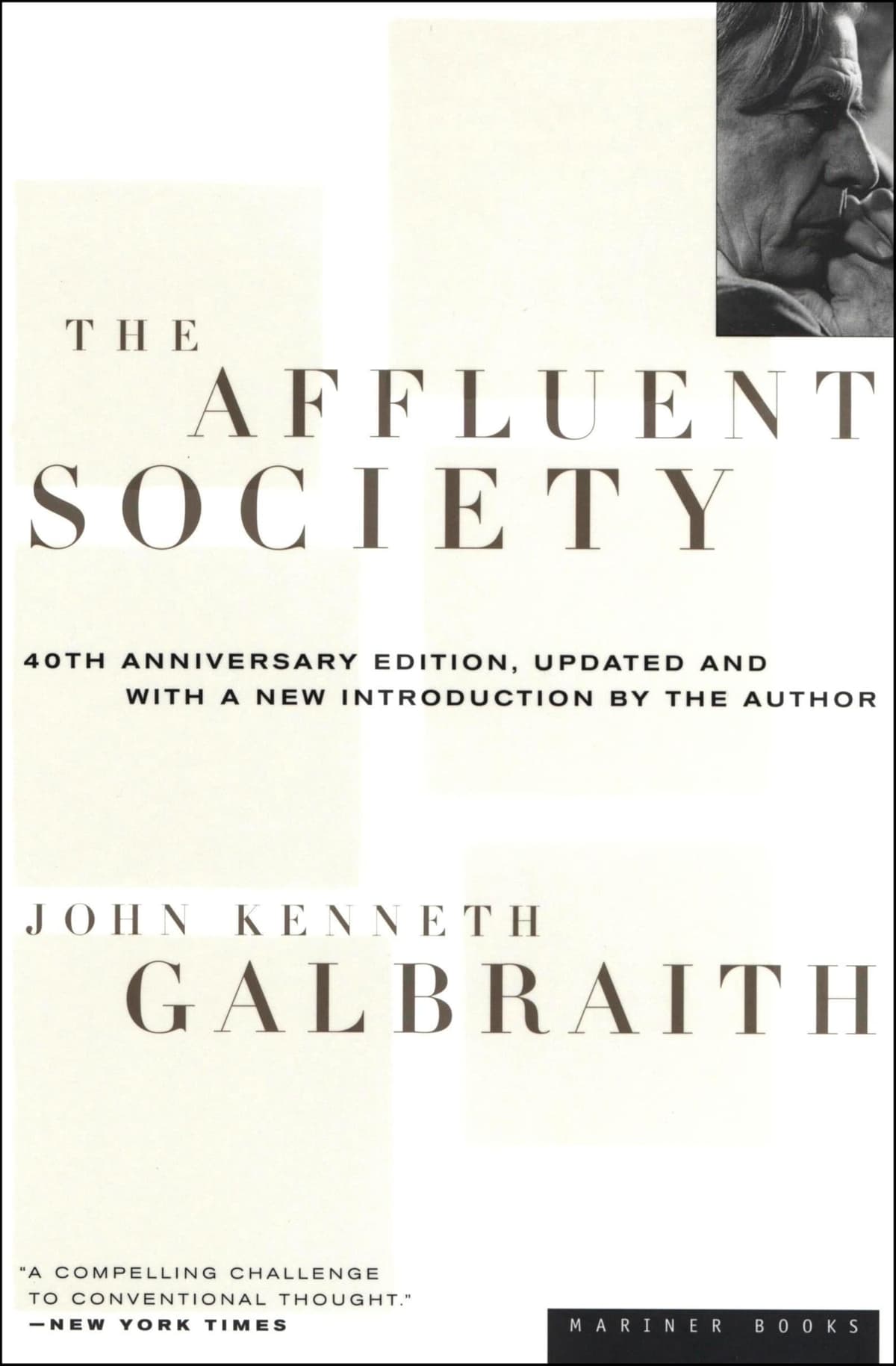
The Affluent Society
“The modern conservative is engaged in one of man's oldest exercises in moral philosophy; that is, the search for a superior moral justification for selfishness.”
The Affluent Society Summary
John Kenneth Galbraith's The Affluent Society opens with a devastating observation: the economic ideas governing the wealthiest nation in history were formulated in an age of scarcity and remain trapped there. Writing at the height of the American postwar boom, Galbraith argues that the United States had achieved a level of private abundance unprecedented in human history, yet continued to operate under economic assumptions designed for a world of poverty. The result was a grotesque imbalance: private wealth accumulated alongside public squalor. Citizens drove new cars on crumbling roads, lived in air-conditioned homes while public schools deteriorated, and consumed ever more goods produced by an economy that manufactured the very desires it then satisfied. Galbraith introduces the concept of the Dependence Effect, arguing that in an affluent society, wants are no longer independently generated but are created by the very production process that fulfills them, principally through advertising and salesmanship. The conventional wisdom, another term he coined, protects this arrangement from scrutiny by enshrining outdated ideas as common sense.
The Affluent Society is one of the most influential works of economic criticism published in the twentieth century. Galbraith challenged the fundamental assumption of postwar economics, that increased production is always beneficial, and argued instead for a rebalancing of resources toward public investment: education, healthcare, infrastructure, urban planning, and the arts. His critique of consumer culture, advertising-driven demand, and the neglect of the public sphere anticipated debates that have only intensified in the decades since publication. The book's wit, clarity, and rhetorical elegance made it a bestseller and brought serious economic argument to a mass audience. Whether one accepts or rejects Galbraith's prescriptions, his diagnosis of the contradictions of affluence remains startlingly relevant.
Why Read The Affluent Society?
If you have ever wondered why the wealthiest societies in history still struggle to fund their schools, repair their bridges, or care for their sick, The Affluent Society provides an answer that remains as sharp and relevant as the day it was written. Galbraith writes with a wit and clarity rare in economic literature, and his central argument, that private opulence coexists with public squalor because our economic thinking is trapped in the assumptions of a bygone age, will change how you see the world around you. This is not a technical treatise but a work of persuasion and intellectual provocation accessible to any thoughtful reader.
You should read this book because it coined terms and concepts that have become part of the common intellectual vocabulary, among them conventional wisdom and the Dependence Effect, and because its critique of consumer culture has only grown more pertinent in an age of algorithmic advertising and manufactured desire. Galbraith challenges you to question whether more production and more consumption actually make life better, or whether they merely generate new forms of need while starving the public goods that genuinely improve human welfare. Whether you find his arguments convincing or contentious, engaging with them will sharpen your thinking about economics, politics, and the society you inhabit.
About John Kenneth Galbraith
John Kenneth Galbraith was born in 1908 in Iona Station, Ontario, Canada, the son of Scotch-Canadian farmers. He studied agricultural economics at the University of Toronto and later earned his doctorate at the University of California, Berkeley. He became an American citizen and spent the bulk of his career at Harvard University, where he taught economics for decades. During World War II, he served as deputy administrator of the Office of Price Administration, and he later served as United States Ambassador to India under President Kennedy. Towering in both stature and intellect, standing six feet eight inches tall, Galbraith moved easily between academia, government, journalism, and public life.
Galbraith was one of the most widely read economists of the twentieth century, a rare figure who combined serious scholarship with literary grace and public engagement. His major works, including American Capitalism, The Affluent Society, and The New Industrial State, challenged orthodox economic thinking and brought questions of power, inequality, and institutional structure to the center of public debate. He was a prolific writer of over forty books, a frequent contributor to magazines and newspapers, and a television presenter. His insistence that economics must grapple with the realities of corporate power, advertising, and public need rather than retreat into abstract models made him a controversial but indispensable voice. He died in 2006, leaving a legacy as one of the great public intellectuals of the American century.
Reading Guide
Ranked #492 among the greatest books of all time, The Affluent Society by John Kenneth Galbraith has earned its place in the literary canon. Originally written in English and published in 1958, this moderate read from United States continues to resonate with readers today.
This book belongs to our Society & Satire collection, where you can discover more books that share its spirit and themes.
If you enjoy moderate reads like this one, you might also like One Hundred Years of Solitude, Nineteen Eighty-Four, or Wuthering Heights.
From the Society & Satire Collection
If you enjoyed The Affluent Society, discover more masterpieces that share its spirit.
 #9View Book
Don Quixote
Miguel de Cervantes
High•35-40 hours #12View Book
Pride and Prejudice
Jane Austen
Accessible•10-12 hours #22View Book
Madame Bovary
Gustave Flaubert
Moderate•12-15 hours #30View Book
Middlemarch
George Eliot
High•30-35 hours
Browse more collections