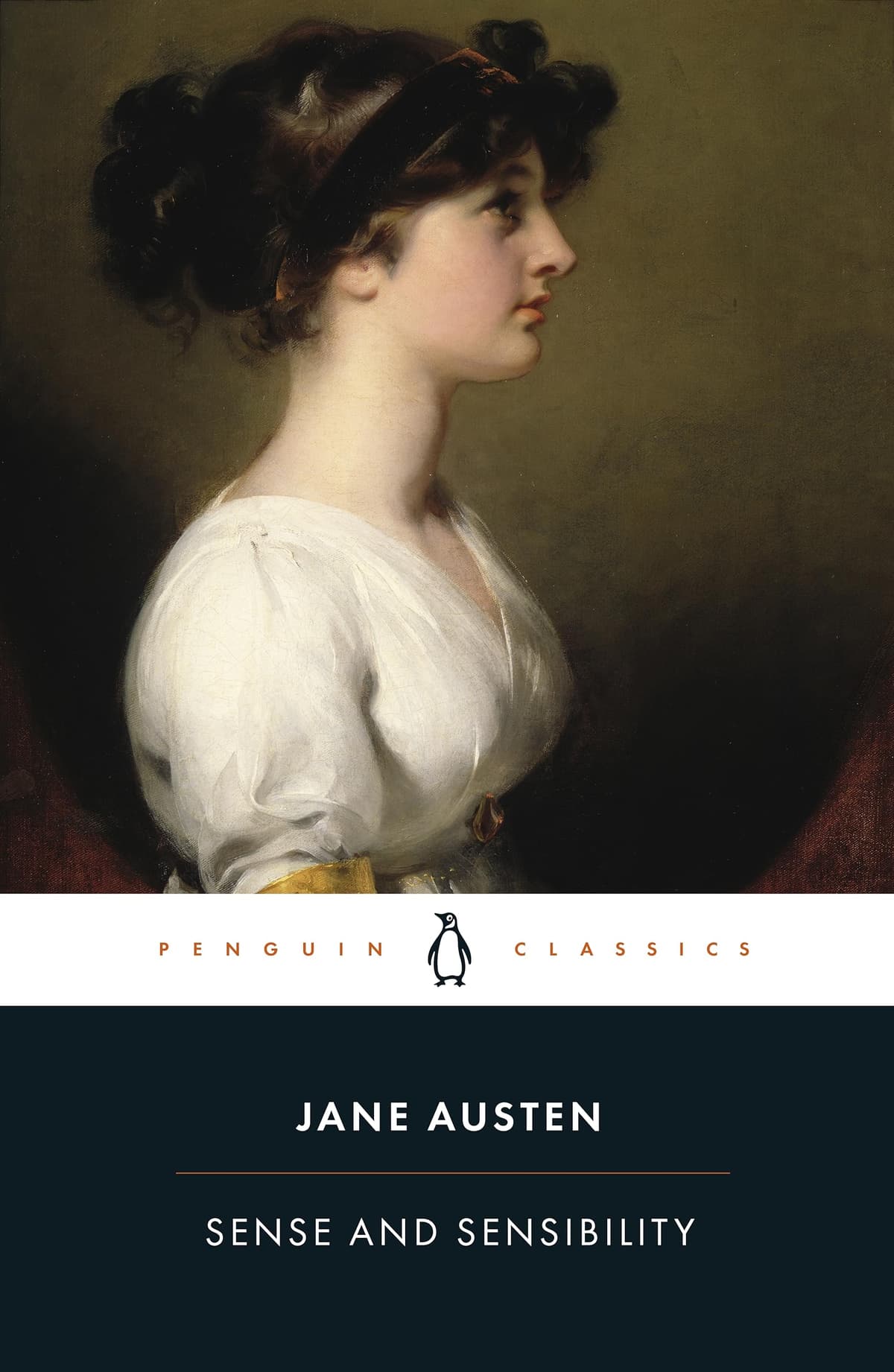
Sense and Sensibility
“It is not time or opportunity that is to determine intimacy;—it is disposition alone.”
Sense and Sensibility Summary
Sense and Sensibility tells the story of Elinor and Marianne Dashwood, two sisters who must navigate the treacherous terrain of love, money, and social expectation in Regency England after their father's death leaves them in reduced circumstances. Elinor, the elder, embodies sense: she is rational, discreet, and willing to subordinate her feelings to propriety, even as she suffers silently over the reserved but appealing Edward Ferrars. Marianne, passionate and romantic, represents sensibility: she falls headlong in love with the dashing John Willoughby and scorns the older, quieter Colonel Brandon as insufficiently exciting. When Willoughby abandons Marianne for a wealthier woman and Edward's secret engagement to another is revealed, both sisters are forced to confront the gap between their ideals and the harsh realities of a society in which women's futures depend entirely on the men they marry.
Austen's first published novel is far more than a simple contrast between reason and emotion. The book is a sharp-eyed examination of how economic vulnerability shapes every aspect of women's lives, from where they can live to whom they can love. Austen reveals the marriage market as a system in which affection is inseparable from financial calculation, and she does so with the wit and precision that would become her hallmark. Elinor and Marianne are not merely types but fully realized characters whose respective philosophies are tested, refined, and ultimately shown to be incomplete without elements of the other. The novel's resolution, in which both sisters find happiness, is earned rather than sentimental, grounded in the recognition that navigating a world of limited options requires both the heart's courage and the mind's discipline.
Why Read Sense and Sensibility?
If you think you know Jane Austen from film adaptations alone, reading Sense and Sensibility will reveal the depth and sharpness that no screen version fully captures. Austen's prose is a marvel of controlled irony: every sentence does double duty, advancing the plot while quietly exposing the absurdities and cruelties of a society obsessed with rank and money. You will laugh at her satirical portraits of the greedy, the foolish, and the self-important, but you will also feel the genuine anguish of two young women whose happiness depends on forces entirely beyond their control. Austen understood that love stories set against economic precarity are not trivial but profoundly political.
You should read Sense and Sensibility because it is the book in which Austen first demonstrated her extraordinary ability to reveal the inner lives of her characters through the smallest social gestures. A glance, a hesitation, an overly polite remark can convey volumes about desire, disappointment, and self-deception. The novel also offers the pleasure of watching a great writer find her voice: you can see Austen developing the techniques of free indirect discourse and social comedy that she would perfect in Pride and Prejudice and Emma. It is a book that rewards rereading endlessly, revealing new layers of meaning with each encounter.
About Jane Austen
Jane Austen was born in 1775 in Steventon, Hampshire, the seventh of eight children in a lively, literate family. Her father was a clergyman who encouraged reading and intellectual curiosity, and Austen began writing stories, poems, and plays as a teenager. She never married, living most of her life with her family in various locations across southern England. Sense and Sensibility, published in 1811, was her first novel to reach print, followed in rapid succession by Pride and Prejudice, Mansfield Park, and Emma. She published all her novels anonymously, identified only as "A Lady," and achieved modest success during her lifetime. She died in 1817 at the age of forty-one, likely from Addison's disease.
Austen's reputation has grown steadily since her death until she now stands as one of the most beloved and most studied writers in the English language. Her novels have never gone out of print, have been adapted countless times for stage, film, and television, and have inspired a global literary industry of sequels, retellings, and scholarly studies. Her achievement was to elevate the domestic novel into a vehicle for the most searching psychological and social analysis, demonstrating that the drawing room could be as revealing of human nature as any battlefield or throne room. Austen's influence extends far beyond the romance genre with which she is sometimes associated: her innovations in narrative technique, character development, and ironic voice shaped the entire trajectory of the English novel.
Reading Guide
Ranked #459 among the greatest books of all time, Sense and Sensibility by Jane Austen has earned its place in the literary canon. Originally written in English and published in 1811, this moderate read from United Kingdom continues to resonate with readers today.
This book belongs to our Love & Loss and Society & Satire collections, where you can discover more books that share its spirit and themes.
If you enjoy moderate reads like this one, you might also like One Hundred Years of Solitude, Nineteen Eighty-Four, or Wuthering Heights.
From the Love & Loss Collection
If you enjoyed Sense and Sensibility, discover more masterpieces that share its spirit.
 #3View Book
The Great Gatsby
F. Scott Fitzgerald
Accessible•5-6 hours #10View Book
Anna Karenina
Leo Tolstoy
High•30-35 hours #12View Book
Pride and Prejudice
Jane Austen
Accessible•10-12 hours #15View Book
Wuthering Heights
Emily Brontë
Moderate•10-12 hours
Browse more collections