Atlas Shrugged
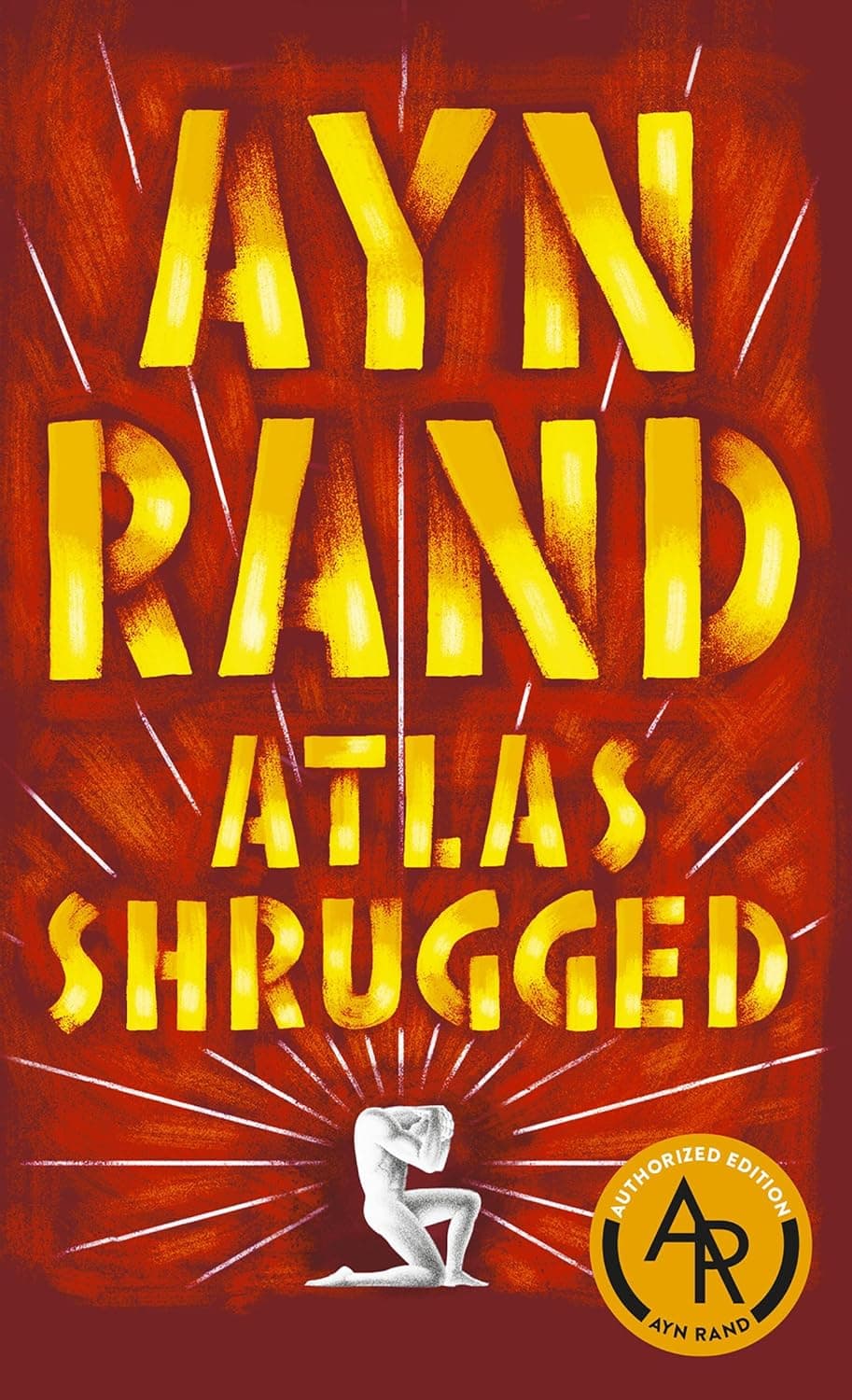
“Who is John Galt?”
Atlas Shrugged Summary
Atlas Shrugged imagines an America in slow collapse, strangled by government regulation, collectivist ideology, and the systematic punishment of productive achievement. As the nation's most talented industrialists, inventors, and artists begin to vanish one by one, railroad executive Dagny Taggart and steel magnate Hank Rearden fight to keep the engines of civilization running against an ever-growing tide of bureaucratic incompetence and parasitic entitlement. The novel's central mystery, who is John Galt and why are the world's creators disappearing, drives a sprawling narrative that encompasses industrial sabotage, forbidden love, philosophical debate, and the construction of a hidden utopia in the Colorado mountains where the strikers have retreated to build a society based on rational self-interest. The story culminates in the total collapse of the collectivist system and the promise of a new world built on the principles of individual rights and voluntary exchange.
Rand's magnum opus is one of the most polarizing novels in American literature, inspiring passionate devotion and equally passionate opposition. At over eleven hundred pages, including a sixty-page philosophical speech that lays out the entirety of Rand's Objectivist philosophy, the novel makes no concessions to the casual reader. Its characters are deliberately archetypal, embodying philosophical positions rather than psychological complexity, and its plot is structured as a moral demonstration rather than a realistic narrative. Yet its influence on American political and economic thought has been enormous, shaping the libertarian movement, influencing business leaders and politicians, and provoking ongoing debates about the relationship between capitalism, individual freedom, and social responsibility. Whether one reads it as a visionary defense of human achievement or a dangerously simplistic celebration of selfishness, Atlas Shrugged remains an inescapable presence in the American intellectual landscape.
Why Read Atlas Shrugged?
Whether you ultimately agree or disagree with its philosophy, you should read Atlas Shrugged because it is one of those rare novels that has genuinely changed the way millions of people think about economics, government, and individual purpose. Rand poses questions that are impossible to dismiss: What happens to a society that punishes excellence? What do the most productive members of a civilization owe to those who produce nothing? Who is entitled to the fruits of whose labor? You may find her answers exhilarating or appalling, but engaging with them seriously will sharpen your own thinking about freedom, responsibility, and the proper relationship between the individual and the state.
You should also read Atlas Shrugged because, whatever its philosophical merits, it is a genuinely compelling work of narrative ambition. Rand was a natural storyteller who understood how to build suspense, create memorable set pieces, and drive a plot across vast distances. The novel's central mystery is genuinely engaging, its industrial settings are rendered with surprising vividness, and characters like Dagny Taggart and Hank Rearden possess a forceful vitality that explains the book's enduring emotional appeal. To understand modern American debates about capitalism, regulation, and the role of government, you need to have read the novel that helped frame them.
About Ayn Rand
Ayn Rand was born Alisa Zinovyevna Rosenbaum in 1905 in St. Petersburg, Russia. She witnessed the Bolshevik Revolution as a child and experienced firsthand the confiscation of her father's pharmacy by the Soviet state, an event that shaped her lifelong hostility to collectivism. She emigrated to the United States in 1926, worked in Hollywood as a screenwriter, and published her first novel, We the Living, in 1936. The Fountainhead, published in 1943, made her famous, and Atlas Shrugged, published in 1957, established her as one of the most controversial intellectual figures in America. She spent her later years developing and promoting Objectivism, her comprehensive philosophical system based on rational self-interest, individual rights, and laissez-faire capitalism.
Rand's literary and intellectual legacy is fiercely contested. Her admirers regard her as a champion of human freedom and rational thought whose novels inspired generations of entrepreneurs, innovators, and political thinkers. Her critics accuse her of promoting a philosophy of selfishness that ignores the realities of social interdependence and economic inequality. What is beyond dispute is her cultural impact: surveys consistently rank Atlas Shrugged among the most influential books in American life, and her ideas continue to shape political discourse decades after her death in 1982. Rand demonstrated that the novel of ideas could reach a mass audience, and her work, for better or worse, remains central to any serious discussion of American capitalism and individualism.
Reading Guide
Ranked #460 among the greatest books of all time, Atlas Shrugged by Ayn Rand has earned its place in the literary canon. Originally written in English and published in 1957, this challenging read from United States continues to resonate with readers today.
This book belongs to our Philosophy & Faith collection, where you can discover more books that share its spirit and themes.
If you enjoy challenging reads like this one, you might also like Ulysses, Moby-Dick, or Lolita.
From the Philosophy & Faith Collection
If you enjoyed Atlas Shrugged, discover more masterpieces that share its spirit.
 #11View Book
Crime and Punishment
Fyodor Dostoevsky
High•20-25 hours #18View Book
The Bible
Various
Variable•60-80 hours #19View Book
The Brothers Karamazov
Fyodor Dostoevsky
Very High•35-40 hours #21View Book
The Stranger
Albert Camus
Moderate•3-4 hours
Browse more collections