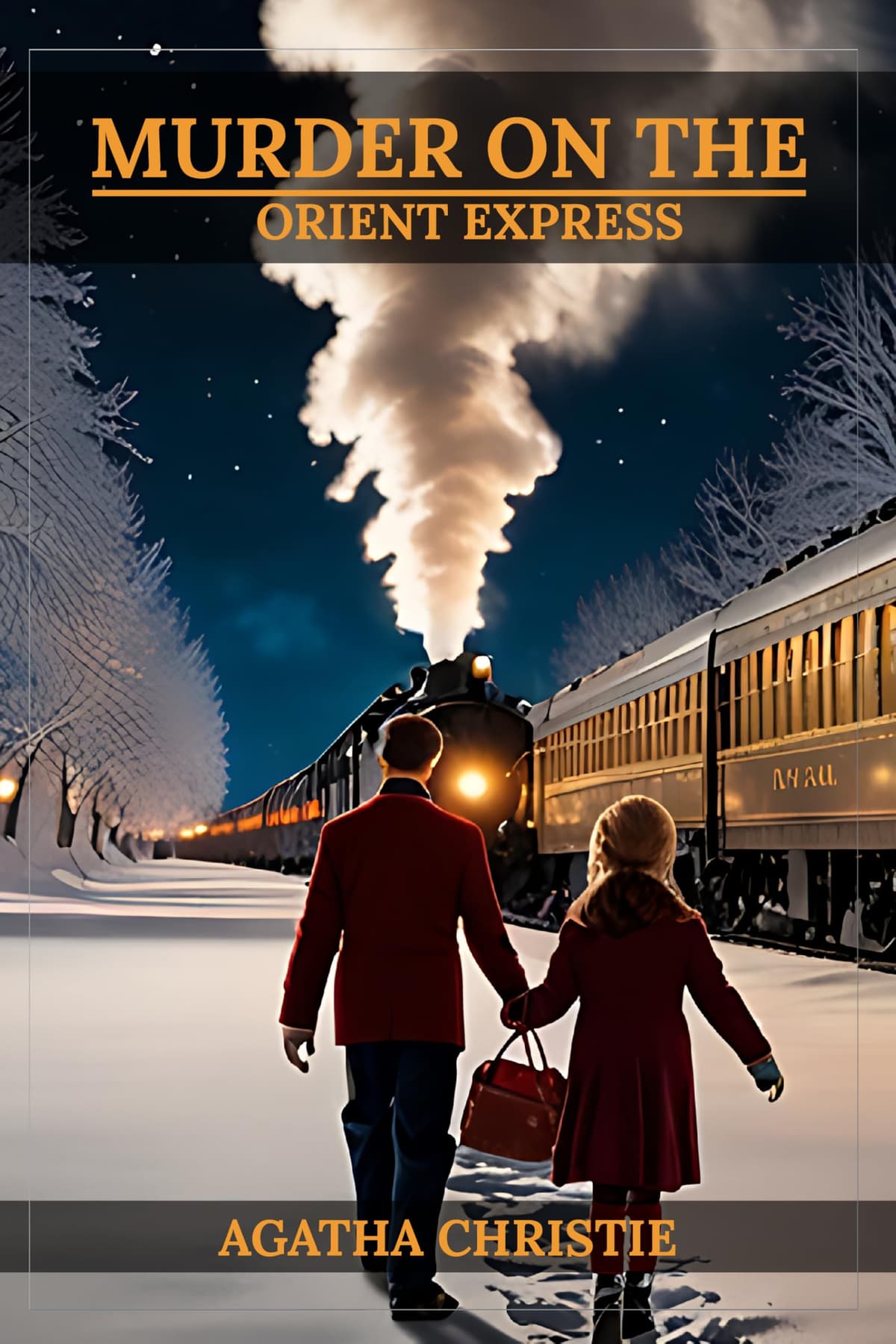
Murder on the Orient Express
“The impossible could not have happened, therefore the impossible must be possible in spite of appearances.”
Murder on the Orient Express Summary
A snowbound train on the Orient Express comes to a shuddering halt somewhere in the Yugoslav countryside, and in the morning a passenger is found dead in his locked compartment, stabbed twelve times. The victim is Samuel Edward Ratchett, an American with a dubious past and a great deal of money, who had sought protection from the very detective who now investigates his murder. Hercule Poirot, the fastidious Belgian detective with the magnificent mustache and the supreme confidence in his own grey cells, finds himself trapped on the immobilized train with a dozen suspects whose stories are too perfect, too contradictory, and too eerily connected to a kidnapping case that shocked America years earlier. As Poirot interrogates each passenger in the dining car, the evidence multiplies into paradox: too many clues, too many alibis, and a locked door that seems to guarantee the impossible.
Agatha Christie's most famous mystery is a masterclass in the architecture of deception, a puzzle box constructed with such elegant precision that its solution, when it arrives, feels both inevitable and astonishing. The confined setting of the snowbound train creates a claustrophobic intensity, and Christie's ability to manipulate reader expectations through carefully planted details and misdirection remains unmatched in the genre. Beyond its mechanics, Murder on the Orient Express poses a genuine moral question about justice and vengeance that elevates it above mere whodunit. The novel's celebrated twist has become one of the most iconic revelations in all of crime fiction, ensuring its place as the defining work of the golden age of detective fiction.
Why Read Murder on the Orient Express?
Murder on the Orient Express is the mystery novel against which all others are measured. Christie constructs a puzzle of such diabolical ingenuity that even readers who know the solution find themselves marveling at its architecture on rereading. The snowbound train creates a perfect closed world where suspicion falls on everyone and trust is impossible, and Poirot's methodical interrogations reveal not just clues but entire hidden lives. If you have never read it, the final revelation will genuinely shock you. If you have, you will discover how carefully Christie planted every detail from the very first page.
But this is more than a brilliant puzzle. Christie uses her confined setting and diverse cast of passengers to ask a real question about the nature of justice: whether the law and morality always align, and what happens when they do not. The novel's solution forces both Poirot and the reader to make a moral choice that has no comfortable answer. In a genre often dismissed as mere entertainment, Christie achieves something quietly profound. This is the book that made her the Queen of Crime, and after nearly a century it remains as surprising, satisfying, and morally provocative as the day it was published.
About Agatha Christie
Agatha Christie was born in 1890 in Torquay, Devon, to a wealthy English family. She was educated at home and began writing during the First World War, publishing her first novel, The Mysterious Affair at Styles, in 1920. Her personal life included a famous eleven-day disappearance in 1926 that has never been fully explained, a divorce from her first husband, and a second marriage to the archaeologist Max Mallowan, with whom she traveled extensively in the Middle East.
Christie became the best-selling fiction writer of all time, with over two billion copies of her books sold worldwide. She created two of the most iconic detectives in literature, Hercule Poirot and Miss Marple, and her sixty-six detective novels and fourteen short story collections defined the golden age of mystery fiction. Her play The Mousetrap has run continuously in London since 1952, the longest-running show in history. Christie was made a Dame Commander of the Order of the British Empire in 1971. She died in 1976, having transformed the mystery genre from pulp entertainment into an art form of precision, wit, and psychological insight that continues to captivate readers across the globe.
Reading Guide
Ranked #407 among the greatest books of all time, Murder on the Orient Express by Agatha Christie has earned its place in the literary canon. Originally written in English and published in 1934, this accessible read from United Kingdom continues to resonate with readers today.
This book belongs to our Society & Satire collection, where you can discover more books that share its spirit and themes.
If you enjoy accessible reads like this one, you might also like The Great Gatsby, The Catcher in the Rye, or Pride and Prejudice.
From the Society & Satire Collection
If you enjoyed Murder on the Orient Express, discover more masterpieces that share its spirit.
 #9View Book
Don Quixote
Miguel de Cervantes
High•35-40 hours #12View Book
Pride and Prejudice
Jane Austen
Accessible•10-12 hours #22View Book
Madame Bovary
Gustave Flaubert
Moderate•12-15 hours #30View Book
Middlemarch
George Eliot
High•30-35 hours
Browse more collections