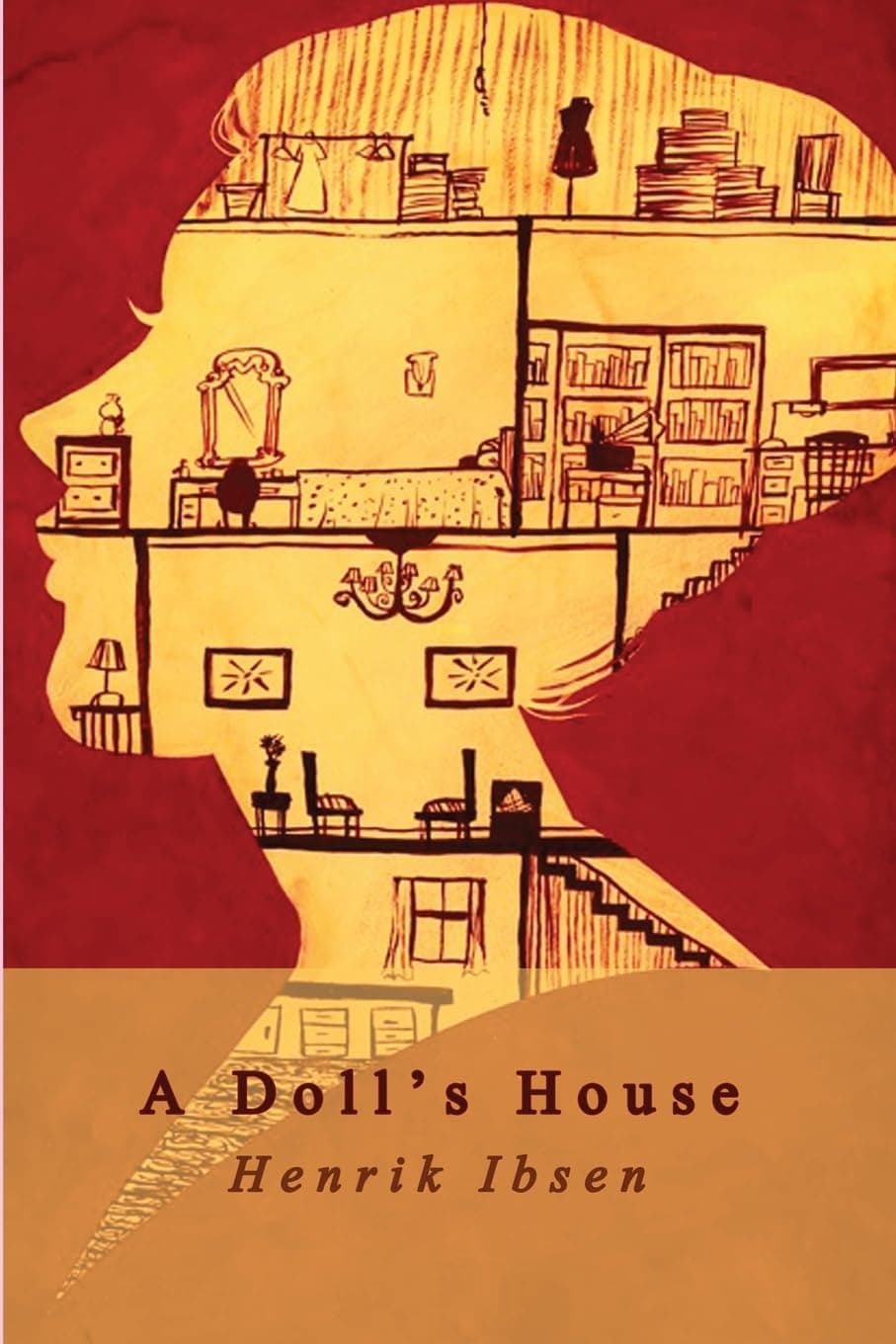
A Doll's House
“I have been performing tricks for you, Torvald. That's how I've survived. You wanted it like that. You and Papa have done me a great wrong.”
A Doll's House Summary
Nora Helmer appears to have everything a nineteenth-century woman could want: a handsome husband newly promoted to bank manager, three beautiful children, and a comfortable bourgeois home decorated for Christmas. But beneath this domestic idyll lies a secret that has defined her marriage. Years ago, when her husband Torvald was gravely ill, Nora secretly borrowed money to finance the trip to Italy that saved his life, forging her dying father's signature on the loan. Now Krogstad, the disgraced moneylender who holds her note, is about to lose his position at Torvald's bank and threatens to reveal everything unless Nora intervenes. As the walls of her dollhouse close in, Nora's desperate attempts to manage the crisis strip away the performance of wifely submission she has maintained for eight years, forcing a confrontation that will shatter not just her marriage but the entire Victorian conception of a woman's place.
Henrik Ibsen's most explosive play detonated like a bomb across the stages of Europe in 1879, and the door Nora slams at its conclusion remains the most famous sound effect in theatrical history. A Doll's House is a work of devastating structural precision: every element of its three acts builds inexorably toward a final scene that transforms domestic drama into existential crisis. Ibsen dismantles the sentimental myths of marriage and motherhood with a playwright's instinct for the moment when politeness becomes intolerable, and Nora's awakening from performing doll-wife to demanding recognition as a human being anticipates the feminist movements of the following century. The play's power lies not in its arguments but in its emotional truth: the terrible recognition that love built on illusion is no love at all.
Why Read A Doll's House?
A Doll's House is one of those rare works that genuinely changed the world. When Nora Helmer walks out of her marriage at the end of the play, she walks out of an entire civilization's assumptions about women, duty, and the meaning of home. Ibsen gives you no comfortable position from which to watch: you will sympathize with Nora and be troubled by her choices, you will understand Torvald and despise his condescension. The play's relentless forward momentum, built across just three acts, creates the sensation of watching a controlled demolition in which every supporting beam is removed until the entire structure collapses.
What makes the play timeless is not its feminism alone but its universality. Anyone who has ever performed a role to keep a relationship intact, who has ever discovered that the person they love does not see them as they truly are, will feel the shock of recognition that Ibsen delivers. The dialogue is spare, naturalistic, and lethal in its precision. Reading or seeing A Doll's House is an experience that takes barely two hours but rearranges something permanent in your understanding of what people owe each other and what it costs to demand the truth.
About Henrik Ibsen
Henrik Ibsen was born in 1828 in Skien, a small port town in southeastern Norway, into a family that fell from prosperity to poverty during his childhood. He worked as a pharmacist's apprentice before turning to theater, serving as a stage director and playwright at theaters in Bergen and Christiania (now Oslo) with limited success. Financial struggle and artistic frustration drove him into a self-imposed exile from Norway in 1864 that lasted twenty-seven years, during which he lived in Italy and Germany and produced his greatest works.
Ibsen is regarded as the father of modern drama, the playwright who transformed theater from melodrama and spectacle into a vehicle for examining the moral contradictions of contemporary life. His realistic plays, including A Doll's House, Ghosts, Hedda Gabler, An Enemy of the People, and The Wild Duck, scandalized audiences with their frank treatment of marriage, sexuality, hypocrisy, and women's rights. His later symbolic works, including The Master Builder and When We Dead Awaken, influenced the development of expressionism and modernist theater. Ibsen returned to Norway in 1891 as a national hero and died in 1906. He remains the most frequently performed dramatist in the world after Shakespeare.
Reading Guide
Ranked #408 among the greatest books of all time, A Doll's House by Henrik Ibsen has earned its place in the literary canon. Originally written in Norwegian and published in 1879, this accessible read from Norway continues to resonate with readers today.
This book belongs to our Society & Satire collection, where you can discover more books that share its spirit and themes.
If you enjoy accessible reads like this one, you might also like The Great Gatsby, The Catcher in the Rye, or Pride and Prejudice.
From the Society & Satire Collection
If you enjoyed A Doll's House, discover more masterpieces that share its spirit.
 #9View Book
Don Quixote
Miguel de Cervantes
High•35-40 hours #12View Book
Pride and Prejudice
Jane Austen
Accessible•10-12 hours #22View Book
Madame Bovary
Gustave Flaubert
Moderate•12-15 hours #30View Book
Middlemarch
George Eliot
High•30-35 hours
Browse more collections