The Razor's Edge
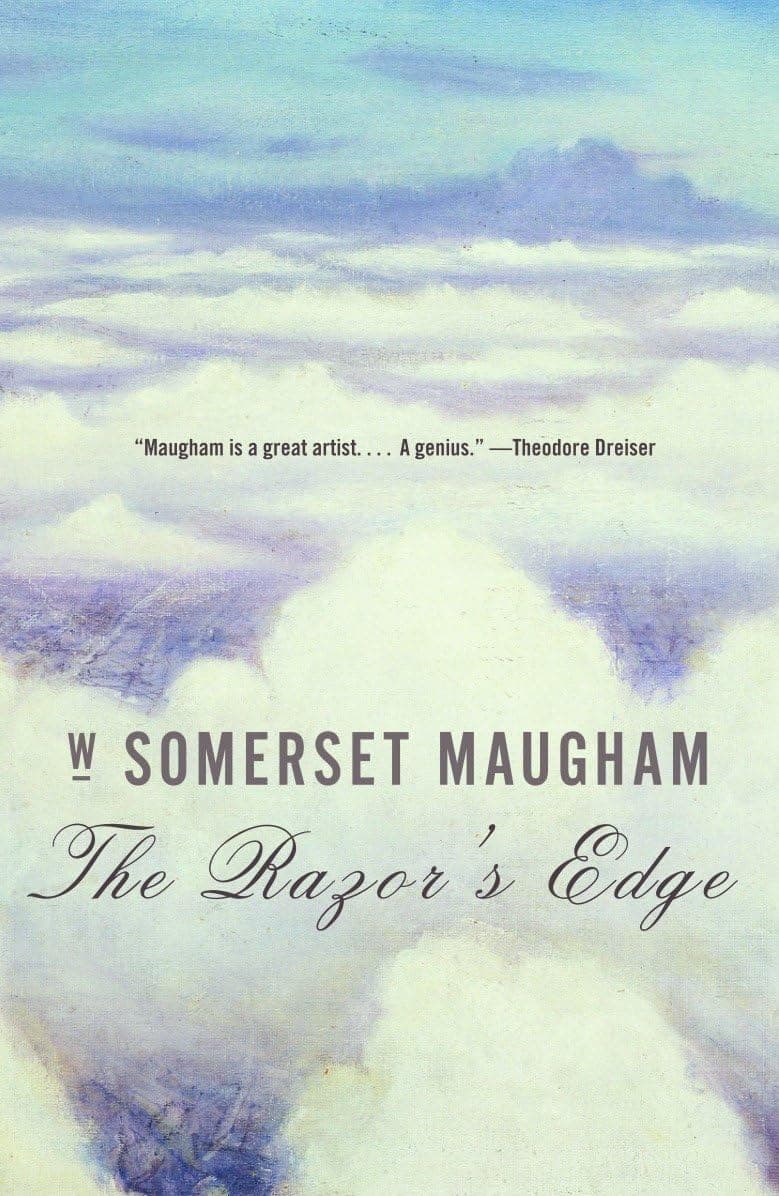
“The sharp edge of a razor is difficult to pass over; thus the wise say the path to Salvation is hard.”
The Razor's Edge Summary
Larry Darrell returns from the First World War a changed man. Once a carefree young Chicagoan engaged to the beautiful Isabel Bradley, he now refuses to settle into a career or conventional life, driven by an inner compulsion to understand why good men die and what meaning, if any, lies behind human suffering. His search takes him from the drawing rooms of Chicago and Paris to the coal mines of northern France, the monasteries of Germany, and finally to an ashram in India, where he encounters a spiritual revelation that transforms his understanding of existence. Around Larry orbit the other characters whose lives Maugham traces with equal care: Isabel, who loves Larry but cannot accept a life without wealth; Elliott Templeton, an aging American snob whose devotion to high society masks a genuine if limited humanity; and Gray Maturin, the solid businessman who marries Isabel and is ruined by the stock market crash of 1929.
W. Somerset Maugham narrates The Razor's Edge in his own voice, presenting himself as a character within the story, a device that lends the novel an unusual intimacy and conversational grace. The title, drawn from a passage in the Katha Upanishad about the difficulty of the path to salvation, signals Maugham's serious engagement with Eastern philosophy and the tension between material and spiritual life. Written during the Second World War, the novel reflects a civilization in crisis, asking whether Western values of ambition and acquisition can sustain the human spirit in an age of catastrophe. Maugham's prose is deceptively simple, elegant and unadorned, and his refusal to judge his characters gives the novel a generosity that makes its spiritual questions genuinely open rather than didactic.
Why Read The Razor's Edge?
The Razor's Edge is one of the great novels about the search for meaning, and it asks its central question with a directness that most literary fiction avoids: what is a good life, and can it be lived outside the structures of career, marriage, and material success? Larry Darrell's refusal to conform is not rebellion but genuine seeking, and Maugham renders his journey with such sympathy and intelligence that you feel the pull of his quest even as you understand the people who cannot follow him. Isabel's choice of security over love is presented without condemnation, and Elliott Templeton's death scene is one of the most quietly devastating passages in twentieth-century fiction.
Maugham writes with a clarity and ease that makes the novel a pleasure to read on every page, but beneath that polished surface lie questions that will not let you rest. The novel forces you to examine your own choices about what matters: whether you have pursued what you truly want or what the world told you to want. Written during the darkest years of the Second World War, The Razor's Edge offers neither easy answers nor false consolation, only the radical suggestion that the examined life is the only one worth living.
About W. Somerset Maugham
William Somerset Maugham was born in 1874 in the British Embassy in Paris, orphaned by the age of ten, and raised by a cold uncle in Kent. He trained as a doctor at St Thomas's Hospital in London, and his experiences in the Lambeth slums provided material for his first novel, Liza of Lambeth. He abandoned medicine for writing and became one of the most successful and widely read authors of the twentieth century, a man equally at home in the worlds of theater, the short story, and the novel.
Maugham's life was as cosmopolitan as his fiction. He served as a British intelligence agent during the First World War, traveled extensively in Southeast Asia, and settled in a villa on the French Riviera that became a gathering place for the literary and social elite. His major works include Of Human Bondage, The Moon and Sixpence, Cakes and Ale, and The Razor's Edge, as well as hundreds of short stories that rank among the finest in the English language. Maugham's style, lucid, economical, and deceptively simple, influenced generations of writers. He died in 1965 at the age of ninety-one, having lived through and written about the tumultuous transformations of the modern world with unmatched grace and observational precision.
Reading Guide
Ranked #409 among the greatest books of all time, The Razor's Edge by W. Somerset Maugham has earned its place in the literary canon. Originally written in English and published in 1944, this moderate read from United Kingdom continues to resonate with readers today.
This book belongs to our Philosophy & Faith and Love & Loss collections, where you can discover more books that share its spirit and themes.
If you enjoy moderate reads like this one, you might also like One Hundred Years of Solitude, Nineteen Eighty-Four, or Wuthering Heights.
From the Philosophy & Faith Collection
If you enjoyed The Razor's Edge, discover more masterpieces that share its spirit.
 #11View Book
Crime and Punishment
Fyodor Dostoevsky
High•20-25 hours #18View Book
The Bible
Various
Variable•60-80 hours #19View Book
The Brothers Karamazov
Fyodor Dostoevsky
Very High•35-40 hours #21View Book
The Stranger
Albert Camus
Moderate•3-4 hours
Browse more collections