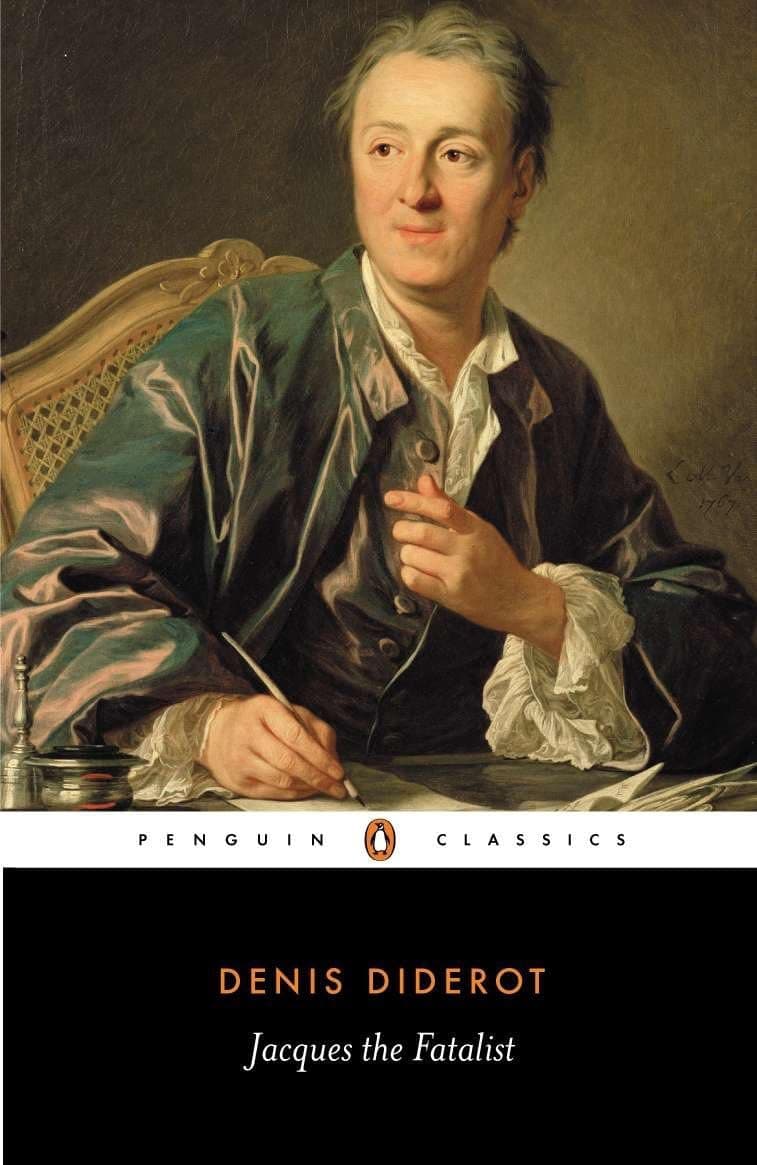
Jacques the Fatalist and His Master
“Do you know the fable of the Sheath and the Knife? One day the Sheath said to the Knife: 'You are a strange fellow, always changing.'”
Jacques the Fatalist and His Master Summary
Jacques the Fatalist opens with a servant and his master riding along a road with no clear destination, and from this simple premise Diderot spins an endlessly digressive, wickedly playful narrative that interrogates the very nature of storytelling. Jacques, the servant, is a philosophical fatalist who believes everything that happens is already written on a great scroll above; his unnamed master is impatient, curious, and perpetually demanding that Jacques finish the story of his love affairs. But the tale is interrupted again and again—by innkeepers, thieves, monks, seductions, duels, and embedded stories that sprout from within other stories like nesting dolls. The narrator himself constantly breaks in to address the reader, mocking our desire for neat plots, taunting us with possible directions the story could take, and reminding us that he is the one pulling the strings. The result is a novel that feels astonishingly modern, more akin to Tristram Shandy or the postmodern experiments of the twentieth century than to anything we might expect from the French Enlightenment.
Diderot, the great architect of the Encyclopedie, brings his restless philosophical intelligence to bear on the question of free will, determinism, and the conventions of fiction itself. The novel is simultaneously a comedy of manners, a philosophical dialogue, and a radical experiment in metafiction. Its humor is sharp and earthy, its digressions purposeful in their apparent chaos, and its central question—whether we are the authors of our own lives or merely characters in a story already written—remains as urgent now as it was in the eighteenth century. Jacques the Fatalist is one of the great overlooked masterpieces of Western literature, a book that anticipates modernism by more than a century.
Why Read Jacques the Fatalist and His Master?
If you think experimental fiction was invented in the twentieth century, Jacques the Fatalist will upend everything you know about literary history. Written in the 1770s but unpublished until after Diderot's death, this is a novel that breaks the fourth wall, mocks its own conventions, and plays games with the reader that would make Borges proud. Diderot is not just telling a story—he is asking what stories are for, whether plot is a lie we tell ourselves, and whether the desire for narrative closure reveals something fundamental about how we understand our own lives. You will laugh, you will argue with the narrator, and you will never think about storytelling the same way again.
Beyond its formal brilliance, Jacques the Fatalist is a deeply humane book. The relationship between Jacques and his master is tender, comic, and surprisingly egalitarian, a portrait of friendship and mutual dependence that transcends class boundaries. Diderot fills every digression with vivid characters, bawdy humor, and philosophical insight, making the novel feel less like an intellectual exercise than a spirited conversation with one of the liveliest minds of the Enlightenment. This is essential reading for anyone who loves Sterne, Calvino, or Kundera—and for anyone who wants to discover where their experiments began.
About Denis Diderot
Denis Diderot was born in 1713 in Langres, a provincial town in eastern France, the son of a prosperous cutler. Educated by the Jesuits, he moved to Paris as a young man and spent a decade living in bohemian poverty, translating, tutoring, and writing before undertaking the project that would consume twenty-five years of his life: the Encyclopedie, the great compendium of Enlightenment knowledge. The project brought him censorship, imprisonment, and the hostility of the French crown and the Catholic Church, but also lasting fame as one of the most audacious intellectual entrepreneurs in history.
Diderot's genius ranged across philosophy, art criticism, drama, and fiction, yet much of his most daring literary work—including Jacques the Fatalist, Rameau's Nephew, and The Nun—was not published until after his death in 1784. His philosophical writings anticipate materialism, evolutionary theory, and modern aesthetics; his art criticism essentially invented the genre. Diderot was a conversationalist of legendary brilliance, and his fiction captures the spontaneity and restless energy of a mind that could not stop questioning. He is now recognized not merely as the editor of the Encyclopedie but as one of the most original and far-sighted writers of the eighteenth century, a thinker whose influence extends from the French Revolution to postmodern literature.
Reading Guide
Ranked #397 among the greatest books of all time, Jacques the Fatalist and His Master by Denis Diderot has earned its place in the literary canon. Originally written in French and published in 1796, this moderate read from France continues to resonate with readers today.
This book belongs to our Philosophy & Faith and Society & Satire collections, where you can discover more books that share its spirit and themes.
If you enjoy moderate reads like this one, you might also like One Hundred Years of Solitude, Nineteen Eighty-Four, or Wuthering Heights.
From the Philosophy & Faith Collection
If you enjoyed Jacques the Fatalist and His Master, discover more masterpieces that share its spirit.
 #11View Book
Crime and Punishment
Fyodor Dostoevsky
High•20-25 hours #18View Book
The Bible
Various
Variable•60-80 hours #19View Book
The Brothers Karamazov
Fyodor Dostoevsky
Very High•35-40 hours #21View Book
The Stranger
Albert Camus
Moderate•3-4 hours
Browse more collections