De Rerum Natura
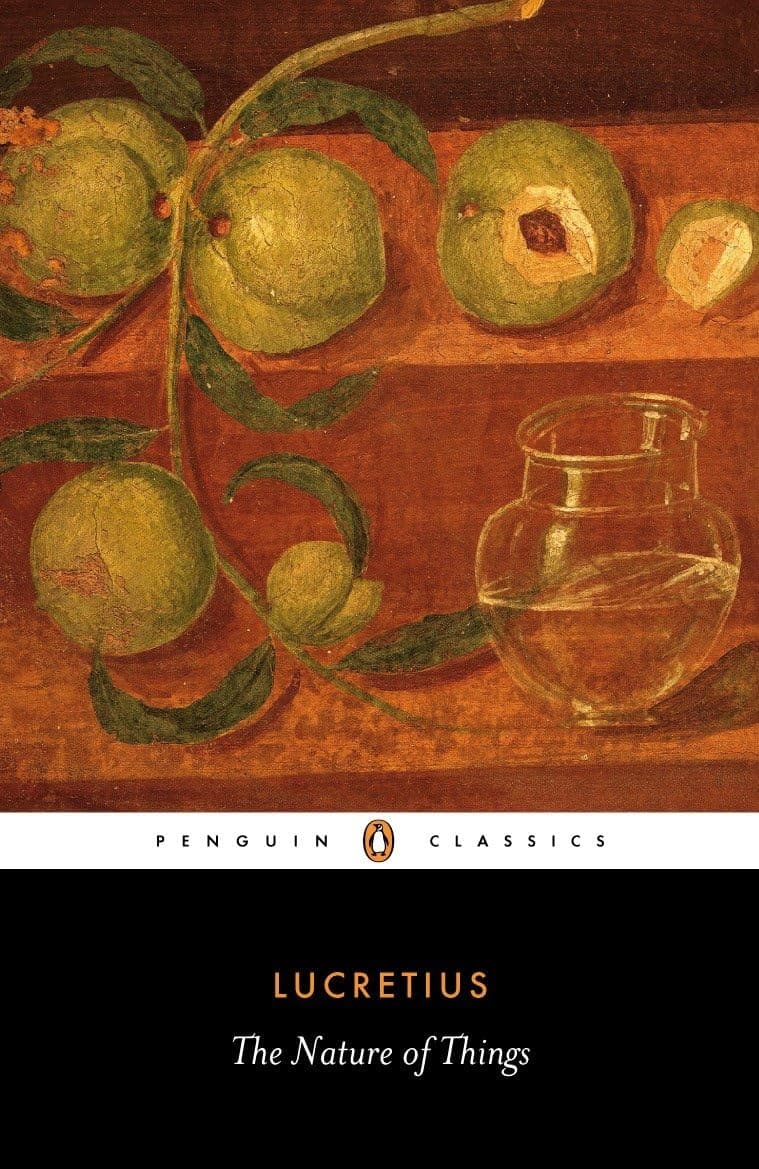
“What is food to one, is to others bitter poison.”
De Rerum Natura Summary
De Rerum Natura—On the Nature of Things—is a philosophical poem of staggering ambition, an attempt to explain the entire workings of the physical universe in six books of Latin hexameter verse. Lucretius takes the atomic theory of Epicurus and transforms it into poetry of extraordinary sensory power, describing how invisible particles combine and dissolve to produce everything from thunderstorms to the sensation of taste, from the growth of crops to the terror of death. He traces the origins of the world and of human civilization, describes the nature of the soul as material and mortal, explains the mechanics of perception and desire, and confronts the great plagues and catastrophes that remind humanity of its fragility. The poem opens with a luminous invocation to Venus as the generative force of nature and closes with a harrowing description of the plague of Athens, moving from creation to destruction in a vast arc that encompasses all of existence. Throughout, Lucretius writes with a passionate urgency, driven by the conviction that understanding nature is the only path to freedom from superstition and the fear of death.
Lost for centuries and rediscovered in a German monastery in 1417—an event that Stephen Greenblatt has argued helped ignite the Renaissance—De Rerum Natura is one of the most influential poems ever written. Its materialism anticipates modern physics; its arguments against divine intervention prefigure the Enlightenment; its insistence that pleasure and the avoidance of pain constitute the highest good resonates with contemporary ethical thought. Yet it is Lucretius's poetic gift, his ability to render abstract philosophy in images of startling beauty and precision, that makes the work endure. This is not a dry treatise but a passionate hymn to the natural world, a poem that finds wonder and consolation in the very atoms from which we are made.
Why Read De Rerum Natura?
De Rerum Natura is one of those rare works that can genuinely change how you see the world. Written over two thousand years ago, it offers an account of the universe that is astonishingly close to modern science: atoms in motion, natural selection, the vastness of space, the mortality of the soul. Lucretius is not merely explaining Epicurean philosophy—he is waging a passionate war against superstition, fear, and the tyranny of religion over the human mind. His arguments for why you should not fear death remain among the most powerful ever composed, and his vision of nature as self-generating and self-sufficient, requiring no gods to explain its workings, anticipates Darwin and the Enlightenment by millennia.
But this is not just a philosophical treatise—it is poetry of extraordinary beauty. Lucretius describes dust motes dancing in a sunbeam as evidence of invisible atoms, renders the origins of language and music with tender speculation, and paints the natural world with a sensory vividness that rivals any nature writer living or dead. Reading De Rerum Natura is to encounter one of the most liberated and liberating minds in all of literature, a writer who found in the material universe not cold mechanism but boundless wonder. If you have ever looked up at the stars and felt both awe and the desire to understand, this poem was written for you.
About Lucretius
Almost nothing is known about Titus Lucretius Carus beyond what can be inferred from his poem. He was born around 99 BCE and died around 55 BCE, during the turbulent final decades of the Roman Republic. A later tradition, originating with St. Jerome, claims that he was driven mad by a love potion and composed his poem in lucid intervals before dying by his own hand—a story most modern scholars regard as Christian slander against a materialist philosopher. Cicero is said to have edited the poem after Lucretius's death, suggesting the author moved in Rome's educated circles.
De Rerum Natura is Lucretius's only known work, but it stands among the supreme achievements of Latin literature and indeed of all poetry. His six-book exposition of Epicurean philosophy—arguing that the universe is composed of atoms and void, that the gods do not intervene in human affairs, and that death is nothing to fear—influenced Virgil, who echoed his cadences, and horrified the medieval Church, which sought to suppress his work. The poem's rediscovery in 1417 sent shockwaves through Renaissance thought, shaping the ideas of Machiavelli, Montaigne, Galileo, and Newton. Lucretius remains the supreme poet-philosopher of the Western tradition, a writer who proved that the deepest truths about nature could be rendered in language of transcendent beauty.
Reading Guide
Ranked #398 among the greatest books of all time, De Rerum Natura by Lucretius has earned its place in the literary canon. Originally written in Latin and published in 55, this challenging read from Roman Empire continues to resonate with readers today.
This book belongs to our Philosophy & Faith and Epics collections, where you can discover more books that share its spirit and themes.
If you enjoy challenging reads like this one, you might also like Ulysses, Moby-Dick, or Lolita.
From the Philosophy & Faith Collection
If you enjoyed De Rerum Natura, discover more masterpieces that share its spirit.
 #11View Book
Crime and Punishment
Fyodor Dostoevsky
High•20-25 hours #18View Book
The Bible
Various
Variable•60-80 hours #19View Book
The Brothers Karamazov
Fyodor Dostoevsky
Very High•35-40 hours #21View Book
The Stranger
Albert Camus
Moderate•3-4 hours
Browse more collections