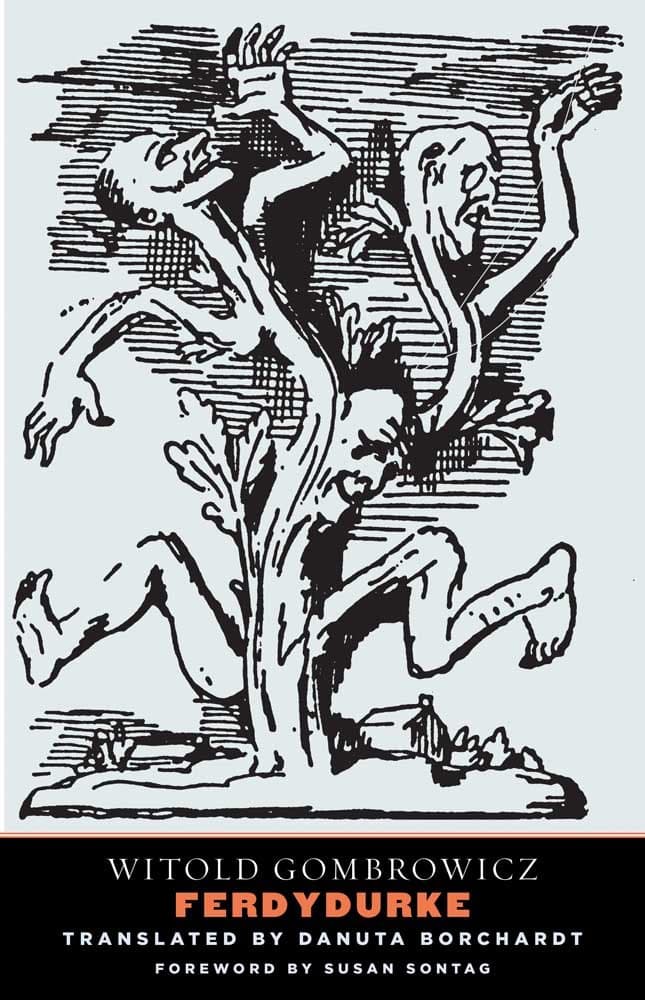
Ferdydurke
“Man is profoundly dependent on the image of himself formed in the minds of others.”
Ferdydurke Summary
Ferdydurke plunges the reader into the frantic consciousness of Józio, a thirty-year-old writer who is forcibly regressed to adolescence by Professor Pimko, a pedantic literary critic who drags him back to school in a surreal act of cultural violence. What follows is a cascading nightmare of imposed immaturity: Józio is trapped among schoolboys, subjected to absurd pedagogical rituals, taken in by a "modern" bourgeois family whose progressive daughter Zuta embodies a different but equally stifling set of conventions, and finally dragged to a country estate where the tensions between masters and servants erupt in a grotesque carnival of mutual face-making. Throughout it all, Józio struggles desperately against the forms that others impose upon him—the masks, poses, and social expectations that trap every individual in a prison of artifice. The novel is punctuated by bizarre interludes, including stories-within-the-story and philosophical digressions, that shatter any pretense of conventional narrative.
Gombrowicz's masterpiece is a savage, wildly inventive assault on cultural pretension, national mythology, and the tyranny of Form itself—the idea that human beings are perpetually shaped, deformed, and infantilized by the roles that society, tradition, and other people impose upon them. Written in a language that veers between philosophical precision and anarchic farce, Ferdydurke anticipates existentialism, absurdism, and postmodern metafiction by decades. Its central insight—that we are never fully ourselves but always performing a version of ourselves for others—remains as unsettling and liberating today as when it scandalized Polish literary society in 1937. The novel is at once hilariously funny and deeply serious, a work that demolishes every comfortable assumption about maturity, identity, and cultural authority.
Why Read Ferdydurke?
Ferdydurke is one of the most original novels of the twentieth century, a book that attacks the very foundations of how we present ourselves to the world. Gombrowicz understood, long before social media made it obvious, that human beings are perpetually trapped in performances of maturity, sophistication, and cultural authority—and that these performances are fundamentally absurd. Reading this novel is like having the masks ripped off every social interaction you have ever witnessed. Its humor is explosive, its intelligence is ferocious, and its central metaphor of enforced immaturity resonates with anyone who has ever felt reduced, condescended to, or forced into a role they did not choose.
Beyond its philosophical brilliance, Ferdydurke is simply one of the funniest books ever written. The scenes of schoolroom absurdity, bourgeois pretension, and rural class warfare are executed with a comic energy that rivals Rabelais and anticipates Monty Python. Yet beneath the farce lies a genuine anguish about human freedom and authenticity that gives the novel its lasting power. If you have ever suspected that culture, tradition, and respectability are elaborate conspiracies against the individual spirit, Gombrowicz is your writer—and Ferdydurke is the book that will confirm your darkest and most liberating suspicions.
About Witold Gombrowicz
Witold Gombrowicz was born in 1904 into a minor Polish noble family in Maloszyce, a village south of Warsaw. He studied law at the University of Warsaw and briefly practiced before devoting himself entirely to literature. His early stories attracted attention for their provocative exploration of immaturity and social form, but it was Ferdydurke in 1937 that established him as one of Poland's most daring and controversial writers. In 1939, he sailed to Argentina on a literary cruise and, with the outbreak of World War II, chose to remain in Buenos Aires, where he lived in poverty and obscurity for over two decades.
From his Argentine exile, Gombrowicz produced a remarkable body of work including the novels Trans-Atlantyk, Pornografia, and Cosmos, the plays Ivona, Princess of Burgundia and The Marriage, and a multi-volume Diary that ranks among the great intellectual autobiographies of the century. He finally left Argentina in 1963 for Europe, settling in the south of France. He received the International Prize for Literature in 1967 and died in Vence in 1969. Long marginalized by Poland's communist authorities, Gombrowicz has since been recognized as one of the most important European writers of the twentieth century, a visionary whose obsession with immaturity, form, and the struggle between the individual and culture anticipated postmodernism and influenced writers from Milan Kundera to Roberto Bolano.
Reading Guide
Ranked #366 among the greatest books of all time, Ferdydurke by Witold Gombrowicz has earned its place in the literary canon. Originally written in Polish and published in 1937, this challenging read from Poland continues to resonate with readers today.
This book belongs to our Society & Satire and Modern Mind collections, where you can discover more books that share its spirit and themes.
If you enjoy challenging reads like this one, you might also like Ulysses, Moby-Dick, or Lolita.
From the Society & Satire Collection
If you enjoyed Ferdydurke, discover more masterpieces that share its spirit.
 #9View Book
Don Quixote
Miguel de Cervantes
High•35-40 hours #12View Book
Pride and Prejudice
Jane Austen
Accessible•10-12 hours #22View Book
Madame Bovary
Gustave Flaubert
Moderate•12-15 hours #30View Book
Middlemarch
George Eliot
High•30-35 hours
Browse more collections