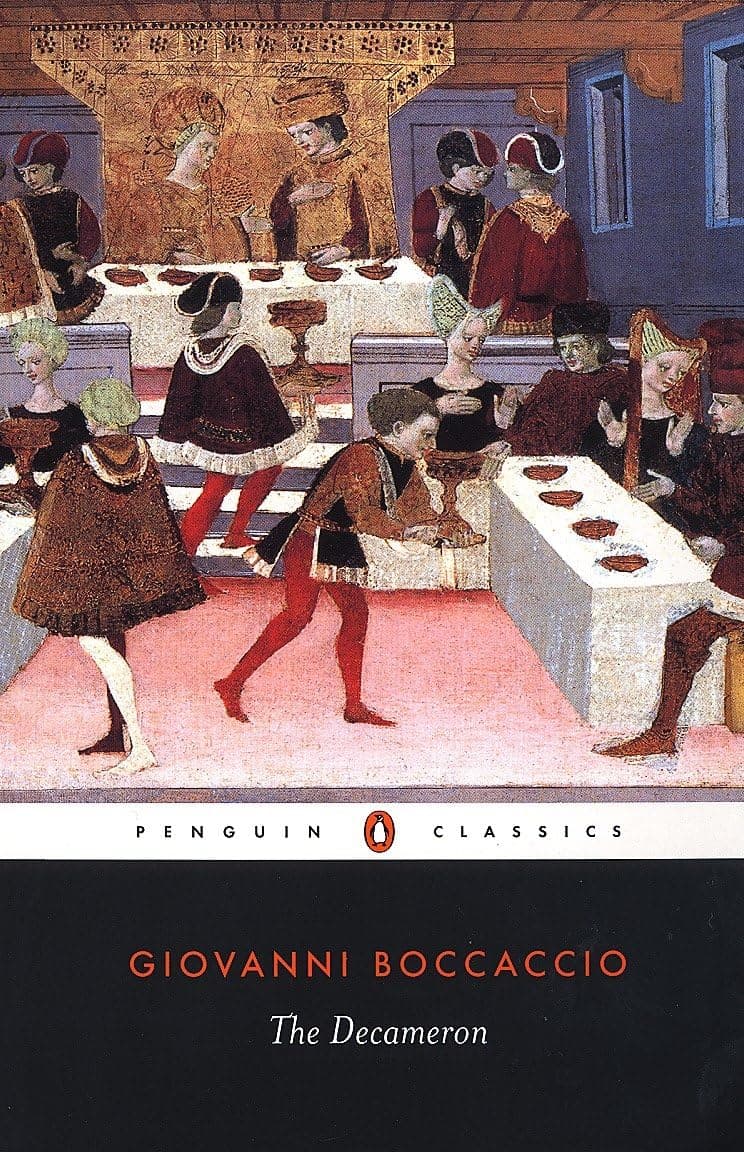
Decameron
“It is better to act and repent than to refrain and regret.”
Decameron Summary
As the Black Death devours Florence in 1348, ten young people—seven women and three men—flee to a villa in the hills and decide to pass the time by telling stories. Over ten days, each tells one tale per day, producing a hundred novellas that range from the bawdy to the sublime, from cunning priests and unfaithful wives to tales of heroic love and heartbreaking sacrifice. The plague frames everything: death presses at the garden walls, and the stories are an act of defiance against annihilation.
Boccaccio's genius lies in the sheer democratic sweep of his imagination. Merchants outwit nobles, women outmaneuver men, and the clever survive where the virtuous do not. The Decameron is a carnival of human appetites—for sex, money, wit, and above all, for the power of a well-told story to hold the darkness at bay.
Why Read Decameron?
The Decameron is one of the cornerstones of European literature and the book that, alongside Dante and Petrarch, forged the Italian language into a literary instrument. It invented the novella as a form and became the model for Chaucer's Canterbury Tales, Shakespeare's comedies, and every short story collection that followed. To read it is to witness the birth of modern narrative prose.
But what makes the Decameron still thrilling after nearly seven centuries is its sheer vitality. These stories pulse with appetite, cunning, and irreverence—nuns smuggling lovers into convents, merchants swindling each other with glee, wives outwitting jealous husbands with devastating ingenuity. Beneath the comedy lies a radical humanism: the insistence that pleasure, intelligence, and compassion matter more than rank or piety. It is a book that says yes to life in the face of death.
About Giovanni Boccaccio
Giovanni Boccaccio (1313–1375) was, along with Dante and Petrarch, one of the three crowns of Italian literature. Born the illegitimate son of a Florentine merchant, he spent his formative years in Naples, where the vibrant court culture and his own romantic entanglements provided the raw material for a lifetime of storytelling.
The Decameron, written in the aftermath of the 1348 plague that killed perhaps half of Florence's population, established prose narrative as an art form equal to poetry. In later life, Boccaccio became a devoted scholar of Dante and a pioneer of classical humanism, but it is the Decameron—earthy, exuberant, and endlessly inventive—that secured his immortality.
Reading Guide
Ranked #126 among the greatest books of all time, Decameron by Giovanni Boccaccio has earned its place in the literary canon. Originally written in Italian and published in 1353, this moderate read from Italy continues to resonate with readers today.
This book belongs to our Society & Satire and Love & Loss collections, where you can discover more books that share its spirit and themes.
If you enjoy moderate reads like this one, you might also like One Hundred Years of Solitude, Nineteen Eighty-Four, or Wuthering Heights.
From the Society & Satire Collection
If you enjoyed Decameron, discover more masterpieces that share its spirit.
 #9View Book
Don Quixote
Miguel de Cervantes
High•35-40 hours #12View Book
Pride and Prejudice
Jane Austen
Accessible•10-12 hours #22View Book
Madame Bovary
Gustave Flaubert
Moderate•12-15 hours #30View Book
Middlemarch
George Eliot
High•30-35 hours
Browse more collections