Communist Manifesto
“The history of all hitherto existing society is the history of class struggles.”
Communist Manifesto Summary
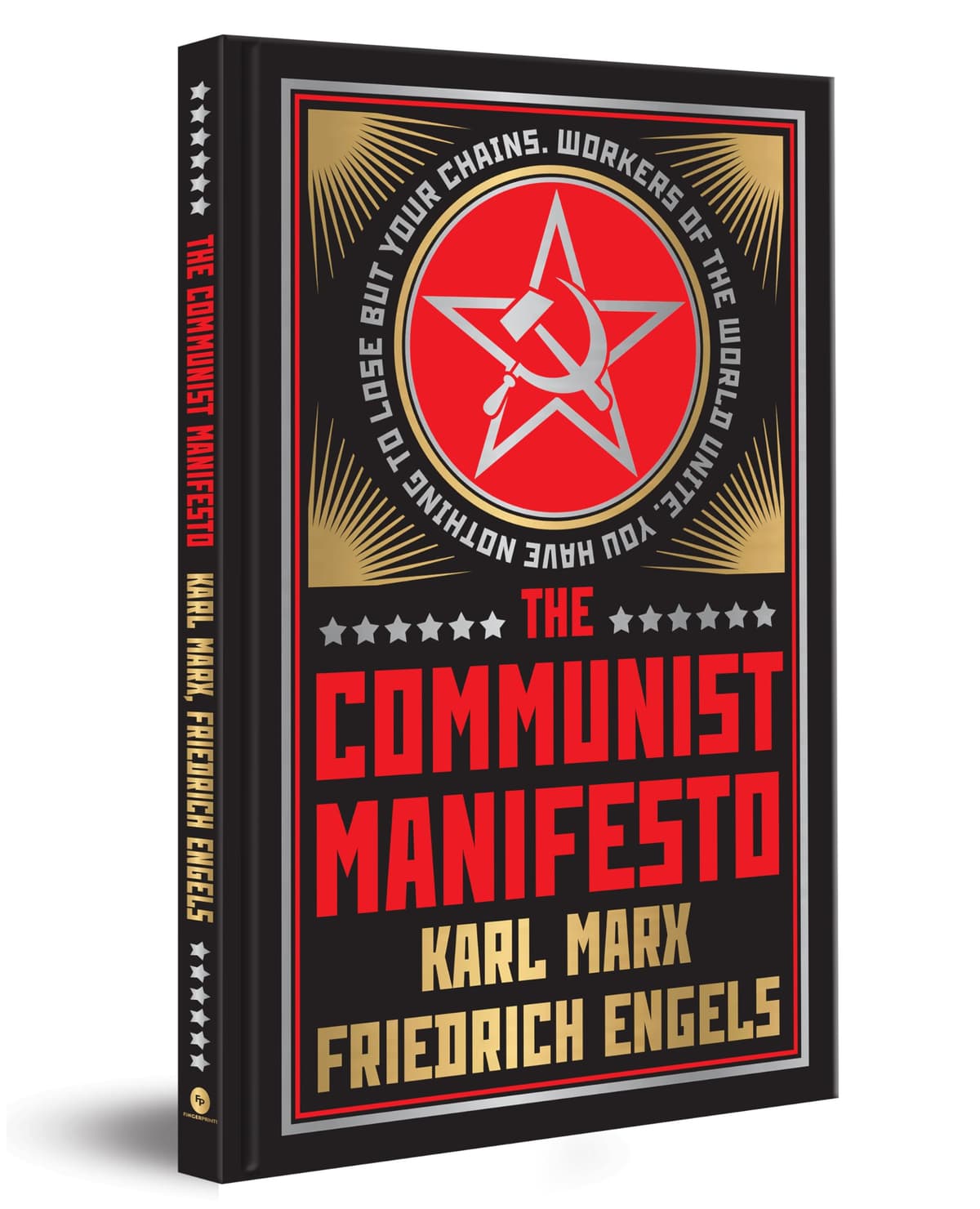
The Communist Manifesto is a political pamphlet written by Karl Marx and Friedrich Engels as the platform of the Communist League, laying out in urgent, declarative prose a theory of history and a program for revolutionary action. The work begins with its famous assertion that all history is the history of class struggles, then traces the rise of the bourgeoisie from the feudal system, arguing that capitalism, for all its revolutionary productive power, contains the seeds of its own destruction. Marx and Engels contend that the bourgeoisie has created the very class -- the proletariat -- that will inevitably overthrow it. The Manifesto outlines how capitalist exploitation alienates workers from the products of their labor and from their own humanity, and it calls for the abolition of private property, the centralization of production, and the eventual dissolution of the state.
As a work of political rhetoric, the Communist Manifesto is extraordinarily effective: its prose combines analytical rigor with prophetic passion, producing phrases that have entered the global vocabulary. As a work of historical analysis, its account of capitalism's transformative power -- dissolving traditional social bonds, globalizing commerce, and revolutionizing production -- remains remarkably acute. The Manifesto's prescriptions have been far more controversial than its diagnoses, and the political movements it inspired produced both genuine social progress and catastrophic human suffering. Regardless of one's political sympathies, the Manifesto is an indispensable document for understanding the modern world: the labor movements, revolutions, welfare states, and ideological conflicts of the past century and a half are incomprehensible without it.
Why Read Communist Manifesto?
Love it or loathe it, the Communist Manifesto is one of the most consequential texts ever written, and engaging with it directly is far more illuminating than encountering it filtered through the opinions of others. At barely fifty pages, it can be read in a single sitting, yet it contains ideas that reshaped the political landscape of the entire world. Marx and Engels write with a rhetorical force that is genuinely thrilling, regardless of whether you agree with their conclusions. Their analysis of how capitalism transforms every aspect of human life -- dissolving traditions, commodifying relationships, and creating a global market -- reads as startlingly prescient in the twenty-first century.
Reading the Manifesto equips you to engage with the political and economic debates that continue to define our era. Questions about inequality, labor rights, globalization, and the relationship between economic power and political freedom all trace back to the arguments Marx and Engels make here. Understanding those arguments in their original form -- rather than through caricatures from either supporters or detractors -- is essential for any informed citizen. The Manifesto is also a remarkable literary achievement: its opening and closing lines are among the most famous in political writing, and its fusion of historical analysis with revolutionary urgency creates a reading experience unlike anything else.
About Karl Marx, Friedrich Engels
Karl Marx (1818-1883) was a German philosopher, economist, and political theorist whose ideas formed the foundation of modern communist and socialist thought. Born in Trier to a middle-class family of converted Jewish heritage, Marx studied law and philosophy before turning to journalism and political activism. His radical writings led to his expulsion from Germany, France, and Belgium, and he spent much of his adult life in London, where he wrote his magnum opus, Das Kapital, while living in often desperate poverty. Friedrich Engels (1820-1895), the son of a wealthy German textile manufacturer, became Marx's closest intellectual collaborator and financial supporter, co-authoring several works and editing the later volumes of Das Kapital after Marx's death.
The intellectual partnership between Marx and Engels is one of the most consequential in modern history. Together and separately, they developed the theory of historical materialism, the critique of political economy, and the concept of class struggle that would inspire revolutionary movements across the globe. Their influence extends far beyond politics into sociology, philosophy, literary criticism, and historiography. The Communist Manifesto, written when Marx was just twenty-nine, remains their most widely read work, its impact on world history rivaled by only a handful of other documents. While the political systems established in their name have been largely discredited, their analytical frameworks continue to shape academic and political discourse worldwide.
Reading Guide
Ranked #314 among the greatest books of all time, Communist Manifesto by Karl Marx, Friedrich Engels has earned its place in the literary canon. Originally written in German and published in 1848, this moderate read from Germany continues to resonate with readers today.
This book belongs to our Philosophy & Faith and Society & Satire collections, where you can discover more books that share its spirit and themes.
If you enjoy moderate reads like this one, you might also like One Hundred Years of Solitude, Nineteen Eighty-Four, or Wuthering Heights.
From the Philosophy & Faith Collection
If you enjoyed Communist Manifesto, discover more masterpieces that share its spirit.
 #11View Book
Crime and Punishment
Fyodor Dostoevsky
High•20-25 hours #18View Book
The Bible
Various
Variable•60-80 hours #19View Book
The Brothers Karamazov
Fyodor Dostoevsky
Very High•35-40 hours #21View Book
The Stranger
Albert Camus
Moderate•3-4 hours
Browse more collections