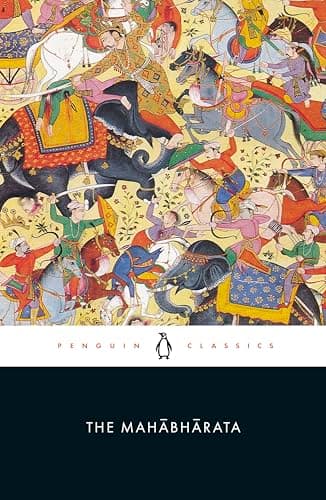
Mahabharata
“What is here may be found elsewhere. What is not here is nowhere.”
Mahabharata Summary
The Mahabharata is one of the two great Sanskrit epics of ancient India and the longest poem ever composed, telling the story of the catastrophic war between two branches of a royal family -- the five Pandava brothers and their hundred Kaurava cousins -- for control of the kingdom of Hastinapura. The narrative encompasses the entire arc of this dynastic conflict, from its origins in divine conception and childhood rivalry through escalating betrayals, a rigged dice game that sends the Pandavas into thirteen years of exile, failed peace negotiations, and finally the devastating eighteen-day battle at Kurukshetra that destroys an entire generation of warriors. Woven throughout are countless subplots, philosophical dialogues, and interpolated tales, including the Bhagavad Gita -- Krishna's discourse on duty, action, and the nature of the self delivered to the warrior Arjuna on the eve of battle.
The Mahabharata is far more than a war story: it is an encyclopedic exploration of dharma -- the moral law that governs human existence -- in all its complexity and contradictions. No character is purely good or evil; even the righteous Pandavas commit morally questionable acts, and even the villainous Kauravas have moments of genuine nobility. This moral ambiguity gives the epic its extraordinary depth and its continued relevance across millennia. The Mahabharata has shaped Indian civilization more profoundly than perhaps any other single text, influencing art, literature, philosophy, law, and religious practice across South and Southeast Asia. Its embedded philosophical texts, particularly the Bhagavad Gita, have achieved independent canonical status and continue to be studied as foundational works of world philosophy.
Why Read Mahabharata?
Encountering the Mahabharata is encountering one of the foundational narratives of human civilization. This is not merely a story but a cosmos -- a vast, interconnected web of tales that encompasses war and peace, love and hatred, philosophy and statecraft, the human and the divine. Its characters are among the most complex in all of world literature: Arjuna paralyzed by moral doubt on the battlefield, Draupadi demanding justice for her humiliation, Karna torn between loyalty and destiny, Yudhishthira wrestling with the impossibility of righteous war. No summary can capture the richness of the full text, which contains within itself virtually every story that can be told.
Reading the Mahabharata transforms your understanding of narrative possibility. Its non-linear structure, its willingness to interrupt the main story for philosophical digressions and embedded tales, and its refusal to reduce moral complexity to simple binaries anticipate the techniques of postmodern fiction by millennia. The Bhagavad Gita alone -- a single episode within the larger epic -- has inspired figures from Thoreau to Gandhi to Oppenheimer. Whether you approach it as literature, philosophy, or spiritual scripture, the Mahabharata offers an inexhaustible wealth of insight into the human condition.
About Vyasa
Vyasa, also known as Krishna Dvaipayana, is the legendary sage traditionally credited with composing the Mahabharata. According to Indian tradition, Vyasa was born on an island in the Yamuna River to the fisherwoman Satyavati and the wandering sage Parashara. He is also credited with compiling the Vedas, composing the Puranas, and writing the Brahma Sutras, making him one of the most important figures in the Hindu intellectual tradition. Within the Mahabharata itself, Vyasa appears as a character -- the grandfather of both the Pandavas and Kauravas -- blurring the line between author and creation in a way that is itself philosophically significant.
Modern scholarship regards the Mahabharata as a composite work that evolved over centuries, with its earliest layers possibly dating to the eighth or ninth century BCE and its final form consolidated around the fourth century CE. The historical Vyasa, if he existed, likely composed a core narrative that was subsequently expanded by generations of poets, priests, and philosophers. This process of accretion gave the epic its encyclopedic character and its famous self-description as containing everything that exists in the world. Regardless of questions of authorship, the Mahabharata stands as one of the supreme achievements of human literary imagination, a work whose influence on Indian and world culture is immeasurable.
Reading Guide
Ranked #313 among the greatest books of all time, Mahabharata by Vyasa has earned its place in the literary canon. Originally written in Sanskrit and published in -400, this challenging read from India continues to resonate with readers today.
This book belongs to our Epics and Philosophy & Faith collections, where you can discover more books that share its spirit and themes.
If you enjoy challenging reads like this one, you might also like Ulysses, Moby-Dick, or Lolita.
From the Epics Collection
If you enjoyed Mahabharata, discover more masterpieces that share its spirit.
 #1View Book
Ulysses
James Joyce
Challenging•35-40 hours #5View Book
One Hundred Years of Solitude
Gabriel García Márquez
Moderate•15-20 hours #7View Book
Moby-Dick
Herman Melville
Challenging•20-25 hours #9View Book
Don Quixote
Miguel de Cervantes
High•35-40 hours
Browse more collections