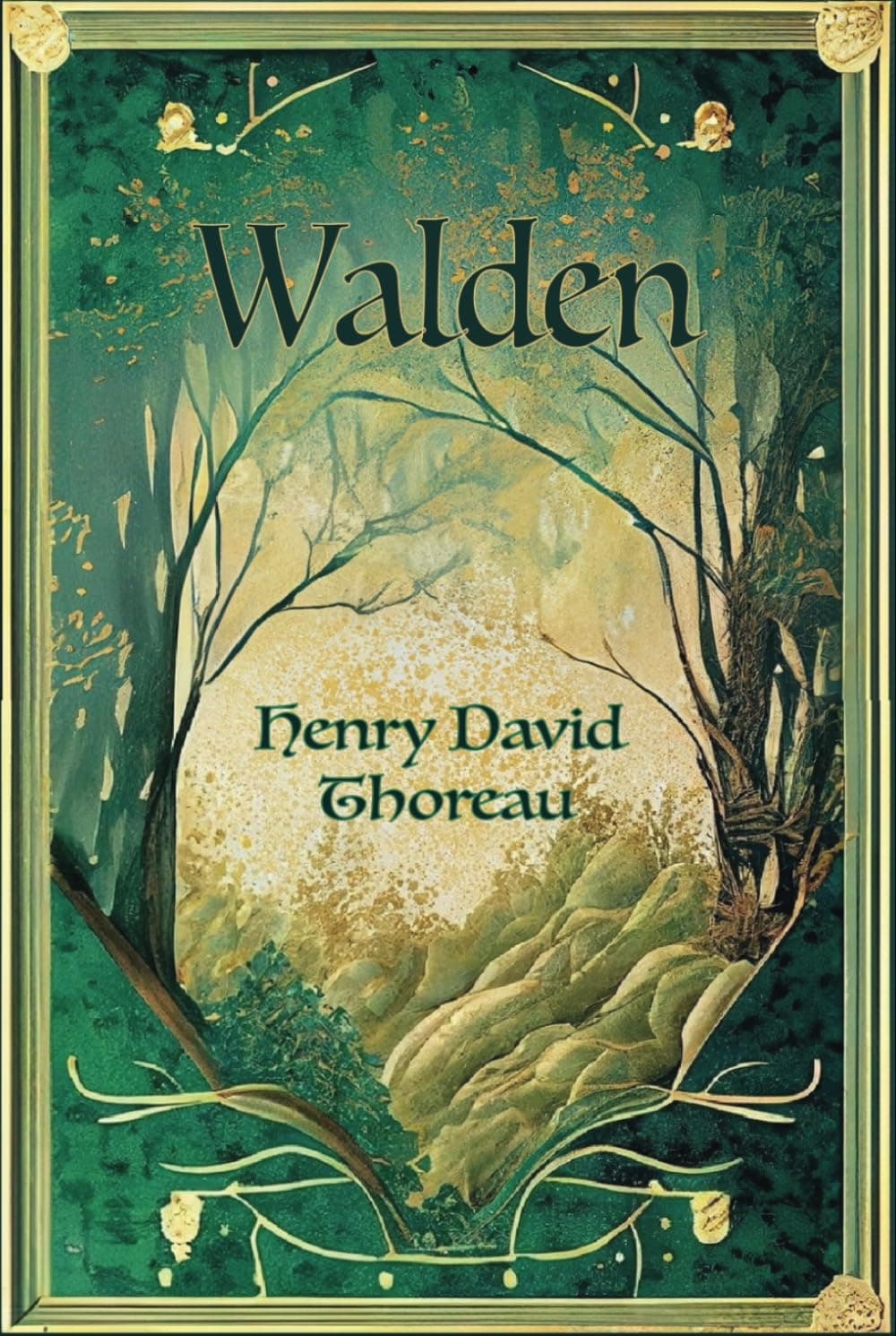
Walden
“I went to the woods because I wished to live deliberately, to front only the essential facts of life, and see if I could not learn what it had to teach, and not, when I came to die, discover that I had not lived.”
Walden Summary
On July 4, 1845, Henry David Thoreau walked into the woods near Concord, Massachusetts, built a small cabin on the shore of Walden Pond, and set about the experiment of living deliberately. For two years, two months, and two days, he grew beans, observed the seasons, measured the pond's depth, listened to the railroad rumble past, and wrote one of the most extraordinary books in the American tradition—a work that is at once a practical manual for self-sufficiency, a transcendentalist meditation on nature and spirit, and a fierce polemic against the quiet desperation of modern life.
Walden is organized around the cycle of a single year, moving from summer through winter and back to spring, and its prose moves with the same organic rhythm—now crystalline and aphoristic, now richly metaphorical, now sharply satirical. Thoreau watches ants wage war on a stump, tracks the melting of the pond ice with scientific precision, and delivers some of the most quotable sentences in English, each one a small act of rebellion against convention, materialism, and the tyranny of the clock.
Why Read Walden?
Walden is the founding text of American counterculture—the original dropout manifesto, the first great argument that the way most people live is not the only way, and probably not the best. Thoreau's experiment at the pond was not an escape from society but a confrontation with it: he went to the woods to strip life down to its essentials and find out what remained when the clutter was cleared away.
What remained was astonishing. Thoreau discovered that a man needs very little to be fully alive—a cabin, a bean field, a pond to swim in, and the time to pay attention. His prose is among the most bracing in the language: every paragraph contains a sentence that can change the way you think about your own life. In an age of digital distraction and consumer excess, Walden's call to simplify, to wake up, to live with intention has never been more urgent or more necessary.
About Henry David Thoreau
Henry David Thoreau (1817-1862) was a Harvard-educated pencil-maker, surveyor, naturalist, and writer who spent his entire life in and around Concord, Massachusetts. A protege of Ralph Waldo Emerson and a central figure of the Transcendentalist movement, he turned the act of paying attention into a literary art form and the act of refusal into a political philosophy.
Thoreau's essay 'Civil Disobedience,' written after he was jailed for refusing to pay a poll tax in protest of slavery and the Mexican War, would go on to influence Tolstoy, Gandhi, and Martin Luther King Jr. He died of tuberculosis at age forty-four, largely unrecognized, but the twentieth century discovered in him one of America's essential voices—a writer who insisted that the examined life was not merely worth living but the only life worth living at all.
Reading Guide
Ranked #105 among the greatest books of all time, Walden by Henry David Thoreau has earned its place in the literary canon. Originally written in English and published in 1854, this challenging read from United States continues to resonate with readers today.
This book belongs to our Philosophy & Faith and American Spirit collections, where you can discover more books that share its spirit and themes.
If you enjoy challenging reads like this one, you might also like Ulysses, Moby-Dick, or Lolita.
From the Philosophy & Faith Collection
If you enjoyed Walden, discover more masterpieces that share its spirit.
 #11View Book
Crime and Punishment
Fyodor Dostoevsky
High•20-25 hours #18View Book
The Bible
Various
Variable•60-80 hours #19View Book
The Brothers Karamazov
Fyodor Dostoevsky
Very High•35-40 hours #21View Book
The Stranger
Albert Camus
Moderate•3-4 hours
Browse more collections