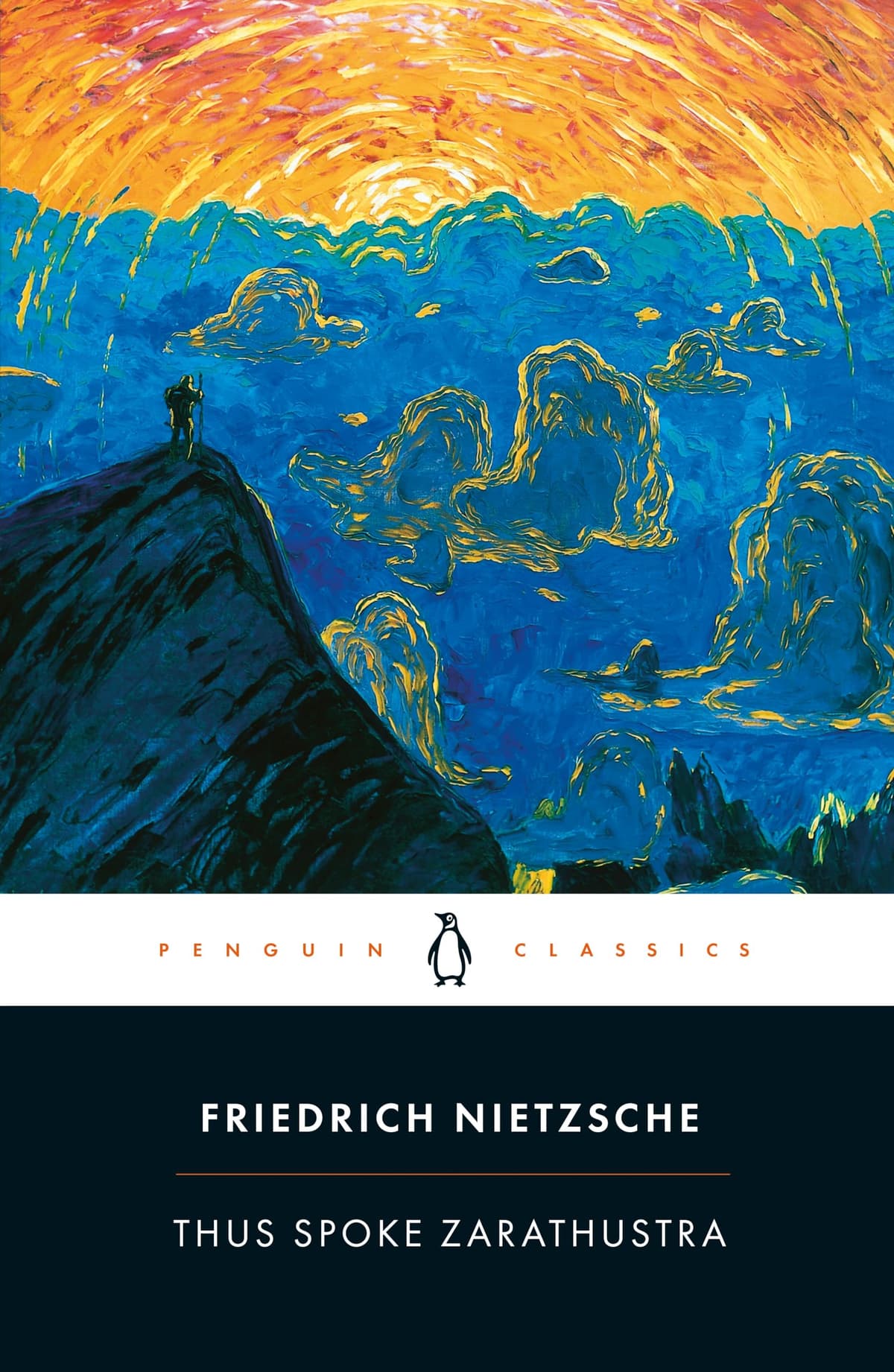
Thus Spake Zarathustra
“You must have chaos within you to give birth to a dancing star.”
Thus Spake Zarathustra Summary
A prophet descends from his mountain solitude after ten years of contemplation, bursting with wisdom he must share with humanity. Zarathustra—named for the ancient Persian sage—wanders through marketplaces, forests, and cities, delivering speeches and parables on the Übermensch, the death of God, and the eternal recurrence of all things. He encounters disciples and detractors, dances with his shadow, converses with animals, and wrestles with the terrible weight of his own teachings. Nietzsche's prose-poem is not a conventional novel or treatise—it is a symphony of ideas performed in the register of biblical prophecy.
Written in a white heat of inspiration between 1883 and 1885, Thus Spake Zarathustra represents Nietzsche's most audacious literary experiment—a work that fuses philosophy with myth, sermon with song, tragedy with ecstatic affirmation. The famous proclamation that God is dead is not a celebration but a challenge: with the old moral scaffolding removed, humanity must create new values or perish in nihilism. The concept of the Übermensch—the human being who overcomes themselves—is Nietzsche's answer to that void. The prose moves between lyrical beauty and savage irony, between tender soliloquy and thundering polemic. It is a book that demands not just reading but reckoning—a gauntlet thrown at the feet of every comfortable assumption about morality, meaning, and the purpose of existence.
Why Read Thus Spake Zarathustra?
This is not a book you read—it is a book that reads you. Nietzsche's Zarathustra will challenge every unexamined assumption you carry about morality, purpose, and what it means to live fully. The prose sings with a beauty that philosophy rarely achieves, moving from whispered intimacy to thunderclap revelation. Whether you emerge a disciple or a dissenter, you will not emerge unchanged. It is one of those rare works that genuinely alters the reader's relationship to received wisdom.
Zarathustra endures because its central questions refuse to age. In a world still grappling with the collapse of inherited certainties—religious, political, moral—Nietzsche's call to create meaning rather than inherit it feels more urgent than ever. The book gave the twentieth century some of its most potent and most misunderstood ideas, and understanding those ideas at their source is an act of intellectual self-defense. You owe it to yourself to hear Zarathustra speak in his own voice, on his own mountain, before the secondhand versions reach you.
About Friedrich Nietzsche
Friedrich Nietzsche (1844–1900) was a German philosopher, cultural critic, and prose stylist whose ideas detonated across the twentieth century like delayed-action bombs. The son of a Lutheran pastor, he became a professor of classical philology at the University of Basel at the astonishing age of twenty-four, before abandoning academia for a wandering life of writing, illness, and solitude in the boarding houses of Switzerland and Italy.
His works—including The Birth of Tragedy, Beyond Good and Evil, On the Genealogy of Morals, and Ecce Homo—attacked conventional morality, Christianity, and philosophical complacency with unprecedented ferocity and wit. Nietzsche suffered a mental collapse in 1889, spending his final eleven years in the care of his mother and sister, who notoriously distorted his legacy to serve nationalist causes. His actual philosophy—life-affirming, fiercely individualist, suspicious of all dogma—has since been reclaimed and stands as one of the most influential bodies of thought in modern intellectual history.
Reading Guide
Ranked #216 among the greatest books of all time, Thus Spake Zarathustra by Friedrich Nietzsche has earned its place in the literary canon. Originally written in German and published in 1883–1885, this challenging read from Germany continues to resonate with readers today.
This book belongs to our Philosophy & Faith collection, where you can discover more books that share its spirit and themes.
If you enjoy challenging reads like this one, you might also like Ulysses, Moby-Dick, or Lolita.
From the Philosophy & Faith Collection
If you enjoyed Thus Spake Zarathustra, discover more masterpieces that share its spirit.
 #11View Book
Crime and Punishment
Fyodor Dostoevsky
High•20-25 hours #18View Book
The Bible
Various
Variable•60-80 hours #19View Book
The Brothers Karamazov
Fyodor Dostoevsky
Very High•35-40 hours #21View Book
The Stranger
Albert Camus
Moderate•3-4 hours
Browse more collections