The Structure of Scientific Revolutions
“Normal science, the activity in which most scientists inevitably spend almost all their time, is predicated on the assumption that the scientific community knows what the world is like.”
The Structure of Scientific Revolutions Summary
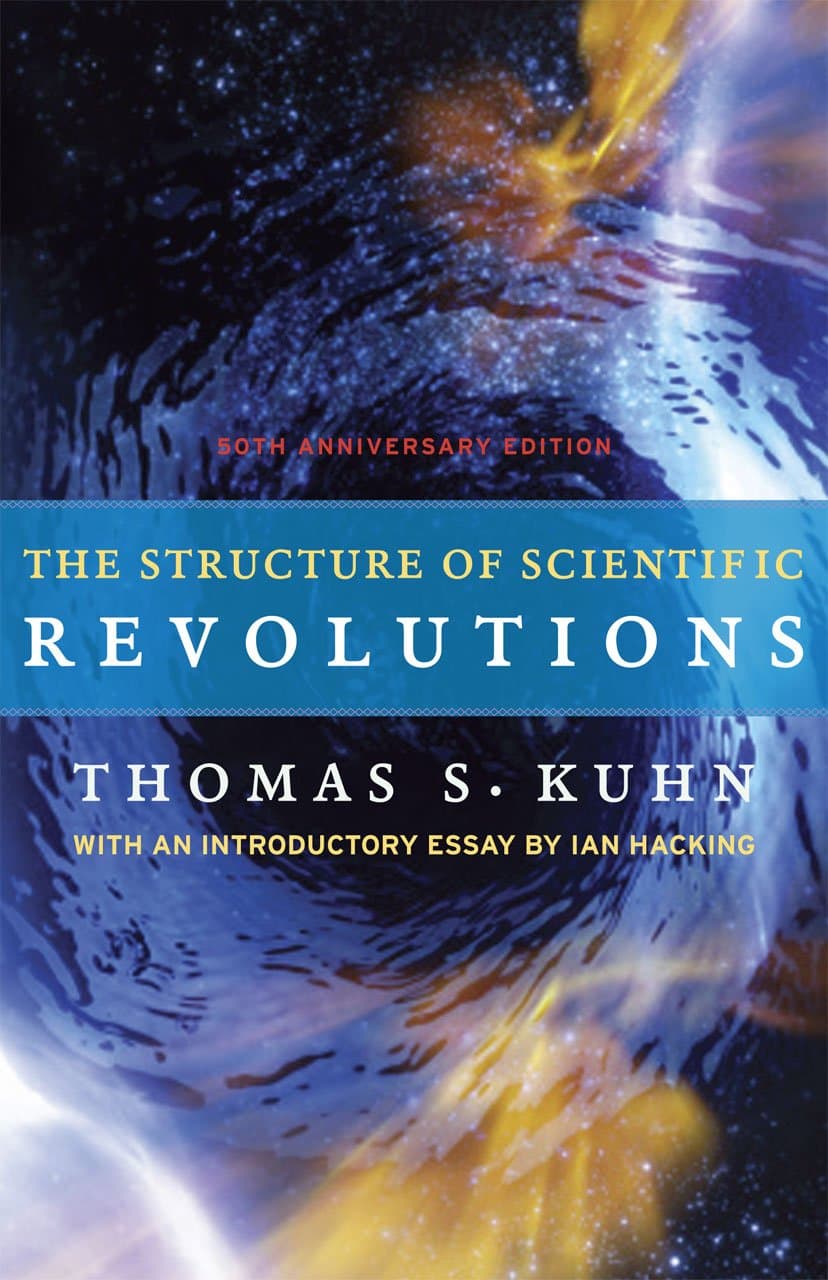
The Structure of Scientific Revolutions dismantles the comfortable myth that science progresses through steady, rational accumulation of knowledge and replaces it with a far more turbulent picture. Thomas Kuhn argues that science moves through distinct phases: long periods of "normal science," in which researchers solve puzzles within an accepted framework or paradigm, punctuated by crises when anomalies accumulate that the reigning paradigm cannot explain. These crises eventually trigger scientific revolutions—wholesale shifts to new paradigms that are not simply extensions of the old but fundamentally incompatible ways of seeing the world. The shift from Ptolemaic to Copernican astronomy, from Newtonian mechanics to Einstein's relativity, from phlogiston theory to Lavoisier's chemistry—these are not corrections but transformations, moments when the scientific community collectively reimagines what counts as a problem, a solution, and even a fact. Kuhn's most provocative claim is that competing paradigms are "incommensurable": scientists working within different paradigms literally see different things when they look at the same data, making the choice between paradigms as much a matter of persuasion and community consensus as of logical proof.
First published in 1962, Kuhn's book is one of the most cited academic works of the twentieth century and one of the few works of philosophy of science to enter the general intellectual vocabulary. The term "paradigm shift" has become ubiquitous, applied far beyond science to describe any fundamental change in worldview. Kuhn's arguments challenged the positivist faith in scientific objectivity and opened fierce debates about relativism, truth, and the social construction of knowledge that continue to this day. Whether one ultimately agrees with Kuhn or not, The Structure of Scientific Revolutions is essential reading for anyone who wants to understand not just how science works but how ideas change the world.
Why Read The Structure of Scientific Revolutions?
The Structure of Scientific Revolutions is one of those rare books that changes not just what you think but how you think. Before Kuhn, most people assumed science was a straight line from ignorance to truth, each generation building neatly on the last. Kuhn showed that the reality is far stranger and far more interesting: that scientific communities operate within paradigms that shape what they can see, that revolutions happen not through gradual improvement but through radical ruptures, and that the transition between worldviews involves something closer to a conversion experience than a logical proof. Once you absorb this idea, you will never look at any field of knowledge—science, politics, art, your own assumptions—the same way again.
This book gave us the phrase "paradigm shift," now so overused that its revolutionary origin has been almost forgotten. Return to the source and you will find an argument of extraordinary subtlety and power, one that raises unsettling questions about objectivity, truth, and whether progress is quite what we think it is. Kuhn writes with clarity and accessibility rare in academic philosophy, illustrating his arguments with vivid historical examples that make abstract epistemology feel concrete and urgent. If you want to understand how ideas triumph and why truth is never as simple as it seems, this is where you begin.
About Thomas Kuhn
Thomas Samuel Kuhn was born in 1922 in Cincinnati, Ohio, and studied physics at Harvard, earning his PhD in 1949. While a graduate student, he was asked to teach a course on the history of science for non-scientists, an experience that led him to realize that the actual practice of science bore little resemblance to the tidy narrative of progress presented in textbooks. This insight became the seed of his life's work. He taught at Harvard, Berkeley, Princeton, and MIT, becoming one of the most influential philosophers of science in the twentieth century.
The Structure of Scientific Revolutions, published in 1962 as part of the International Encyclopedia of Unified Science, became an unexpected intellectual sensation, eventually selling over a million copies and being translated into dozens of languages. Kuhn's concept of the "paradigm shift" entered common parlance and influenced fields far beyond the philosophy of science, including sociology, literary criticism, political theory, and business. His later work, including The Essential Tension and Black-Body Theory and the Quantum Discontinuity, refined and defended his positions. Kuhn died in 1996 in Cambridge, Massachusetts. His legacy remains contested—scientists often resist his implications about objectivity, while humanists have sometimes pushed his ideas further than he intended—but his impact on how the modern world understands knowledge and change is beyond dispute.
Reading Guide
Ranked #402 among the greatest books of all time, The Structure of Scientific Revolutions by Thomas Kuhn has earned its place in the literary canon. Originally written in English and published in 1962, this moderate read from United States continues to resonate with readers today.
This book belongs to our Philosophy & Faith collection, where you can discover more books that share its spirit and themes.
If you enjoy moderate reads like this one, you might also like One Hundred Years of Solitude, Nineteen Eighty-Four, or Wuthering Heights.
From the Philosophy & Faith Collection
If you enjoyed The Structure of Scientific Revolutions, discover more masterpieces that share its spirit.
 #11View Book
Crime and Punishment
Fyodor Dostoevsky
High•20-25 hours #18View Book
The Bible
Various
Variable•60-80 hours #19View Book
The Brothers Karamazov
Fyodor Dostoevsky
Very High•35-40 hours #21View Book
The Stranger
Albert Camus
Moderate•3-4 hours
Browse more collections