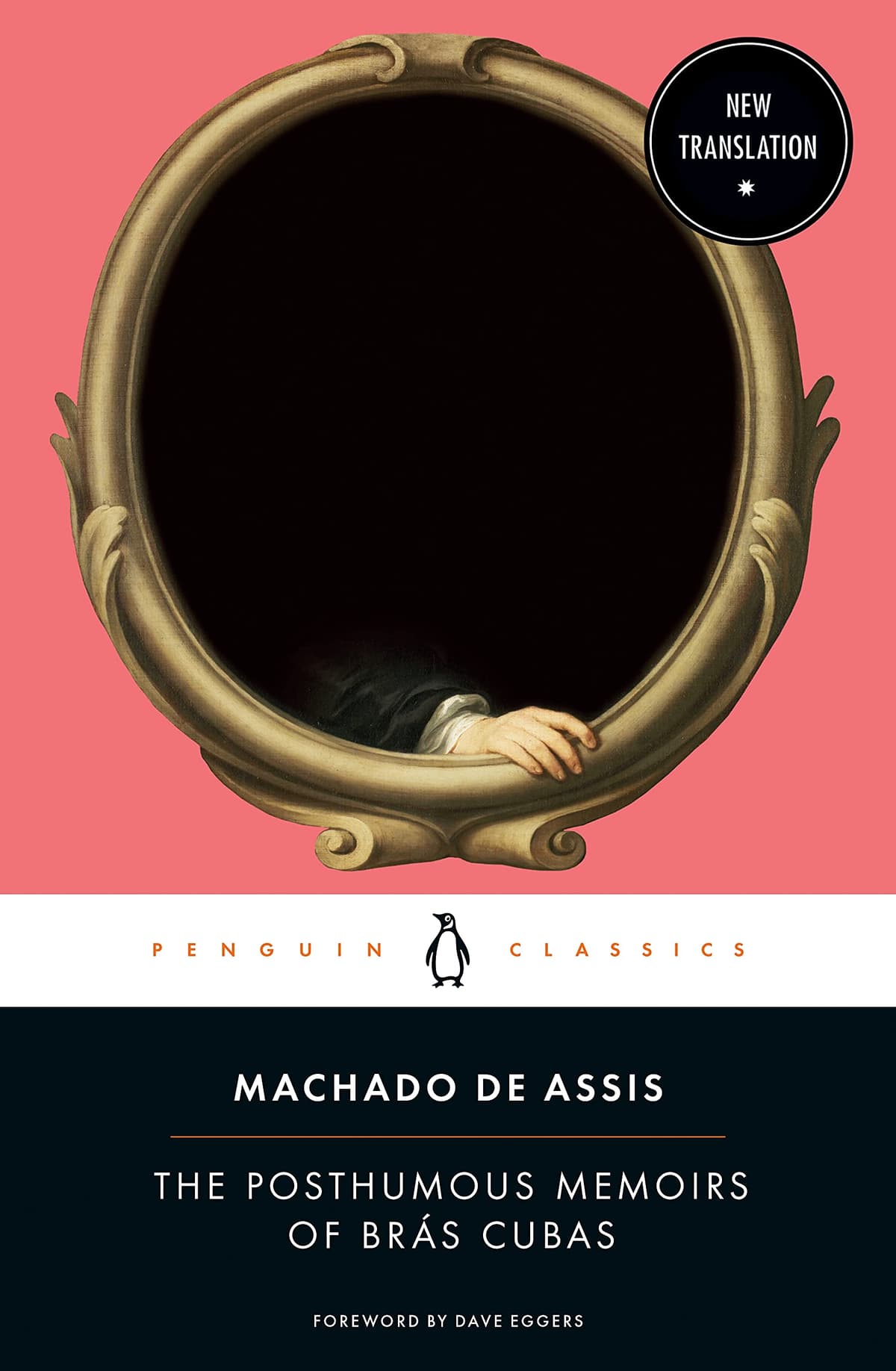
The Posthumous Memoirs of Bras Cubas
“To the worm who first gnawed on the cold flesh of my corpse, I dedicate with fond remembrance these posthumous memoirs.”
The Posthumous Memoirs of Bras Cubas Summary
Bras Cubas, a wealthy, idle member of the Brazilian elite, narrates his own life story from beyond the grave, having decided that death grants him the perfect vantage point from which to tell the truth without consequence. Beginning with his own demise and funeral, he works backward and forward through his existence with gleeful disregard for chronological order, addressing the reader directly, interrupting his own narrative with philosophical digressions, blank chapters, and typographical experiments. He recounts a pampered childhood in Rio de Janeiro, a dissolute youth in Portugal, a halfhearted political career, and a prolonged love affair with Virgilia, a married woman of his own social class. He dabbles in philosophy, inventing a system he calls Humanitism, a satirical pseudo-philosophy promoted by his friend Quincas Borba that declares envy, war, and selfishness to be the engines of human progress. Throughout, Bras Cubas observes the vanity, hypocrisy, and self-deception of Brazilian high society with a wit that is by turns charming and savage, never sparing himself from his own acid commentary.
Machado de Assis's masterpiece is one of the most audacious and original novels of the nineteenth century, anticipating by decades the metafictional experiments of modernism and postmodernism. Written in 1881, it predates the narrative innovations typically associated with Sterne-influenced twentieth-century fiction, yet its self-aware narrator, its disrupted structure, and its philosophical playfulness feel startlingly contemporary. Beneath its comic brilliance lies a devastating critique of Brazilian slaveholding society, class privilege, and the moral bankruptcy of an elite that has confused wealth with virtue. The novel's final line, in which Bras Cubas tallies his life's accounts and finds a small surplus in having fathered no children and thus transmitted his misery to no one, is among the most bleakly funny conclusions in all of literature.
Why Read The Posthumous Memoirs of Bras Cubas?
Opening a novel narrated by a dead man who cheerfully admits he has nothing left to lose sets the tone for one of the most inventive and entertaining reading experiences in world literature. Machado de Assis writes with a lightness and wit that disguise the depth of his intelligence, producing a book that makes you laugh on nearly every page while systematically dismantling the pretensions of an entire society. Bras Cubas is an unreliable narrator of the highest order, charming you with his candor even as you realize that his confessions are themselves performances of vanity.
This novel is also one of literature's best-kept secrets outside the Portuguese-speaking world, a book that anticipated the experiments of modernism and postmodernism by several decades and influenced writers from Borges to Salman Rushdie. Its brevity makes it an ideal entry point into one of the greatest literary imaginations of the nineteenth century, and its themes of social hypocrisy, wasted privilege, and the comedy of self-deception are as sharp today as they were in 1881. If you think you know what nineteenth-century fiction looks like, this book will delightfully prove you wrong.
About Machado de Assis
Joaquim Maria Machado de Assis was born in 1839 in Rio de Janeiro to a mixed-race family of modest means. His father was a house painter of Afro-Brazilian descent, and his mother, who died when he was young, was a Portuguese immigrant from the Azores. Largely self-educated, Machado worked as a typesetter's apprentice and journalist before establishing himself as a writer of poetry, short stories, novels, and plays. He rose to become the most important literary figure in Brazil, co-founding and serving as the first president of the Brazilian Academy of Letters in 1897.
Machado's career is typically divided into two phases: an early period of conventional Romantic novels and a revolutionary later period inaugurated by The Posthumous Memoirs of Bras Cubas in 1881. His later novels, including Quincas Borba and Dom Casmurro, are characterized by irony, psychological complexity, metafictional experimentation, and a corrosive skepticism about human nature that places him alongside Sterne, Cervantes, and Swift. Despite suffering from epilepsy and a severe stammer throughout his life, Machado produced one of the richest bodies of work in any language. He died in 1908 in Rio de Janeiro and is now recognized internationally as one of the greatest writers of the nineteenth century and a foundational figure of Latin American literature.
Reading Guide
Ranked #285 among the greatest books of all time, The Posthumous Memoirs of Bras Cubas by Machado de Assis has earned its place in the literary canon. Originally written in Portuguese and published in 1881, this moderate read from Brazil continues to resonate with readers today.
This book belongs to our Society & Satire collection, where you can discover more books that share its spirit and themes.
If you enjoy moderate reads like this one, you might also like One Hundred Years of Solitude, Nineteen Eighty-Four, or Wuthering Heights.
From the Society & Satire Collection
If you enjoyed The Posthumous Memoirs of Bras Cubas, discover more masterpieces that share its spirit.
 #9View Book
Don Quixote
Miguel de Cervantes
High•35-40 hours #12View Book
Pride and Prejudice
Jane Austen
Accessible•10-12 hours #22View Book
Madame Bovary
Gustave Flaubert
Moderate•12-15 hours #30View Book
Middlemarch
George Eliot
High•30-35 hours
Browse more collections