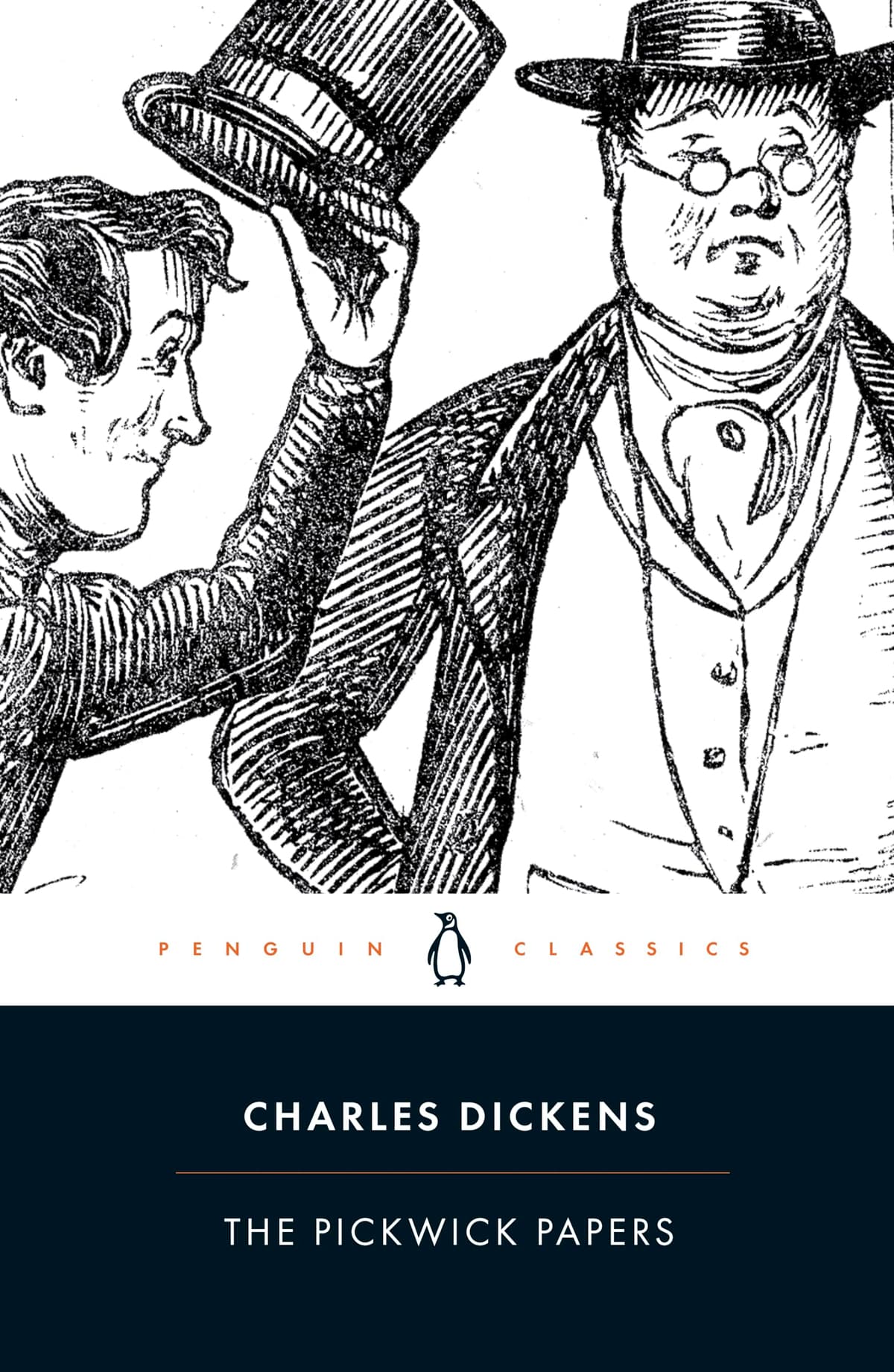
The Pickwick Papers
“It's over, and can't be helped, and that's one consolation, as they always says in Turkey, ven they cuts the wrong man's head off.”
The Pickwick Papers Summary
Samuel Pickwick, a portly, benevolent, and magnificently naive retired businessman, founds the Pickwick Club and sets off with three companions, the amorous Tupman, the poetic Snodgrass, and the sporting Winkle, on a series of journeys through the English countryside to observe and report on the human condition. What follows is a gloriously episodic cascade of misadventures: Pickwick stumbles into a military review at Rochester, is entangled in the breach-of-promise suit brought by his scheming landlady Mrs. Bardell, witnesses a riotous parliamentary election at Eatanswill, and is thrown into the Fleet debtors' prison when he refuses on principle to pay Mrs. Bardell's damages. Along the way, he acquires the immortal Sam Weller as his servant, a Cockney wit whose street-smart resourcefulness perfectly complements his master's innocent goodwill. The novel teems with interpolated tales, from gothic ghost stories to sentimental melodramas, and introduces a vast gallery of English eccentrics, charlatans, and good-hearted souls.
Dickens's first novel, originally serialized in monthly parts beginning in 1836, is a fountainhead of comic invention and the book that made its twenty-four-year-old author the most famous writer in England almost overnight. The Pickwick Papers operates less through conventional plot than through the irresistible energy of its voice and the warmth of its central relationship between the innocent master and the worldly servant, a pairing that echoes Don Quixote and Sancho Panza. Beneath the rollicking comedy, Dickens launches his lifelong critique of English institutions, particularly the law, whose absurdities and cruelties receive withering treatment in the Bardell trial and the Fleet Prison chapters. The novel's shift in tone from pure farce to social commentary in its later installments marks the emergence of the great Dickens who would go on to write Oliver Twist, Bleak House, and Great Expectations.
Why Read The Pickwick Papers?
The sheer exuberance of The Pickwick Papers is unlike anything else in Dickens or, indeed, in the English novel. Written when Dickens was barely twenty-four, the book bursts with a young genius's delight in the infinite variety of human nature, and its comic set pieces, the Eatanswill election, the Christmas at Dingley Dell, the trial of Bardell v. Pickwick, rank among the funniest scenes in all of literature. Sam Weller's cockney aphorisms alone justify the price of admission, and the friendship between the worldly servant and his guileless master is one of fiction's great double acts.
You will discover in these pages the origins of Dickens's entire artistic universe: the passionate sympathy for the downtrodden, the savage humor directed at institutional corruption, and the conviction that goodness, however naive, is a force worth celebrating. The novel's episodic structure makes it wonderfully readable in pieces, each chapter offering a self-contained comic adventure. Reading The Pickwick Papers, you experience the infectious joy of a writer discovering his powers for the first time, and you understand why Victorian England fell immediately and irrevocably in love with Charles Dickens.
About Charles Dickens
Charles Dickens (1812-1870) was born in Portsmouth, England, the second of eight children. His childhood was marked by financial instability and the traumatic experience of working in a blacking factory while his father was imprisoned for debt, experiences that fueled his lifelong concern with poverty and social justice. He began his literary career as a journalist and parliamentary reporter before the phenomenal success of The Pickwick Papers, serialized in 1836-1837, transformed him into the most popular novelist of the Victorian age. Over the next three decades he produced a body of work, including Oliver Twist, David Copperfield, Bleak House, Great Expectations, and A Tale of Two Cities, that defines the English novel.
Dickens's influence on literature and culture is immeasurable. He essentially invented the modern Christmas celebration through A Christmas Carol, pioneered the serial publication format that shaped nineteenth-century fiction, and created characters so vivid that names like Scrooge, Fagin, and Miss Havisham have entered common language. He was also a tireless social reformer, editor, and public performer whose dramatic readings drew enormous crowds. His novels combined popular entertainment with serious social criticism in ways that no writer before or since has matched, and his compassion for the vulnerable and dispossessed remains the moral center of his enduring appeal.
Reading Guide
Ranked #260 among the greatest books of all time, The Pickwick Papers by Charles Dickens has earned its place in the literary canon. Originally written in English and published in 1836, this moderate read from United Kingdom continues to resonate with readers today.
This book belongs to our Society & Satire collection, where you can discover more books that share its spirit and themes.
If you enjoy moderate reads like this one, you might also like One Hundred Years of Solitude, Nineteen Eighty-Four, or Wuthering Heights.
From the Society & Satire Collection
If you enjoyed The Pickwick Papers, discover more masterpieces that share its spirit.
 #9View Book
Don Quixote
Miguel de Cervantes
High•35-40 hours #12View Book
Pride and Prejudice
Jane Austen
Accessible•10-12 hours #22View Book
Madame Bovary
Gustave Flaubert
Moderate•12-15 hours #30View Book
Middlemarch
George Eliot
High•30-35 hours
Browse more collections