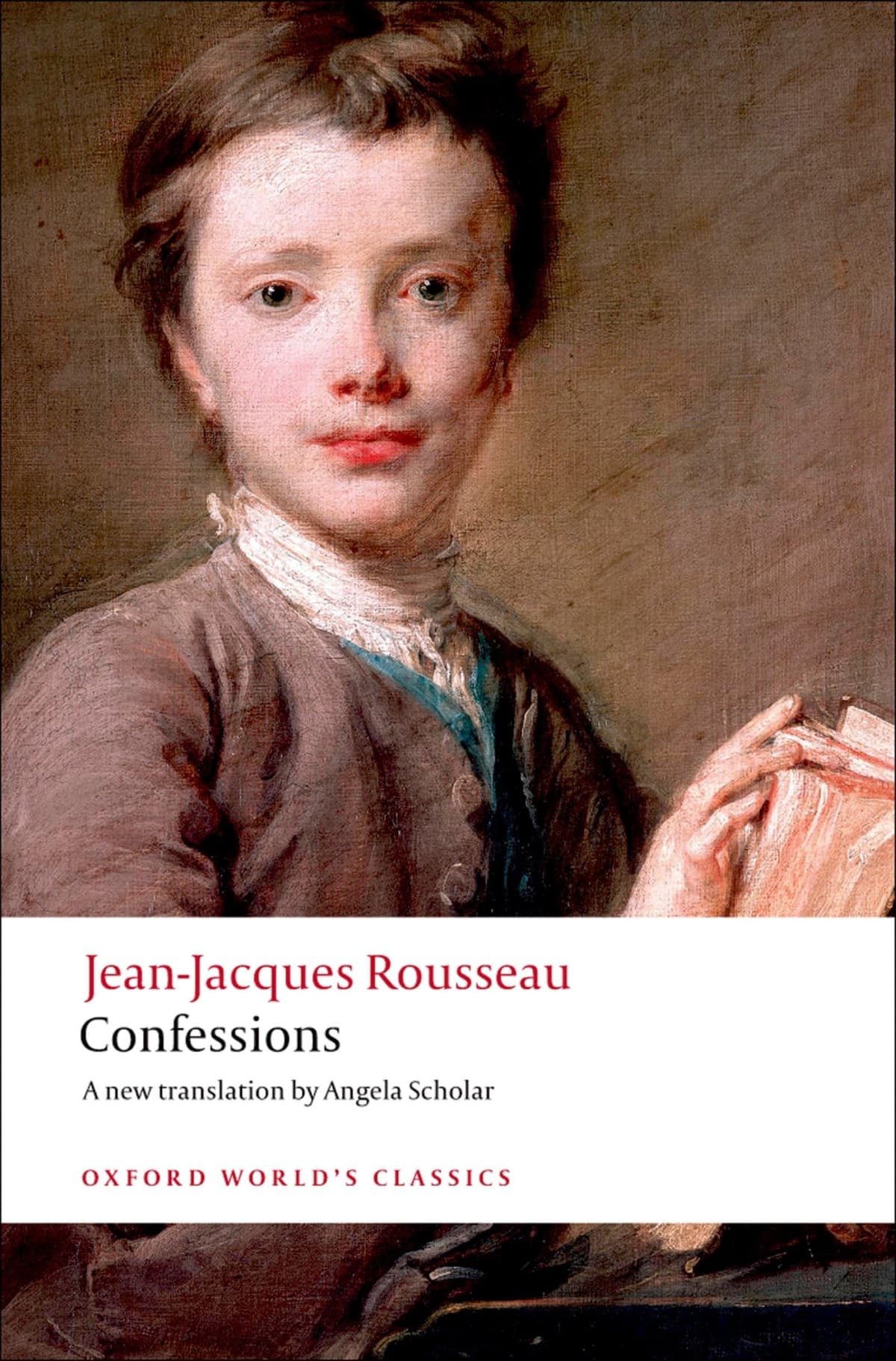
The Confessions of Jean-Jacques Rousseau
“I felt before I thought, which is the common lot of humanity.”
The Confessions of Jean-Jacques Rousseau Summary
Jean-Jacques Rousseau undertakes a revolutionary act of self-examination, pledging to reveal himself to the reader with absolute honesty and sparing nothing, not even the most shameful episodes of his life. Beginning with his birth in Geneva in 1712, which cost his mother her life, Rousseau traces his formation from a sensitive, book-obsessed child to a restless young man wandering through France, Italy, and Switzerland. He recounts his complicated relationship with Madame de Warens, who served as both maternal figure and lover, his years of poverty and odd employment, his gradual entry into Parisian intellectual circles, and his fateful friendships and quarrels with the great figures of the Enlightenment, including Diderot, Voltaire, and d'Alembert. He confesses to placing his five children in a foundling home, to petty thefts, to sexual peculiarities, and to acts of cowardice and betrayal that torment his conscience. The narrative extends through his literary triumphs, the scandal following the publication of Emile, and his flight into exile and mounting paranoia.
The Confessions is the founding text of modern autobiography, the first sustained attempt by a major writer to reveal the full complexity of an inner life without the protective armor of literary convention. Rousseau's insistence that the self is formed by feeling rather than reason, that childhood experience shapes the adult personality, and that sincerity is the highest moral virtue profoundly influenced Romanticism, psychoanalysis, and the entire tradition of confessional writing. The work is at once magnificently self-aware and maddeningly self-serving, as Rousseau's claim to total honesty is constantly complicated by his gift for self-justification and his growing persecution mania. Yet the cumulative power of the narrative is undeniable: Rousseau creates a voice so intimate and so vivid that the reader feels implicated in his confessions, drawn into a relationship of startling closeness with a man who lived more than two centuries ago.
Why Read The Confessions of Jean-Jacques Rousseau?
Before Rousseau, no one had ever attempted what he does in the opening pages of the Confessions: to stand before the world and declare that he will reveal everything, concealing nothing, presenting his soul in all its contradictions and shames. This act of radical self-exposure essentially invented modern autobiography and established the template for every confessional memoir that followed. The writing itself is extraordinary, moving fluidly between lyrical descriptions of Alpine landscapes, sharp portraits of Enlightenment society, and moments of raw psychological exposure that feel centuries ahead of their time.
You gain from this work an intimate encounter with one of the most influential minds in Western history, the philosopher whose ideas about nature, education, and the social contract helped shape the French Revolution and modern democratic thought. But you also gain something rarer: a demonstration of how the attempt to tell the truth about oneself inevitably reveals the limits of self-knowledge. Rousseau's confessions are riveting precisely because his blind spots are as revealing as his insights, and reading him, you come to understand something profound about the human tendency to construct narratives of innocence even in the midst of guilt.
About Jean-Jacques Rousseau
Jean-Jacques Rousseau (1712-1778) was born in Geneva, Switzerland, and lost his mother at birth, a trauma that shadows his entire autobiography. Raised haphazardly by his father, a watchmaker, and then by relatives, he left Geneva at sixteen and spent years wandering before settling in Paris, where he became a central, if contentious, figure of the French Enlightenment. His major philosophical works, including the Discourse on Inequality, The Social Contract, and Emile, articulated ideas about natural goodness, popular sovereignty, and education that profoundly influenced the French Revolution and modern political thought. His personal life was marked by turbulent relationships, paranoia, and self-imposed exile.
Rousseau's literary legacy extends far beyond philosophy. The Confessions, published posthumously between 1782 and 1789, is considered the first modern autobiography, while his novel Julie, or the New Heloise was the bestselling fiction of the eighteenth century. His emphasis on emotion, nature, and individual experience made him a foundational figure of the Romantic movement. Figures as diverse as Kant, Tolstoy, and Freud acknowledged their debt to his thought. His influence on autobiography, political philosophy, educational theory, and the novel makes him one of the most consequential writers in Western history.
Reading Guide
Ranked #259 among the greatest books of all time, The Confessions of Jean-Jacques Rousseau by Jean-Jacques Rousseau has earned its place in the literary canon. Originally written in French and published in 1782, this challenging read from France continues to resonate with readers today.
This book belongs to our Philosophy & Faith collection, where you can discover more books that share its spirit and themes.
If you enjoy challenging reads like this one, you might also like Ulysses, Moby-Dick, or Lolita.
From the Philosophy & Faith Collection
If you enjoyed The Confessions of Jean-Jacques Rousseau, discover more masterpieces that share its spirit.
 #11View Book
Crime and Punishment
Fyodor Dostoevsky
High•20-25 hours #18View Book
The Bible
Various
Variable•60-80 hours #19View Book
The Brothers Karamazov
Fyodor Dostoevsky
Very High•35-40 hours #21View Book
The Stranger
Albert Camus
Moderate•3-4 hours
Browse more collections