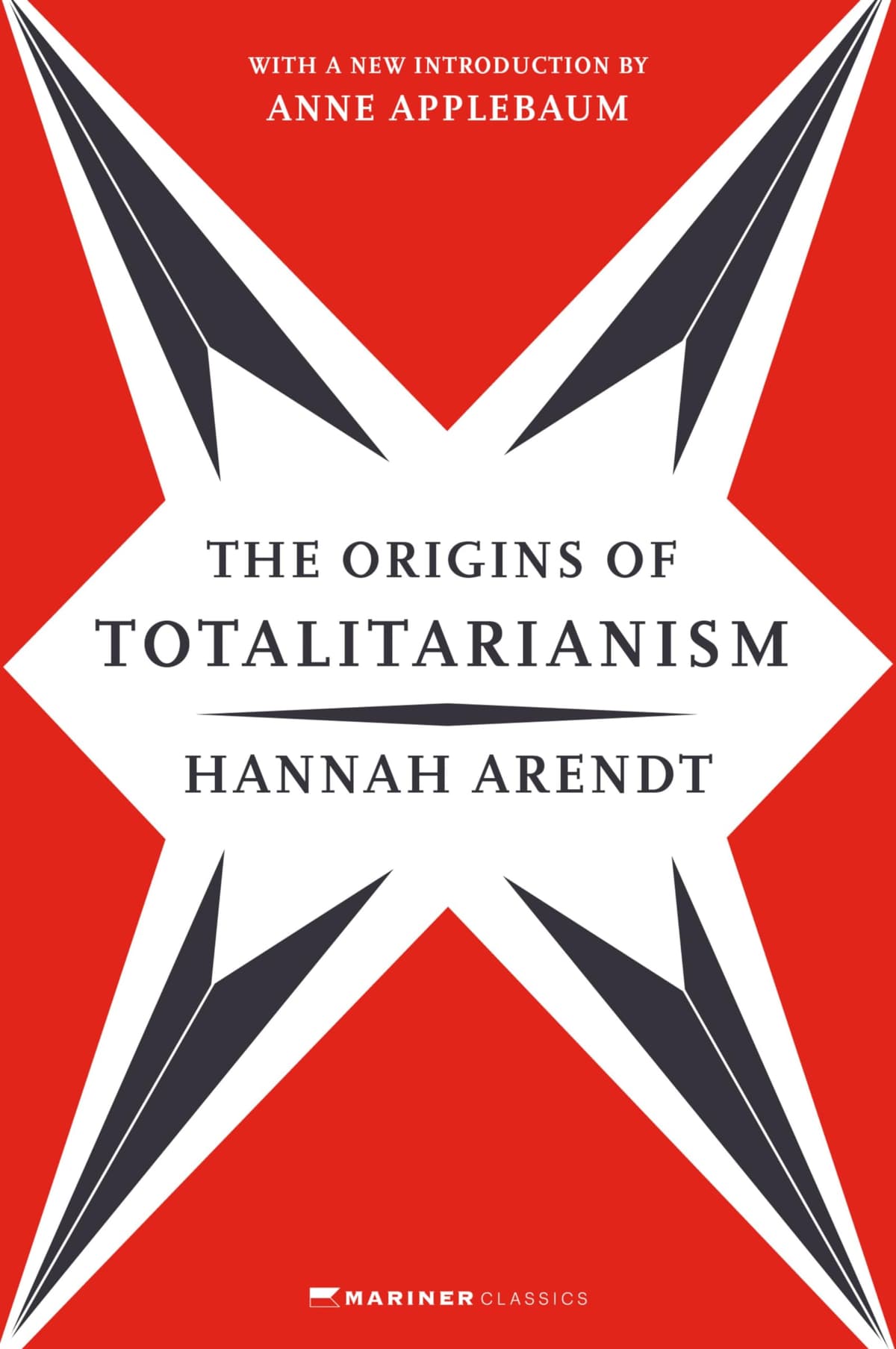
The Origins of Totalitarianism
“The ideal subject of totalitarian rule is not the convinced Nazi or the convinced Communist, but people for whom the distinction between fact and fiction and the distinction between true and false no longer exist.”
The Origins of Totalitarianism Summary
The Origins of Totalitarianism traces the emergence of the twin horrors of Nazism and Stalinism not as aberrations of history but as products of specific political, social, and intellectual conditions that had been building across Europe for over a century. Arendt begins with the roots of antisemitism, examining how the decline of the nation-state and the rise of pan-national movements transformed the Jewish question from a social prejudice into a political weapon. She then analyzes imperialism, arguing that the European colonial project, with its racism, its bureaucratic domination, and its reduction of entire populations to superfluous beings, created the administrative and ideological templates that totalitarian regimes would later apply to their own citizens. The final section confronts totalitarianism itself: its reliance on terror and ideology, its destruction of the private sphere, its manufacture of loneliness as a political condition, and its ultimate aim of rendering human beings predictable and disposable. Arendt's analysis of the concentration camps as laboratories for the transformation of human nature remains among the most searing passages in twentieth-century political thought.
Published in 1951, The Origins of Totalitarianism established Arendt as one of the great political thinkers of the modern age. The book resists easy categorization: it is at once a work of history, political theory, philosophy, and moral reckoning, written in prose that combines scholarly rigor with an urgency born of lived experience. Arendt's central insight, that totalitarianism represents something genuinely new in political history rather than merely an extreme form of tyranny, transformed how we understand modern political evil. Her analysis of how loneliness, rootlessness, and the collapse of traditional authority create the conditions for total domination has only grown more relevant in an age of mass displacement and digital isolation.
Why Read The Origins of Totalitarianism?
The Origins of Totalitarianism is one of those books that becomes more urgent with each passing year. Arendt wrote it in the aftermath of the Holocaust and the full revelation of Stalinist terror, but her analysis of how democracies collapse, how propaganda replaces truth, and how entire populations can be rendered politically superfluous reads today less as history than as warning. Her account of how loneliness and rootlessness create the preconditions for authoritarian movements speaks directly to our current moment, and her insistence that totalitarianism was not an inevitable product of modernity but a specific political catastrophe that must be understood if it is to be prevented gives the work its moral force.
This is not an easy book, but it is an essential one. Arendt writes with a combination of philosophical depth and passionate clarity that makes even her most complex arguments accessible to attentive readers. She does not merely describe totalitarianism; she excavates its roots in the very structures of modern society, revealing connections between colonialism, racism, statelessness, and political terror that remain indispensable for understanding the world we inhabit. If you want to understand how civilizations fail and what is at stake when they do, there is no more important book to read.
About Hannah Arendt
Hannah Arendt was born in Hannover, Germany, in 1906 and grew up in Konigsberg, the city of Kant. She studied philosophy with Martin Heidegger and Karl Jaspers, completing her doctorate on the concept of love in Saint Augustine. As a Jew in Nazi Germany, she was briefly arrested by the Gestapo in 1933, fled to Paris, and spent eight years as a stateless refugee before escaping to New York in 1941 via Lisbon. These experiences of persecution, exile, and statelessness profoundly shaped her political thinking.
Arendt became one of the most original and controversial political thinkers of the twentieth century. The Origins of Totalitarianism, published in 1951, established her reputation, and she followed it with The Human Condition, a philosophical exploration of labor, work, and action, and Eichmann in Jerusalem, whose concept of the banality of evil ignited fierce debate that continues to this day. She taught at the University of Chicago, Columbia, and the New School for Social Research, and her essays and lectures on revolution, violence, truth, and lying in politics remain essential reading. Arendt died in New York in 1975, leaving an unfinished work on judgment. Her insistence on thinking without banisters, on confronting political reality without the comfort of ideology, makes her one of the indispensable voices of the modern world.
Reading Guide
Ranked #421 among the greatest books of all time, The Origins of Totalitarianism by Hannah Arendt has earned its place in the literary canon. Originally written in English and published in 1951, this challenging read from Germany continues to resonate with readers today.
This book belongs to our Philosophy & Faith collection, where you can discover more books that share its spirit and themes.
If you enjoy challenging reads like this one, you might also like Ulysses, Moby-Dick, or Lolita.
From the Philosophy & Faith Collection
If you enjoyed The Origins of Totalitarianism, discover more masterpieces that share its spirit.
 #11View Book
Crime and Punishment
Fyodor Dostoevsky
High•20-25 hours #18View Book
The Bible
Various
Variable•60-80 hours #19View Book
The Brothers Karamazov
Fyodor Dostoevsky
Very High•35-40 hours #21View Book
The Stranger
Albert Camus
Moderate•3-4 hours
Browse more collections