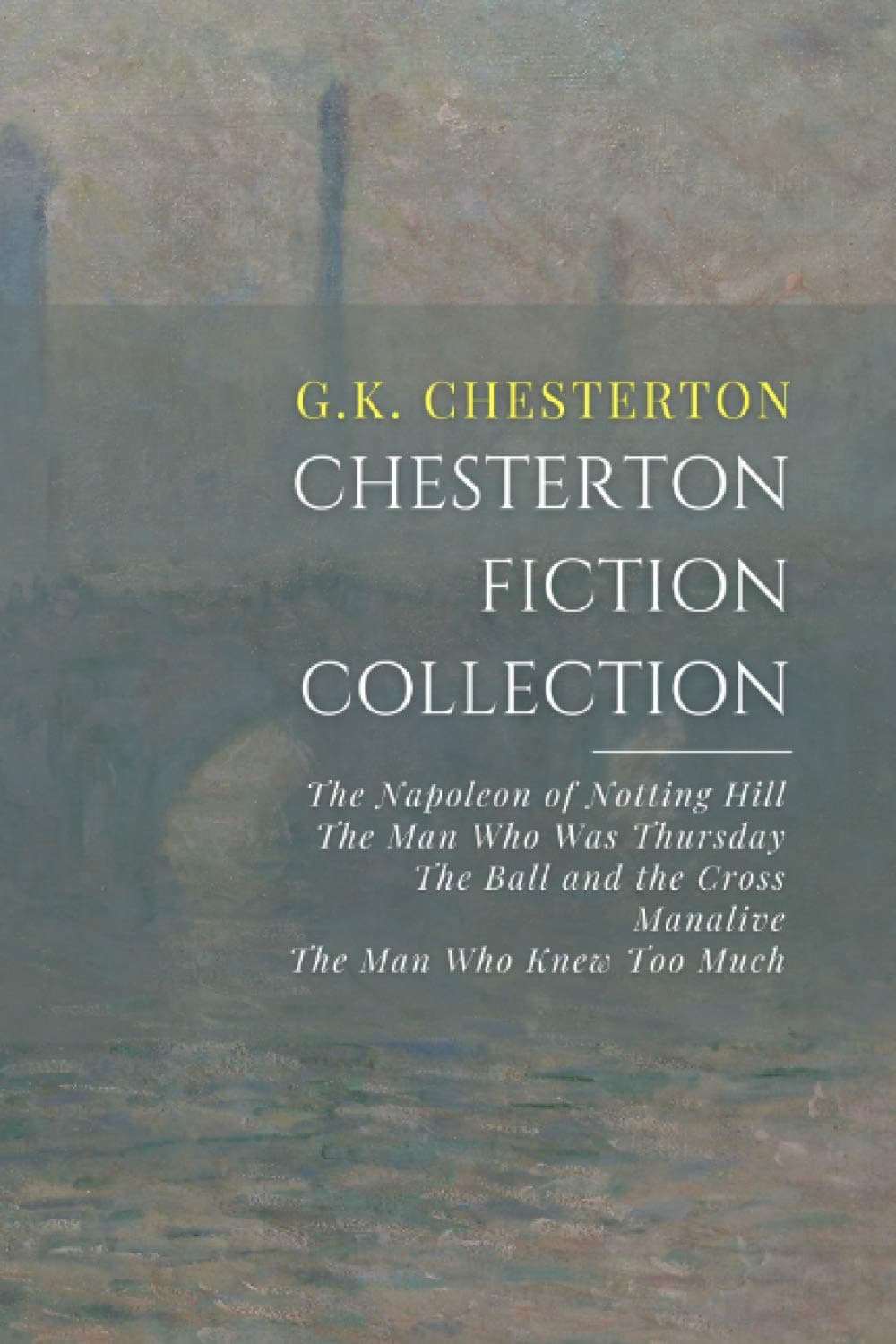
The Man Who Was Thursday
“Shall I tell you the secret of the whole world? It is that we have only known the back of the world. We see everything from behind, and it looks brutal. That is not a tree, but the back of a tree. That is not a cloud, but the back of a cloud. Cannot you see that everything is stooping and hiding a face? If we could only get round in front—”
The Man Who Was Thursday Summary
The Man Who Was Thursday opens in the dim, reddened streets of Saffron Park, a London suburb where the poet Gabriel Syme is recruited by a Scotland Yard detective to infiltrate the Central Anarchist Council, a shadowy organization whose seven members each bear the name of a day of the week. Syme manages to get himself elected as Thursday, only to discover that the council's plans are more terrifying than he imagined, particularly those of its president, the enormous, inscrutable Sunday, who seems less a man than a force of nature. What follows is a breakneck chase across Europe, from the streets of London to the snowy cliffs of a French coast, as Syme discovers that the council is not what it appears to be, and that the nature of the conspiracy is far stranger than any political plot. The novel accelerates into a surreal, almost hallucinatory finale in which masks are stripped away, identities dissolve, and the pursuit of anarchists becomes a pursuit of something closer to the meaning of existence itself. The final revelation is at once absurd, terrifying, and mysteriously beautiful, leaving readers arguing about its significance for over a century.
Subtitled "A Nightmare," Chesterton's metaphysical thriller is a work that defies genre classification. It is simultaneously a detective story, a political satire, a theological allegory, and a philosophical adventure, all propelled by some of the most exuberant prose in the English language. Chesterton's wit is omnipresent, his paradoxes detonate on every page, and beneath the comedy runs a profound meditation on the nature of evil, the problem of suffering, and the possibility that the universe, for all its apparent chaos, is governed by a benevolent if incomprehensible intelligence. The Man Who Was Thursday is one of those rare books that grows richer and stranger with each rereading, its mysteries deepening rather than resolving.
Why Read The Man Who Was Thursday?
The Man Who Was Thursday is the most thrilling philosophical argument you will ever read. Chesterton disguises one of the most profound meditations on good, evil, and the nature of God as a rip-roaring spy adventure, and the combination is irresistible. The novel moves at the speed of a chase scene, from foggy London streets to snowbound clifftops, while simultaneously asking questions about reality, identity, and the meaning of suffering that most novels would not dare to raise in a footnote. You will read it for the plot and find yourself ambushed by ideas that lodge in your mind for years.
What makes the novel unforgettable is Chesterton's voice: exuberant, paradoxical, and blazing with a joy that feels earned rather than naive. His prose has a physical energy that makes you feel the wind on the clifftop and the terror of an unmasked face, while his arguments about the nature of existence are delivered with the timing of a master comedian. The final chapter is one of the most debated endings in English literature, a scene that has been read as Christian allegory, absurdist comedy, and mystical vision, and that somehow manages to be all three at once. This is a book for anyone who believes that thinking should be an adventure.
About G. K. Chesterton
Gilbert Keith Chesterton was born in London in 1874 and grew up in Kensington, where his prodigious literary gifts manifested early. He studied art at the Slade School and literature at University College London, though he took no degree, and began his career as a journalist, quickly becoming one of the most prolific and recognizable writers in England. His output was staggering: he produced novels, short stories, poetry, plays, philosophy, theology, literary criticism, and an estimated four thousand newspaper essays, all in a career that spanned four decades.
Chesterton is best known for the Father Brown detective stories, the novels The Man Who Was Thursday and The Napoleon of Notting Hill, and works of Christian apologetics including Orthodoxy and The Everlasting Man, the latter of which C. S. Lewis credited with his conversion to Christianity. His paradoxical wit, his generosity of spirit, and his physical enormousness made him one of the most beloved literary figures of his age, and his public debates with George Bernard Shaw and H. G. Wells became legendary. He converted to Roman Catholicism in 1922 and died in Beaconsfield in 1936. His influence extends from Lewis and Tolkien to Neil Gaiman and Jorge Luis Borges, who called him one of the greatest writers of the twentieth century.
Reading Guide
Ranked #425 among the greatest books of all time, The Man Who Was Thursday by G. K. Chesterton has earned its place in the literary canon. Originally written in English and published in 1908, this moderate read from United Kingdom continues to resonate with readers today.
This book belongs to our Philosophy & Faith and Gothic & Dark collections, where you can discover more books that share its spirit and themes.
If you enjoy moderate reads like this one, you might also like One Hundred Years of Solitude, Nineteen Eighty-Four, or Wuthering Heights.
From the Philosophy & Faith Collection
If you enjoyed The Man Who Was Thursday, discover more masterpieces that share its spirit.
 #11View Book
Crime and Punishment
Fyodor Dostoevsky
High•20-25 hours #18View Book
The Bible
Various
Variable•60-80 hours #19View Book
The Brothers Karamazov
Fyodor Dostoevsky
Very High•35-40 hours #21View Book
The Stranger
Albert Camus
Moderate•3-4 hours
Browse more collections