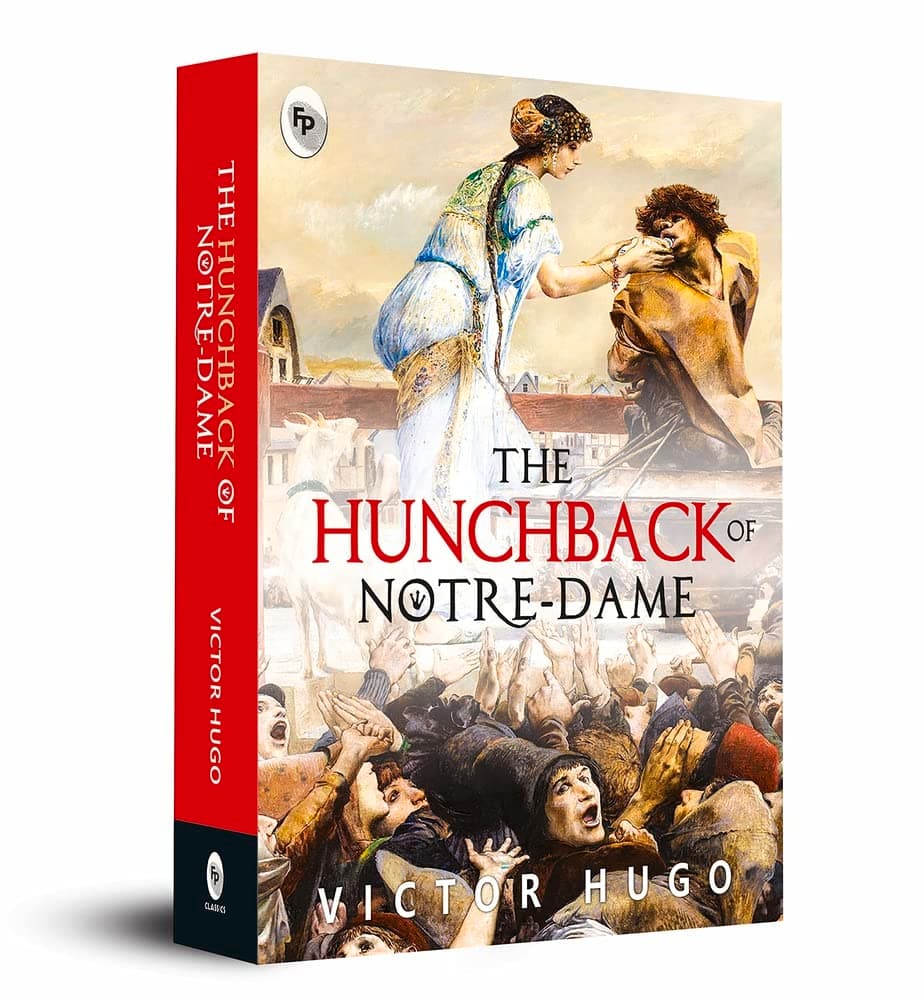
The Hunchback of Notre-Dame
“He therefore turned to mankind only with regret. His cathedral was enough for him. It was peopled with marble figures of kings, saints and bishops who at least did not laugh in his face.”
The Hunchback of Notre-Dame Summary
Medieval Paris rises from the pages of Hugo's novel like a living creature, its Gothic cathedral of Notre-Dame at its heart, a stone forest of gargoyles, flying buttresses, and bell towers that shelters the most wretched and the most sublime of human lives. Quasimodo, the deaf, half-blind hunchback who rings the cathedral's bells, has known no world beyond its walls and no love beyond his devotion to his master, the Archdeacon Claude Frollo, a brilliant scholar consumed by lust and theological torment. When the beautiful Romani dancer Esmeralda appears in the square before the cathedral, she sets in motion a catastrophe that draws together Frollo's obsessive desire, Quasimodo's awakening tenderness, the shallow chivalry of the soldier Phoebus, and the scheming of the Court of Miracles, the underground kingdom of Paris's beggars and thieves. The novel surges toward a climax of siege, betrayal, and sacrifice played out on the towers and parapets of the great cathedral itself.
Victor Hugo's early masterpiece is far more than the story Disney made famous. It is a vast, digressive, passionately argued novel about the relationship between architecture, civilization, and the written word. Hugo devotes entire chapters to the history and meaning of Gothic architecture, arguing that the cathedral was the book of the medieval world, a text written in stone that the invention of printing would render obsolete. The novel's emotional power derives from its vision of a society stratified by cruelty, in which the most physically grotesque figure possesses the purest heart, and the most learned man is the most morally deformed. Hugo writes with a Romantic intensity that can be overwhelming, but his set pieces, the Festival of Fools, Quasimodo's defense of the cathedral, Esmeralda's execution, achieve a grandeur that few novelists have ever matched.
Why Read The Hunchback of Notre-Dame?
The Hunchback of Notre-Dame is one of the great experiences in all of fiction: a novel so vast in scope and so intense in emotion that it makes you feel as though you are standing on the towers of the cathedral itself, looking out over the rooftops of a city teeming with life, cruelty, and beauty. Hugo writes with a visionary power that transforms stone into symbol and makes a building the central character of his story. You will never look at a Gothic cathedral the same way again. Quasimodo's devotion, Frollo's torment, Esmeralda's innocence: these are characters who have entered the collective imagination because Hugo endowed them with a mythic force that transcends their historical setting.
But this is not merely a melodrama of beauty and the beast. Hugo uses his medieval setting to mount a devastating critique of religious hypocrisy, judicial cruelty, and the destruction of beauty by power. The novel's famous digressions on architecture are not obstacles but revelations, showing how civilizations encode their values in stone and how those values can be read by anyone willing to look up. If you want to understand why Notre-Dame matters, not just as a building but as an idea, this is the book that will show you. It demands patience for its scope, but it rewards that patience with scenes of such power that they burn themselves into memory.
About Victor Hugo
Victor Hugo was born in 1802 in Besancon, France, the son of a general in Napoleon's army. A prodigy who declared at fourteen that he would be Chateaubriand or nothing, Hugo published his first collection of poetry at twenty and rapidly became the leading figure of French Romanticism. His early career was marked by literary triumphs, political ambition, and personal tragedy, including the drowning death of his beloved daughter Leopoldine in 1843.
Hugo's opposition to Napoleon III's coup d'etat in 1851 forced him into nineteen years of exile on the Channel Islands, during which he produced his greatest works, including Les Miserables and the poetry collections Les Contemplations and La Legende des siecles. He returned to France in triumph after the fall of the Second Empire and became a living symbol of the Republic. Hugo's literary output is staggering in its range: poetry, novels, plays, essays, and political writings that shaped French culture for generations. The Hunchback of Notre-Dame, published when he was just twenty-nine, is credited with saving the cathedral from demolition and inspiring the Gothic Revival across Europe. Hugo died in 1885; two million people attended his funeral. He remains France's greatest literary figure and one of the towering presences in world literature.
Reading Guide
Ranked #411 among the greatest books of all time, The Hunchback of Notre-Dame by Victor Hugo has earned its place in the literary canon. Originally written in French and published in 1831, this challenging read from France continues to resonate with readers today.
This book belongs to our Gothic & Dark and Love & Loss collections, where you can discover more books that share its spirit and themes.
If you enjoy challenging reads like this one, you might also like Ulysses, Moby-Dick, or Lolita.
From the Gothic & Dark Collection
If you enjoyed The Hunchback of Notre-Dame, discover more masterpieces that share its spirit.
 #15View Book
Wuthering Heights
Emily Brontë
Moderate•10-12 hours #29View Book
Jane Eyre
Charlotte Brontë
Accessible•15-20 hours #41View Book
Frankenstein
Mary Shelley
Accessible•6-8 hours #44View Book
Absalom, Absalom!
William Faulkner
Very High•12-15 hours
Browse more collections