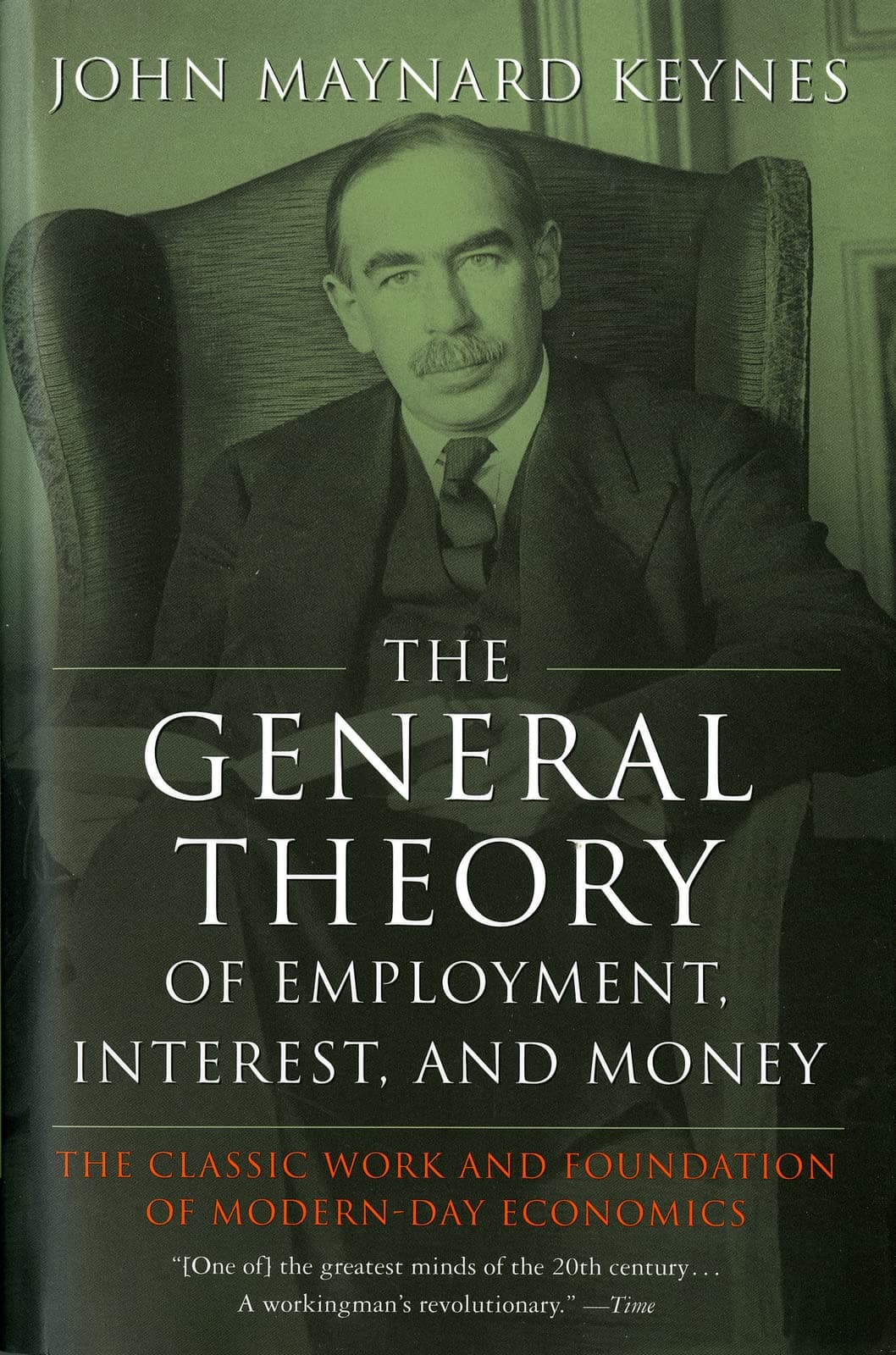
The General Theory of Employment, Interest and Money
“The difficulty lies not so much in developing new ideas as in escaping from old ones.”
The General Theory of Employment, Interest and Money Summary
The General Theory of Employment, Interest and Money presents John Maynard Keynes's revolutionary challenge to classical economics and its assumption that free markets naturally tend toward full employment. Writing during the Great Depression, Keynes argues that aggregate demand -- the total spending in an economy -- is the primary driver of economic activity and employment, and that insufficient demand can trap economies in prolonged periods of high unemployment and stagnation. He introduces concepts that would reshape economic thinking: the marginal propensity to consume, the multiplier effect, liquidity preference, and the paradox of thrift. The work systematically dismantles the classical view that wage and interest rate flexibility will automatically correct economic downturns, demonstrating instead that economies can reach equilibrium at levels well below full employment.
The significance of the General Theory can hardly be overstated: it is one of the most influential books of the twentieth century, fundamentally transforming both economic theory and government policy. Keynes's argument that governments should use fiscal policy -- spending and taxation -- to manage aggregate demand and stabilize economies became the foundation of macroeconomic policy in the postwar era. The book's influence extends far beyond economics into political philosophy, shaping debates about the proper role of government that continue to this day. While subsequent economists have challenged, refined, and extended Keynes's ideas, the core insight that market economies are susceptible to demand-driven downturns requiring active policy intervention remains central to modern macroeconomics. The General Theory is both a technical treatise and a profoundly political document, arguing that capitalism can be saved from its own instabilities through intelligent management.
Why Read The General Theory of Employment, Interest and Money?
Whether you realize it or not, the world you live in has been profoundly shaped by this book. Every time a government responds to a recession with stimulus spending, every debate about deficits and austerity, every central bank decision about interest rates traces back to the arguments Keynes makes in the General Theory. Reading it gives you access to the intellectual foundations of modern economic policy and equips you to evaluate the economic debates that dominate contemporary politics with genuine understanding rather than received opinion.
The book is undeniably demanding -- Keynes himself acknowledged its difficulty -- but the effort yields extraordinary rewards. Beyond the technical economics, Keynes writes with a literary flair rare among economists, and his insights into human psychology, particularly the role of uncertainty and "animal spirits" in driving investment decisions, remain strikingly relevant. The General Theory is not merely a historical document but a living argument about how economies work and how societies should respond when they malfunction. For anyone who wants to understand why governments behave as they do in economic crises, this is essential reading.
About John Maynard Keynes
John Maynard Keynes (1883-1946) was a British economist whose ideas fundamentally transformed economic theory and government policy in the twentieth century. Educated at Eton and King's College, Cambridge, where he studied under Alfred Marshall and Arthur Pigou, Keynes served in the British Treasury during World War I and represented Britain at the Versailles peace conference, where his prescient warnings about the dangers of punitive reparations were published in The Economic Consequences of the Peace. He became a leading public intellectual, writing prolifically on economics, probability, and public affairs while also serving as a successful investor, patron of the arts, and founder of the Arts Theatre in Cambridge.
Keynes's intellectual legacy is immense. The General Theory launched the Keynesian revolution in economics, establishing macroeconomics as a distinct field and providing the theoretical justification for government intervention in the economy. His ideas shaped the Bretton Woods international monetary system, the creation of the International Monetary Fund and World Bank, and the postwar economic policies that produced decades of unprecedented prosperity. Though monetarist and new classical economists challenged Keynesian orthodoxy from the 1970s onward, the 2008 financial crisis brought renewed attention to his insights. Keynes remains one of the most consequential thinkers of the modern era, a figure whose ideas continue to shape how governments around the world respond to economic crises.
Reading Guide
Ranked #309 among the greatest books of all time, The General Theory of Employment, Interest and Money by John Maynard Keynes has earned its place in the literary canon. Originally written in English and published in 1936, this very high read from United Kingdom continues to resonate with readers today.
This book belongs to our Philosophy & Faith and Society & Satire collections, where you can discover more books that share its spirit and themes.
If you enjoy very high reads like this one, you might also like The Sound and the Fury, War and Peace, or The Brothers Karamazov.
From the Philosophy & Faith Collection
If you enjoyed The General Theory of Employment, Interest and Money, discover more masterpieces that share its spirit.
 #11View Book
Crime and Punishment
Fyodor Dostoevsky
High•20-25 hours #18View Book
The Bible
Various
Variable•60-80 hours #19View Book
The Brothers Karamazov
Fyodor Dostoevsky
Very High•35-40 hours #21View Book
The Stranger
Albert Camus
Moderate•3-4 hours
Browse more collections