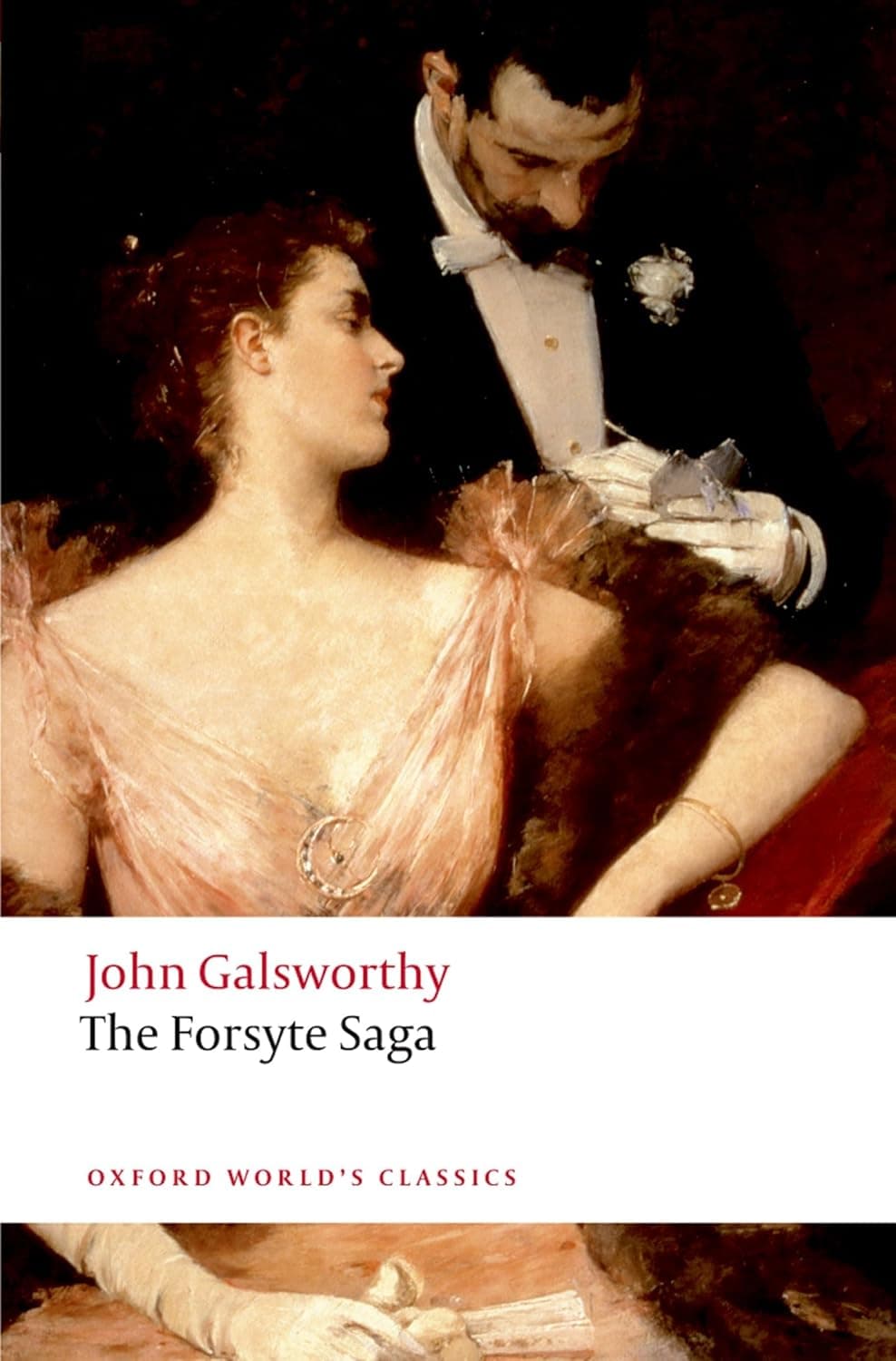
The Forsyte Saga
“A Forsyte took his stand on the things he could see; free, fearless, sane, looking before and after, he stood in the doorway of the future, and what he saw there displeased him.”
The Forsyte Saga Summary
The Forsyte family is the embodiment of Victorian England's propertied class—a sprawling clan of solicitors, tea merchants, and rentiers whose collective grip on money, land, and social position is as tenacious as it is instinctive. At the heart of the saga stands Soames Forsyte, "the man of property," a successful solicitor who regards his beautiful wife Irene as one more possession to be owned and controlled. When Irene falls in love with the architect Philip Bosinney—the man Soames has commissioned to build their country house—the resulting collision of passion and possessiveness sends shockwaves through the entire family, reverberating across decades and generations.
Galsworthy's trilogy—The Man of Property, In Chancery, and To Let—together with their connecting interludes, traces the Forsyte dynasty from the high noon of Victorian certainty through the upheavals of the Edwardian era and the First World War to the uncertain dawn of the 1920s. It is a monumental study of how the instinct to own and possess—property, people, beauty itself—warps human relationships and corrodes the soul. The prose moves with the measured authority of a legal brief, yet it achieves moments of piercing emotional clarity, particularly in the figure of Irene, whose silent resistance to Soames becomes the moral center of the entire work. The Forsyte Saga is both a panoramic social chronicle and an intimate examination of the damage inflicted when love is treated as a transaction.
Why Read The Forsyte Saga?
If you have ever wondered what it truly means to possess something—or someone—The Forsyte Saga will hold up a mirror to that impulse and show you its full, devastating cost. Galsworthy's portrait of the Forsyte family is one of the great achievements of English realism: a panoramic canvas populated by dozens of meticulously drawn characters, each embodying a different facet of the acquisitive instinct that defines their class. It is a novel you can live inside for weeks, watching history unfold through the eyes of people who believe they are above it.
The saga endures because its central conflict—between the desire to possess and the need to be free—is as relevant now as it was in the drawing rooms of Victorian London. Soames Forsyte, the man who cannot understand why owning something beautiful is not the same as loving it, is one of literature's great tragic figures. Galsworthy won the Nobel Prize in Literature in 1932, and this is the work that earned it. If you love Downton Abbey, this is the deeper, darker, more psychologically complex original.
About John Galsworthy
John Galsworthy (1867–1933) was born into the very class of wealthy, propertied Englishmen he would spend his literary career anatomizing. Educated at Harrow and Oxford, he trained as a barrister but never practiced, turning instead to writing after a transformative friendship with Joseph Conrad, whom he met on a sailing voyage. His early works were published under the pseudonym John Sinjohn, but it was The Man of Property in 1906 that established his reputation and introduced the Forsyte family to the world.
Galsworthy continued the Forsyte chronicles across six novels and several connecting interludes, producing one of the most ambitious family sagas in English literature. He was equally celebrated as a playwright, with works like Strife and Justice championing social reform. A committed humanitarian, he supported causes ranging from prison reform to women's suffrage and animal welfare. He was awarded the Nobel Prize in Literature in 1932, just a year before his death, in recognition of his distinguished art of narration and his penetrating analysis of the English upper-middle class.
Reading Guide
Ranked #231 among the greatest books of all time, The Forsyte Saga by John Galsworthy has earned its place in the literary canon. Originally written in English and published in 1906–1921, this challenging read from United Kingdom continues to resonate with readers today.
This book belongs to our Society & Satire and Epics collections, where you can discover more books that share its spirit and themes.
If you enjoy challenging reads like this one, you might also like Ulysses, Moby-Dick, or Lolita.
From the Society & Satire Collection
If you enjoyed The Forsyte Saga, discover more masterpieces that share its spirit.
 #9View Book
Don Quixote
Miguel de Cervantes
High•35-40 hours #12View Book
Pride and Prejudice
Jane Austen
Accessible•10-12 hours #22View Book
Madame Bovary
Gustave Flaubert
Moderate•12-15 hours #30View Book
Middlemarch
George Eliot
High•30-35 hours
Browse more collections