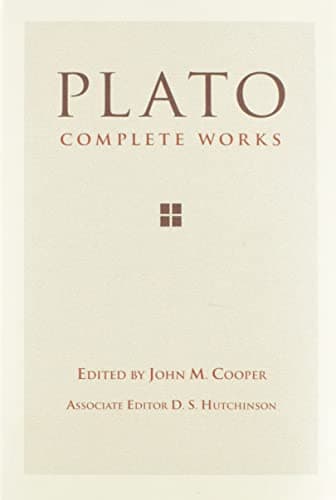
The Complete Works of Plato
“The unexamined life is not worth living.”
The Complete Works of Plato Summary
The Complete Works of Plato encompasses the entire surviving output of the thinker who, more than any other individual, shaped the intellectual foundations of Western civilization. At their heart are the dialogues—dramatic philosophical conversations in which Socrates, Plato's teacher and protagonist, engages friends, rivals, sophists, and students in relentless inquiry into the nature of justice, beauty, truth, love, knowledge, and the good life. The early dialogues—Euthyphro, Apology, Crito, Meno—capture the living Socrates: ironic, relentless, professing ignorance while demolishing the certainties of his interlocutors. The middle dialogues—Republic, Phaedrus, Symposium, Phaedo—develop Plato's own grand metaphysical vision: the Theory of Forms, the immortality of the soul, the philosopher-king, and the Allegory of the Cave, that unforgettable image of humanity imprisoned in shadows and struggling toward the light. The late dialogues—Theaetetus, Parmenides, Sophist, Timaeus, Laws—show a thinker ruthlessly interrogating his own earlier ideas, grappling with problems of knowledge, being, and political governance with ever-greater technical sophistication.
What makes Plato endlessly readable, unlike most philosophers, is his genius as a literary artist. The dialogues are populated by vivid, individualized characters; they are set in specific Athenian locations at particular moments; they contain myths, allegories, jokes, and moments of genuine dramatic tension. The Symposium is a masterpiece of comic and erotic storytelling; the Apology is one of the most moving courtroom speeches ever recorded; the Republic is simultaneously a work of political theory, epistemology, psychology, and utopian imagination. To read Plato is not merely to encounter a set of ideas but to witness the birth of philosophy itself—the moment when the Western mind first turned its full power upon the questions that still define us.
Why Read The Complete Works of Plato?
To read Plato is to encounter the origin of nearly every major question in Western thought—justice, beauty, truth, love, the nature of reality, the meaning of a good life—in their freshest, most vivid, and most provocative form. These are not dusty academic treatises but living conversations, crackling with wit, irony, and dramatic tension. Socrates is one of the great characters in all of literature: maddening, inspiring, funny, and ultimately tragic, a man who preferred death to the unexamined life. Whether he is cross-examining a general about courage, a priest about piety, or a roomful of drunken revelers about love, the experience of reading these dialogues is electric—you feel the ideas being born in real time.
The scope of Plato's achievement is staggering. The Republic alone contains enough ideas to occupy a lifetime of thought, from the nature of justice to the psychology of desire to the role of art in society. The Symposium is the most beautiful meditation on love ever written. The Allegory of the Cave is the most powerful metaphor for intellectual awakening in all of philosophy. And these are just three dialogues among dozens. You do not need to read them all at once—each dialogue is a self-contained world—but to begin reading Plato is to begin a conversation with the deepest and most searching mind of antiquity, one that has never stopped being relevant.
About Plato
Plato was born around 428 BCE into one of Athens' most distinguished aristocratic families. As a young man, he became a devoted follower of Socrates, whose trial and execution in 399 BCE profoundly shaped his philosophical mission. After Socrates' death, Plato traveled through Greece, Egypt, and southern Italy, where he encountered Pythagorean philosophy. Around 387 BCE, he founded the Academy in Athens—the first institution of higher learning in the Western world—which would endure for nearly nine centuries. He made three fateful trips to Syracuse in an attempt to put his political philosophy into practice with the tyrant Dionysius, all of which ended in failure and, on one occasion, near enslavement.
Plato's influence on Western thought is so pervasive that Alfred North Whitehead famously described all of European philosophy as a series of footnotes to his work. His dialogues established the foundations of metaphysics, epistemology, ethics, political theory, aesthetics, and the philosophy of mind. Beyond philosophy, his literary artistry—the dramatic settings, the individualized characters, the myths and allegories—has influenced writers from Cicero to Iris Murdoch. He died around 348 BCE, reportedly at a wedding feast, leaving behind a body of work that has been continuously read, debated, translated, and reimagined for nearly two and a half millennia. No other single author has had a comparable impact on the intellectual history of civilization.
Reading Guide
Ranked #371 among the greatest books of all time, The Complete Works of Plato by Plato has earned its place in the literary canon. Originally written in Ancient Greek and published in -387, this challenging read from Greece continues to resonate with readers today.
This book belongs to our Philosophy & Faith collection, where you can discover more books that share its spirit and themes.
If you enjoy challenging reads like this one, you might also like Ulysses, Moby-Dick, or Lolita.
From the Philosophy & Faith Collection
If you enjoyed The Complete Works of Plato, discover more masterpieces that share its spirit.
 #11View Book
Crime and Punishment
Fyodor Dostoevsky
High•20-25 hours #18View Book
The Bible
Various
Variable•60-80 hours #19View Book
The Brothers Karamazov
Fyodor Dostoevsky
Very High•35-40 hours #21View Book
The Stranger
Albert Camus
Moderate•3-4 hours
Browse more collections