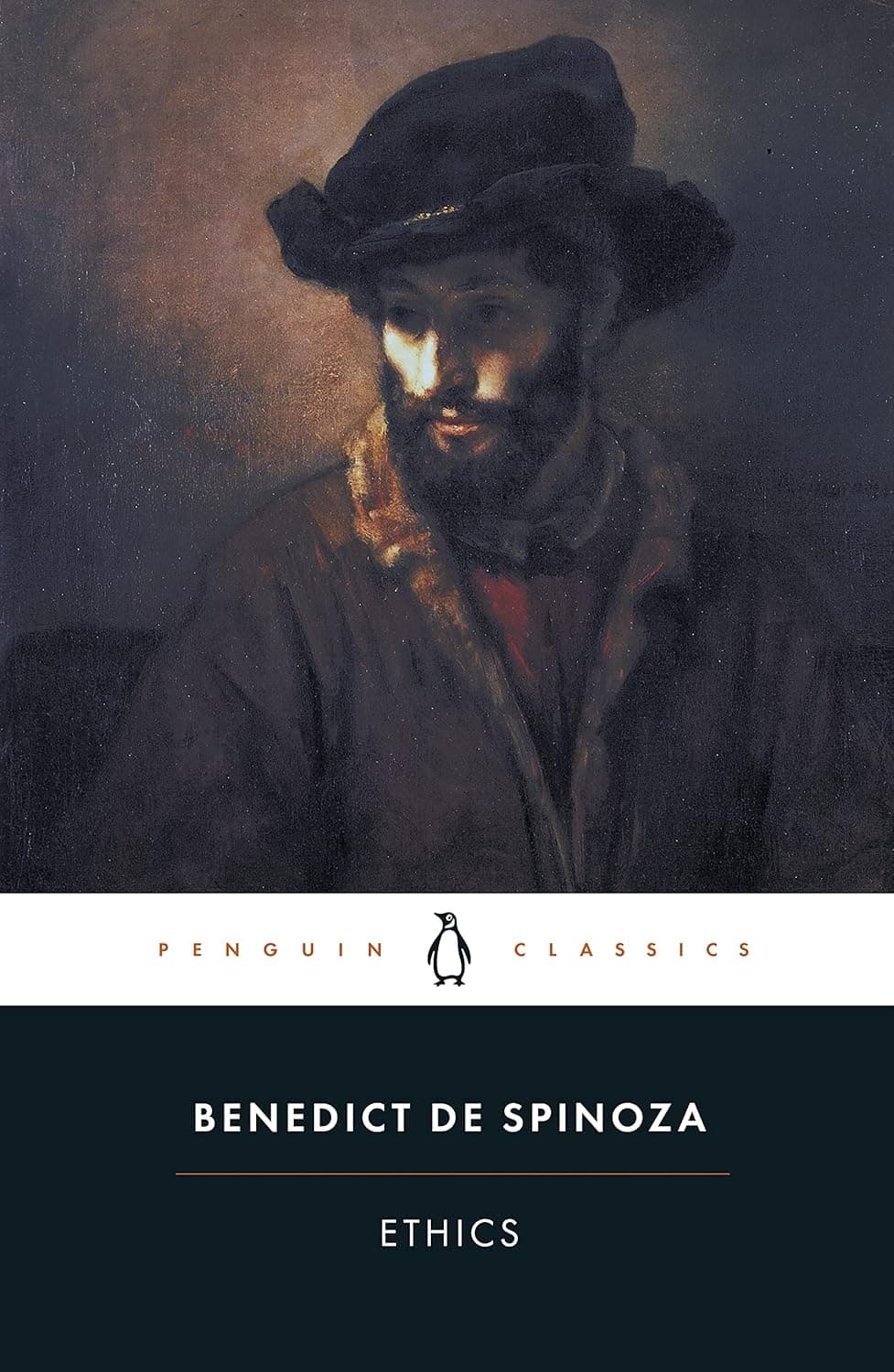
Ethics
“I have laboured carefully, not to mock, lament, or execrate, but to understand human actions.”
Ethics Summary
Spinoza's Ethics presents one of the most audacious intellectual structures ever conceived: a complete philosophical system encompassing God, nature, the human mind, the emotions, and the path to freedom, all demonstrated in the manner of Euclid's geometry—through definitions, axioms, propositions, and proofs. Beginning with the proposition that there is only one substance, which Spinoza identifies as God or Nature (Deus sive Natura), the work systematically dismantles the traditional separation between Creator and creation, arguing that everything that exists is a mode or expression of this single infinite substance. From this foundation, Spinoza builds an account of the human mind as inseparable from the body, of the emotions as natural phenomena that can be understood with the same rigor as lines and planes, and of human bondage to the passions as a form of inadequate understanding. The work culminates in a vision of human freedom achieved not through the suppression of desire but through the intellectual love of God—a rational understanding of our place within the infinite whole that transforms suffering into blessedness.
The Ethics is at once a work of breathtaking logical ambition and profound emotional power. Beneath its geometric surface lies a deeply human meditation on what it means to live well, to understand our own nature, and to find peace in a universe that operates according to necessity rather than providence. Spinoza's identification of God with Nature scandalized his contemporaries and led to his excommunication from the Jewish community of Amsterdam, yet his ideas have influenced thinkers from Goethe and Einstein to Deleuze and contemporary neuroscience. The Ethics remains one of the foundational texts of Western philosophy—a work that challenges every reader to think more clearly, feel more deeply, and live more freely.
Why Read Ethics?
The Ethics is one of those rare books that can genuinely change the way you see everything—not just philosophy, but your own mind, your emotions, and your relationship to the universe. Spinoza's vision is radical and strangely consoling: there is no transcendent God judging from above, no free will in the traditional sense, and no purpose to the universe beyond its own existence—yet from these seemingly bleak premises, he constructs an account of human flourishing that is among the most beautiful and intellectually satisfying ever written. To understand your emotions not as mysterious forces but as natural phenomena, to see yourself not as separate from nature but as an expression of it—this is the liberation Spinoza offers, and it has lost none of its power in three and a half centuries.
Admittedly, the geometric method can be daunting at first, with its numbered propositions and formal proofs. But persevere, and you will discover that the architecture is part of the beauty—each proposition building upon the last like the stones of a cathedral. The final sections on human bondage and human freedom contain passages of such concentrated wisdom that they read like secular scripture. Einstein said that his God was Spinoza's God. To read the Ethics is to understand why, and to encounter a mind of such extraordinary clarity and courage that it illuminates everything it touches.
About Baruch de Spinoza
Baruch (Benedict) de Spinoza was born in 1632 in Amsterdam to a family of Portuguese-Jewish merchants who had fled the Inquisition. He received a traditional Jewish education but was drawn increasingly to the new philosophy of Descartes and to heterodox biblical criticism. In 1656, at the age of twenty-three, he was excommunicated from the Jewish community with extraordinary severity—the cherem pronounced against him was one of the harshest in the community's history. He spent the rest of his life in quiet independence, earning a modest living as a lens grinder while devoting himself to philosophical work. He refused a professorship at Heidelberg to preserve his intellectual freedom.
Spinoza's major works—the Theologico-Political Treatise and the Ethics—were among the most controversial and influential texts of the early modern period. The Ethics, his masterpiece, was published posthumously in 1677, the year of his death from a lung disease at the age of forty-four, likely aggravated by years of inhaling glass dust from his lens grinding. For a century after his death, Spinoza was reviled as an atheist and his name was synonymous with intellectual danger. Yet the subsequent centuries have vindicated him spectacularly: Hegel called him the essential starting point for all philosophy, and his influence extends through German Idealism, Romanticism, and into contemporary philosophy of mind and affect theory. He remains one of the most radical and admired thinkers in the Western tradition.
Reading Guide
Ranked #370 among the greatest books of all time, Ethics by Baruch de Spinoza has earned its place in the literary canon. Originally written in Latin and published in 1677, this very high read from Netherlands continues to resonate with readers today.
This book belongs to our Philosophy & Faith collection, where you can discover more books that share its spirit and themes.
If you enjoy very high reads like this one, you might also like The Sound and the Fury, War and Peace, or The Brothers Karamazov.
From the Philosophy & Faith Collection
If you enjoyed Ethics, discover more masterpieces that share its spirit.
 #11View Book
Crime and Punishment
Fyodor Dostoevsky
High•20-25 hours #18View Book
The Bible
Various
Variable•60-80 hours #19View Book
The Brothers Karamazov
Fyodor Dostoevsky
Very High•35-40 hours #21View Book
The Stranger
Albert Camus
Moderate•3-4 hours
Browse more collections