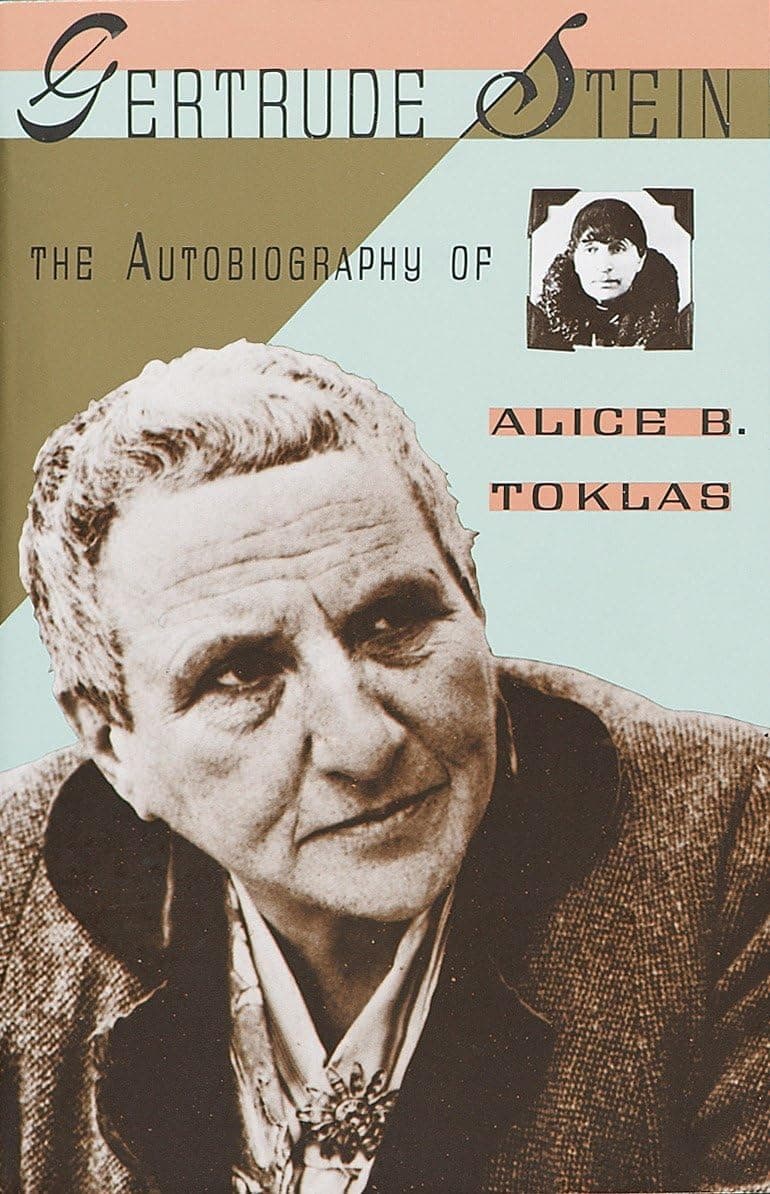
The Autobiography of Alice B. Toklas
“I am writing for myself and strangers. This is the only way that I can do it.”
The Autobiography of Alice B. Toklas Summary
Gertrude Stein's most accessible and commercially successful book is an act of literary ventriloquism: a memoir written in the voice of her lifelong companion Alice B. Toklas, describing the extraordinary world they inhabited together in Paris from 1907 onward. Through Alice's wry, seemingly guileless narration, we enter the legendary salon at 27 rue de Fleurus, where the walls are hung with paintings by Picasso, Matisse, Cezanne, and Renoir, and where the most important artists and writers of the twentieth century gathered to argue, drink, and transform the arts. Stein recounts the birth of Cubism, her friendships and rivalries with Picasso, Hemingway, Sherwood Anderson, and dozens of others, and the daily life of two American women who placed themselves at the center of the Parisian avant-garde. The narrative moves with a gossipy, anecdotal energy through the great events of modernism, including the Armory Show, the First World War (during which Stein and Toklas drove supplies for the French), and the emergence of the Lost Generation.
What makes the book extraordinary is its double vision: Stein uses Alice's voice to praise herself with a directness that would be insufferable in the first person but becomes comic and oddly charming in the third. The prose style, deceptively simple and repetitive, enacts Stein's radical theories about language and time even as it tells an apparently conventional story. The Autobiography is simultaneously a portrait of genius, a love letter to Paris, a catalog of modernism's greatest hits, and a sly demonstration that the line between autobiography and fiction, between self and other, is far more porous than we pretend. It remains the most entertaining doorway into the world of early twentieth-century modernism.
Why Read The Autobiography of Alice B. Toklas?
The Autobiography of Alice B. Toklas is the most delightful book ever written about genius. Stein's decision to narrate her own life through the voice of her companion transforms what could have been an exercise in self-congratulation into something witty, warm, and endlessly entertaining. You will meet Picasso as a young unknown hanging paintings on walls that would become the most famous art collection in private hands. You will watch Hemingway arrive in Paris with his manuscripts and his ambition. You will sit in a room where the entire course of modern art is being decided over cups of tea and fierce arguments about form.
But this is more than literary gossip, however irresistible that gossip may be. Stein's prose style, with its deliberate repetitions and refusal of conventional punctuation, quietly enacts the revolution in language that she spent her career pursuing. The book demonstrates that the most radical experiments can also be the most accessible, and that a great mind telling stories about other great minds is one of literature's purest pleasures. If you want to understand what it felt like to be alive at the moment when the twentieth century invented itself, this book will take you there with a grace and humor that no history can match.
About Gertrude Stein
Gertrude Stein was born in 1874 in Allegheny, Pennsylvania, and grew up in Oakland, California, and Vienna. She studied psychology under William James at Radcliffe College and attended Johns Hopkins Medical School before abandoning medicine to move to Paris in 1903 with her brother Leo. At 27 rue de Fleurus, she established the legendary salon where she collected modern art and held court over the most important artists and writers of the century, from Picasso and Matisse to Hemingway and Fitzgerald.
Stein's experimental writing, with its radical disruption of syntax, grammar, and narrative convention, made her one of the most influential and controversial figures of literary modernism. Her works include Three Lives, Tender Buttons, The Making of Americans, and the opera Four Saints in Three Acts with composer Virgil Thomson. The Autobiography of Alice B. Toklas, published in 1933, became her only bestseller and brought her international fame. Stein coined phrases that entered the language, including the famous declaration about Oakland and the phrase "Lost Generation." She remained in France during the German occupation, a decision that has prompted complex historical reassessment. She died in Paris in 1946. Her influence on American literature, from the Beats to Language poetry, is immeasurable, and her insistence that literature must continually reinvent its means of expression remains a challenge that writers are still answering.
Reading Guide
Ranked #413 among the greatest books of all time, The Autobiography of Alice B. Toklas by Gertrude Stein has earned its place in the literary canon. Originally written in English and published in 1933, this moderate read from United States continues to resonate with readers today.
This book belongs to our Modern Mind and Society & Satire collections, where you can discover more books that share its spirit and themes.
If you enjoy moderate reads like this one, you might also like One Hundred Years of Solitude, Nineteen Eighty-Four, or Wuthering Heights.
From the Modern Mind Collection
If you enjoyed The Autobiography of Alice B. Toklas, discover more masterpieces that share its spirit.
 #1View Book
Ulysses
James Joyce
Challenging•35-40 hours #2View Book
In Search of Lost Time
Marcel Proust
High•100+ hours #8View Book
The Sound and the Fury
William Faulkner
Very High•12-15 hours #13View Book
Lolita
Vladimir Nabokov
Challenging•12-15 hours
Browse more collections