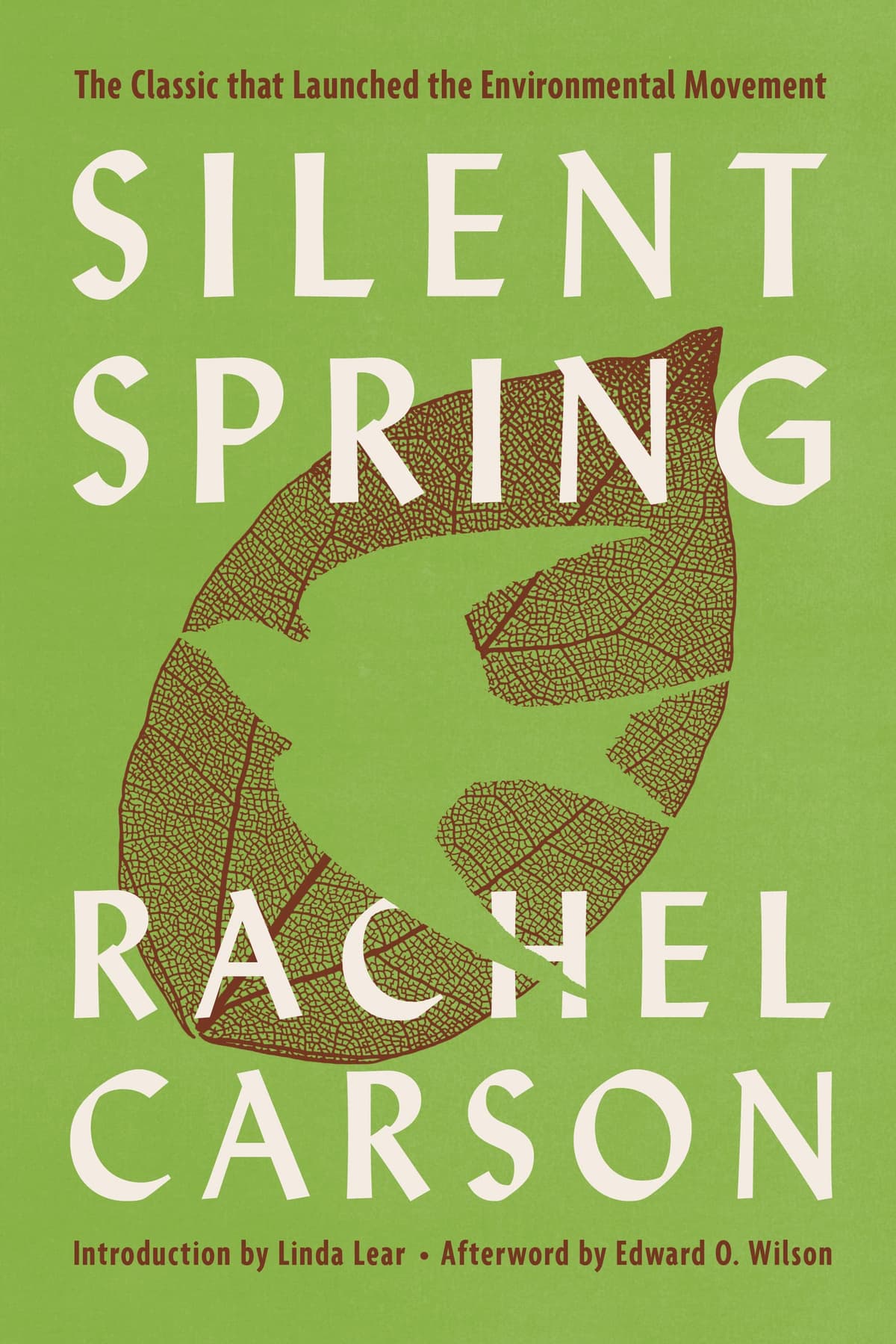
Silent Spring
“In nature nothing exists alone.”
Silent Spring Summary
In the spring of 1962, a marine biologist turned lyric prose stylist delivered a warning that changed the world. Rachel Carson's Silent Spring opens with a fable—a nameless American town where birds no longer sing, bees no longer hum, and a strange blight has silenced the natural world. From this haunting parable, Carson builds a meticulous, devastating case against the indiscriminate use of synthetic pesticides—particularly DDT—documenting how these chemical poisons cascade through soil, water, and the food chain, killing far more than their intended targets. She traces the path of toxins from crop-dusted fields into the tissues of fish, birds, and human beings, revealing a web of ecological destruction that the chemical industry had fought to keep hidden.
What makes Silent Spring extraordinary is not just its science but its artistry. Carson writes about ecosystems with the reverence of a poet and the precision of a researcher, making the reader feel the interconnectedness of all living things. The book sparked a firestorm—the chemical industry spent millions trying to discredit her—but it also ignited the modern environmental movement, leading directly to the creation of the Environmental Protection Agency and the banning of DDT. More than six decades later, its central argument—that humanity cannot wage war on nature without destroying itself—remains as urgent as the day it was published.
Why Read Silent Spring?
This is one of those rare books that bent the arc of history. Before Silent Spring, the word "environmentalism" barely existed; after it, the world could never again pretend that industrial progress came without cost. Carson's gift was her ability to translate complex science into prose of crystalline beauty—you do not need a biology degree to feel the horror of a poisoned landscape or the wonder of a healthy one. She makes you see the invisible threads that connect every living thing.
But Silent Spring is more than a historical document. Its argument—that we are part of nature, not its master—has only grown more relevant in an age of climate crisis and mass extinction. Carson teaches you to pay attention to the world outside your window, to understand that the fate of the smallest organism is bound up with your own. Reading it is an act of ecological awakening, a reminder that the silence she warned about is still creeping closer, and that the choice to act remains ours.
About Rachel Carson
Rachel Carson (1907–1964) was an American marine biologist and writer whose work bridged the worlds of science and literature. Born in Springdale, Pennsylvania, she studied at the Pennsylvania College for Women and Johns Hopkins University before joining the U.S. Fish and Wildlife Service, where she wrote government publications about marine life. Her earlier books—Under the Sea-Wind, The Sea Around Us, and The Edge of the Sea—established her as one of America's finest nature writers, with The Sea Around Us becoming a bestseller and winning the National Book Award.
Silent Spring, her final and most consequential work, was published while Carson was battling breast cancer—a fact she kept largely private to prevent the chemical industry from using her illness to discredit her research. She died less than two years after its publication, never seeing the full impact of her work. She is widely credited with inspiring the modern environmental movement and remains one of the most important public intellectuals of the twentieth century.
Reading Guide
Ranked #157 among the greatest books of all time, Silent Spring by Rachel Carson has earned its place in the literary canon. Originally written in English and published in 1962, this moderate read from United States continues to resonate with readers today.
This book belongs to our Philosophy & Faith and Society & Satire collections, where you can discover more books that share its spirit and themes.
If you enjoy moderate reads like this one, you might also like One Hundred Years of Solitude, Nineteen Eighty-Four, or Wuthering Heights.
From the Philosophy & Faith Collection
If you enjoyed Silent Spring, discover more masterpieces that share its spirit.
 #11View Book
Crime and Punishment
Fyodor Dostoevsky
High•20-25 hours #18View Book
The Bible
Various
Variable•60-80 hours #19View Book
The Brothers Karamazov
Fyodor Dostoevsky
Very High•35-40 hours #21View Book
The Stranger
Albert Camus
Moderate•3-4 hours
Browse more collections