Relativity
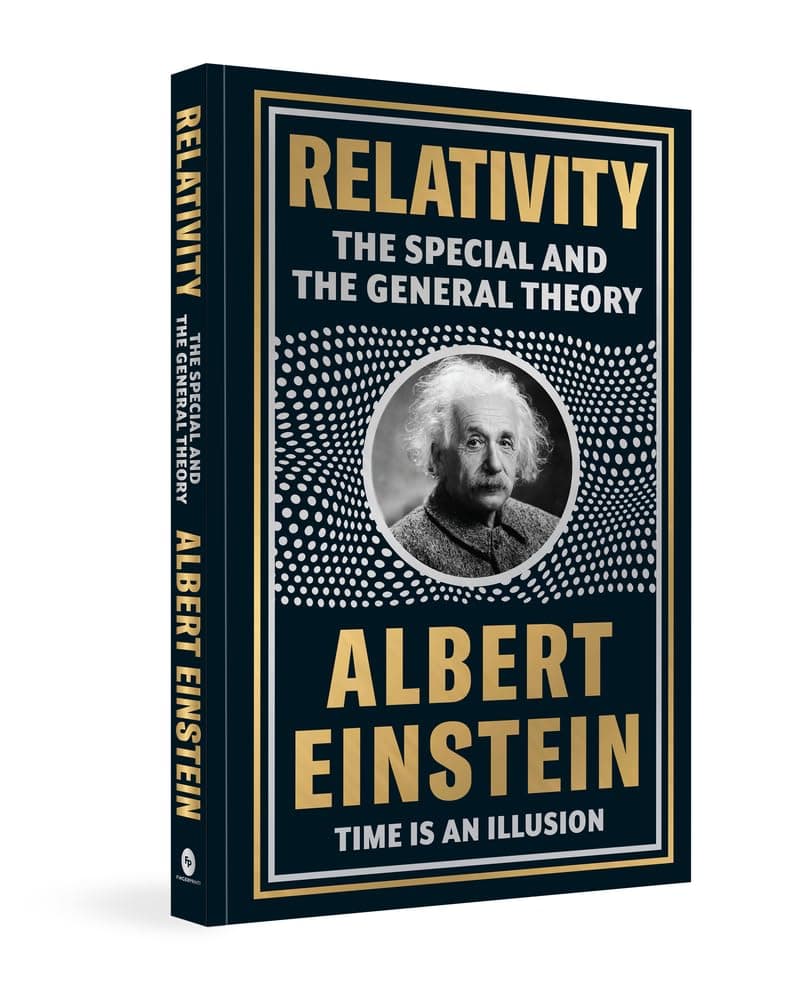
“The most incomprehensible thing about the world is that it is comprehensible.”
Relativity Summary
Relativity: The Special and the General Theory presents Albert Einstein's own account of his two revolutionary theories, written for a general audience without advanced mathematics. The book begins with special relativity, published in 1905, which establishes that the laws of physics are the same for all observers moving at constant speeds and that the speed of light is constant regardless of the observer's motion. From these two principles, Einstein derives startling consequences: time slows down for objects in motion, lengths contract, mass increases with velocity, and energy and mass are interchangeable according to the famous equation E=mc². The second part introduces general relativity, completed in 1915, which reimagines gravity not as a force but as the curvature of spacetime caused by mass and energy. Einstein explains how massive objects bend the fabric of the universe, causing light to curve and clocks to run differently depending on the strength of the gravitational field.
What makes this book remarkable is not just the ideas themselves—which fundamentally transformed our understanding of space, time, and the cosmos—but Einstein's gift for clear, patient exposition. He builds his arguments from simple thought experiments, such as imagining observers on moving trains, making concepts that revolutionized physics accessible to the attentive lay reader. The work demonstrates that the most profound scientific insights can be communicated without sacrificing rigor, and it reveals Einstein's philosophical depth alongside his scientific genius. Relativity laid the groundwork for modern cosmology, GPS technology, nuclear energy, and our understanding of black holes and the expanding universe. It remains one of the most important and accessible scientific texts ever written, a window into the mind of the twentieth century's greatest physicist.
Why Read Relativity?
Hearing the theory of relativity explained by Einstein himself is an experience no secondhand account can replicate. His prose is remarkably clear, his thought experiments are elegant, and his patience with the reader is extraordinary. Einstein does not talk down to his audience; he invites you to think alongside him, building each revolutionary insight from principles simple enough for anyone to grasp. The result is not just an understanding of relativity but an encounter with a singular mind—one that combined extraordinary imagination with rigorous logic to overturn centuries of assumptions about the nature of reality.
Beyond its scientific content, this book offers something increasingly rare: the experience of having your picture of the universe fundamentally altered. Learning that time is not absolute, that space can curve, that mass and energy are two faces of the same coin—these are not mere facts but transformations of perception. Einstein's theory is one of the supreme achievements of human thought, and reading his own account of it is one of the most rewarding intellectual experiences available. The book is short, the mathematics minimal, and the rewards immense. There is no better way to understand why Einstein's name has become synonymous with genius.
About Albert Einstein
Albert Einstein was born in 1879 in Ulm, Germany, and grew up in Munich and northern Italy. After graduating from the Swiss Federal Polytechnic in Zurich, he worked as a patent clerk in Bern, where in 1905—his "miracle year"—he published four papers that revolutionized physics, including his theory of special relativity and the photoelectric effect. His general theory of relativity, completed in 1915, redefined gravity and became one of the two pillars of modern physics. He received the Nobel Prize in Physics in 1921 for his work on the photoelectric effect.
Einstein fled Nazi Germany in 1933 and settled at the Institute for Advanced Study in Princeton, New Jersey, where he spent the rest of his life. He became an American citizen in 1940 and used his fame to advocate for civil rights, pacifism, and Zionism. His letter to President Roosevelt warning of the potential for atomic weapons helped initiate the Manhattan Project, a consequence he later deeply regretted. Einstein died in 1955 in Princeton. Beyond his scientific contributions—which include the foundations of quantum theory, statistical mechanics, and cosmology—Einstein became the most recognized scientist in history and a cultural icon representing the power of human reason and imagination. His theories continue to be confirmed by experiment, from gravitational waves to black hole imaging, more than a century after their formulation.
Reading Guide
Ranked #304 among the greatest books of all time, Relativity by Albert Einstein has earned its place in the literary canon. Originally written in German and published in 1916, this challenging read from Germany continues to resonate with readers today.
This book belongs to our Philosophy & Faith collection, where you can discover more books that share its spirit and themes.
If you enjoy challenging reads like this one, you might also like Ulysses, Moby-Dick, or Lolita.
From the Philosophy & Faith Collection
If you enjoyed Relativity, discover more masterpieces that share its spirit.
 #11View Book
Crime and Punishment
Fyodor Dostoevsky
High•20-25 hours #18View Book
The Bible
Various
Variable•60-80 hours #19View Book
The Brothers Karamazov
Fyodor Dostoevsky
Very High•35-40 hours #21View Book
The Stranger
Albert Camus
Moderate•3-4 hours
Browse more collections