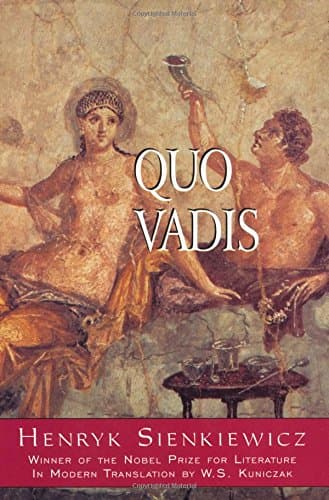
Quo Vadis
“No one can emerge from a crucible of suffering without being purified.”
Quo Vadis Summary
Quo Vadis immerses the reader in the sensory extravagance and moral chaos of Nero's Rome, following the love story of Marcus Vinicius, a young Roman patrician and military tribune, and Lygia, a beautiful hostage princess raised among the early Christians. Vinicius, a man of the sword accustomed to taking what he desires, is bewildered and infuriated by Lygia's refusal to yield to him, and his obsessive pursuit of her draws him into the hidden world of Rome's Christian community—the catacombs, the secret gatherings, the preaching of the apostles Peter and Paul. Around this central romance, Sienkiewicz conjures the full spectacle of imperial Rome at its most decadent: Nero's grotesque artistic pretensions, his burning of Rome, the orgies and cruelties of the court, and the horrifying persecution of Christians in the arena. Presiding over the narrative with sardonic magnificence is Petronius, Nero's arbiter of elegance, a cultured aesthete whose wit and worldliness stand in ironic counterpoint to the Christians' otherworldly faith.
Henryk Sienkiewicz's epic historical novel, which helped earn him the Nobel Prize in Literature, is a monumental achievement of narrative sweep and atmospheric power. The collision between pagan Rome's worship of beauty, power, and sensual pleasure and Christianity's radical message of love, forgiveness, and spiritual equality becomes a drama of civilizational transformation rendered in vivid, cinematic detail. The novel's title—"Where are you going?"—refers to the legend of Peter's encounter with Christ on the Appian Way, a moment that crystallizes the novel's central question about the direction of the human soul. Quo Vadis combines the grandeur of epic storytelling with genuine philosophical and spiritual depth, and its influence on the historical novel genre, as well as on Hollywood's biblical epics, has been immense.
Why Read Quo Vadis?
Quo Vadis is one of those novels that transports you so completely into another world that you emerge blinking, as if you have actually smelled the incense of Roman temples and heard the roar of the Colosseum crowd. Sienkiewicz was a master of spectacle and sensation, and his portrait of Nero's Rome—its beauty, its cruelty, its terrifying caprice—is rendered with a vividness that no film adaptation has ever fully captured. The characters are unforgettable: Petronius, the world-weary aesthete who faces death with perfect style; Ursus, the gentle giant whose strength becomes an instrument of faith; and Nero himself, a monster of vanity whose artistic delusions make him both absurd and terrifying.
But beyond the spectacle, Quo Vadis poses questions that remain urgently relevant: What happens when a civilization built on power encounters a movement built on love? How does the individual conscience survive under tyranny? The novel's exploration of these themes is neither preachy nor simplistic—Sienkiewicz gives full weight to the beauty and sophistication of pagan culture even as he dramatizes its spiritual bankruptcy. Reading Quo Vadis is an immersive, thrilling experience that will leave you with a deeper understanding of one of history's most consequential moments of transformation.
About Henryk Sienkiewicz
Henryk Sienkiewicz was born in 1846 in Wola Okrzejska, in the Russian-controlled portion of partitioned Poland. He studied at the University of Warsaw and began his career as a journalist and feuilletonist, gaining early recognition for his vivid travel writing from the American West, where he briefly attempted to establish a utopian Polish community in California. His Trilogy of historical novels—With Fire and Sword, The Deluge, and Pan Wolodyjowski—made him the most popular writer in Poland, celebrated for his stirring depictions of seventeenth-century Polish heroism.
Quo Vadis, published in 1895, brought Sienkiewicz international fame on an extraordinary scale—it was translated into over fifty languages and became one of the best-selling novels in the world. He was awarded the Nobel Prize in Literature in 1905 for his outstanding merits as an epic writer. Sienkiewicz used his fame and wealth to support Polish cultural and charitable causes throughout his life. He died in 1916 in Vevey, Switzerland, during World War I, having devoted his final years to relief efforts for war victims. His work remains central to Polish literary identity, and Quo Vadis continues to be read worldwide as one of the great historical novels, a book that shaped how generations of readers imagined ancient Rome.
Reading Guide
Ranked #368 among the greatest books of all time, Quo Vadis by Henryk Sienkiewicz has earned its place in the literary canon. Originally written in Polish and published in 1895, this moderate read from Poland continues to resonate with readers today.
This book belongs to our Epics and Philosophy & Faith collections, where you can discover more books that share its spirit and themes.
If you enjoy moderate reads like this one, you might also like One Hundred Years of Solitude, Nineteen Eighty-Four, or Wuthering Heights.
From the Epics Collection
If you enjoyed Quo Vadis, discover more masterpieces that share its spirit.
 #1View Book
Ulysses
James Joyce
Challenging•35-40 hours #5View Book
One Hundred Years of Solitude
Gabriel García Márquez
Moderate•15-20 hours #7View Book
Moby-Dick
Herman Melville
Challenging•20-25 hours #9View Book
Don Quixote
Miguel de Cervantes
High•35-40 hours
Browse more collections