Parallel Lives
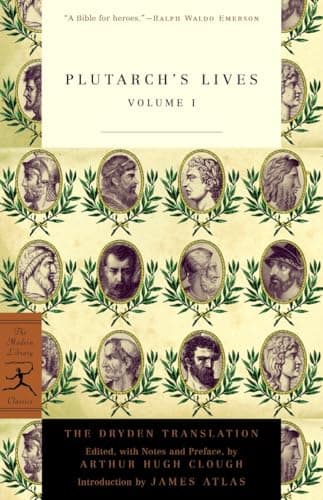
“The mind is not a vessel to be filled, but a fire to be kindled.”
Parallel Lives Summary
Parallel Lives presents paired biographies of famous Greeks and Romans, setting each figure from one civilization alongside a comparable figure from the other. Theseus is paired with Romulus, Alexander the Great with Julius Caesar, Demosthenes with Cicero, and so on through roughly twenty-three surviving pairs. For each subject, Plutarch traces the arc of a life from birth and education through the decisive actions of maturity to the circumstances of death, weaving together historical narrative, anecdote, and moral reflection. The biographies are rich with vivid scenes: Alexander taming Bucephalus, Caesar crossing the Rubicon, Alcibiades charming and scandalizing Athens, Coriolanus turning against his own city.
Plutarch's purpose is explicitly ethical rather than strictly historical. He selects and arranges his material to illuminate character, arguing that small actions and private habits often reveal more about a person than great battles or political achievements. The comparative structure invites readers to consider how similar virtues and vices manifest across different cultures and historical circumstances. Courage, ambition, temperance, pride, and the corrupting influence of power are examined through concrete examples rather than abstract philosophy. Parallel Lives became one of the most widely read books in the Western world for nearly two millennia, profoundly influencing Shakespeare, the founders of the American and French republics, and the entire tradition of biographical writing. It remains an inexhaustible treasury of stories about leadership, moral choice, and the complex relationship between personal character and public destiny.
Why Read Parallel Lives?
Reading Plutarch is like having a private audience with the greatest leaders of the ancient world, guided by a narrator whose warmth, intelligence, and moral seriousness make him the ideal companion. These biographies are not dry historical records but vivid, dramatically compelling portraits that bring Alexander, Caesar, Pericles, and dozens of other figures to life with an immediacy that transcends the centuries. The stories Plutarch tells are among the most famous in Western civilization, and encountering them in his own voice reveals depths that summaries cannot convey.
Beyond the pleasure of the narratives themselves, Parallel Lives offers a practical education in the relationship between character and destiny. Plutarch shows again and again how small moral choices accumulate into the shape of a life, how ambition unchecked by wisdom leads to ruin, and how virtue tested by adversity reveals its true quality. Shakespeare drew more heavily from Plutarch than from any other source outside Holinshed. If you want to understand the moral imagination that shaped Western political thought, or simply want to read some of the greatest stories ever told about power and the people who wield it, Parallel Lives is indispensable.
About Plutarch
Plutarch (c. 46-120 CE) was born in Chaeronea, a small town in Boeotia, Greece, and remained rooted there throughout his life despite extensive travels and connections to the wider Roman world. He studied philosophy at the Academy in Athens under Ammonius and later visited Rome, where he lectured and developed friendships among the Roman elite. He served as a priest at the Oracle of Delphi for the last thirty years of his life, and held various civic offices in his hometown, believing that even modest public service was a moral duty.
Plutarch was extraordinarily prolific, producing works on ethics, philosophy, natural science, and literature in addition to the Parallel Lives. His Moralia, a collection of over sixty essays and dialogues, covers subjects ranging from the education of children to the intelligence of animals to the nature of the divine. The Parallel Lives, however, became his enduring monument, exerting an incalculable influence on Western literature, political thought, and the biographical tradition. Montaigne called him the greatest writer of antiquity; Emerson named him one of the essential authors for any serious reader. His emphasis on character over chronicle, on the moral meaning of historical action, established a model of biography that persists to this day.
Reading Guide
Ranked #322 among the greatest books of all time, Parallel Lives by Plutarch has earned its place in the literary canon. Originally written in Greek and published in 100, this challenging read from Greece continues to resonate with readers today.
This book belongs to our Philosophy & Faith collection, where you can discover more books that share its spirit and themes.
If you enjoy challenging reads like this one, you might also like Ulysses, Moby-Dick, or Lolita.
From the Philosophy & Faith Collection
If you enjoyed Parallel Lives, discover more masterpieces that share its spirit.
 #11View Book
Crime and Punishment
Fyodor Dostoevsky
High•20-25 hours #18View Book
The Bible
Various
Variable•60-80 hours #19View Book
The Brothers Karamazov
Fyodor Dostoevsky
Very High•35-40 hours #21View Book
The Stranger
Albert Camus
Moderate•3-4 hours
Browse more collections