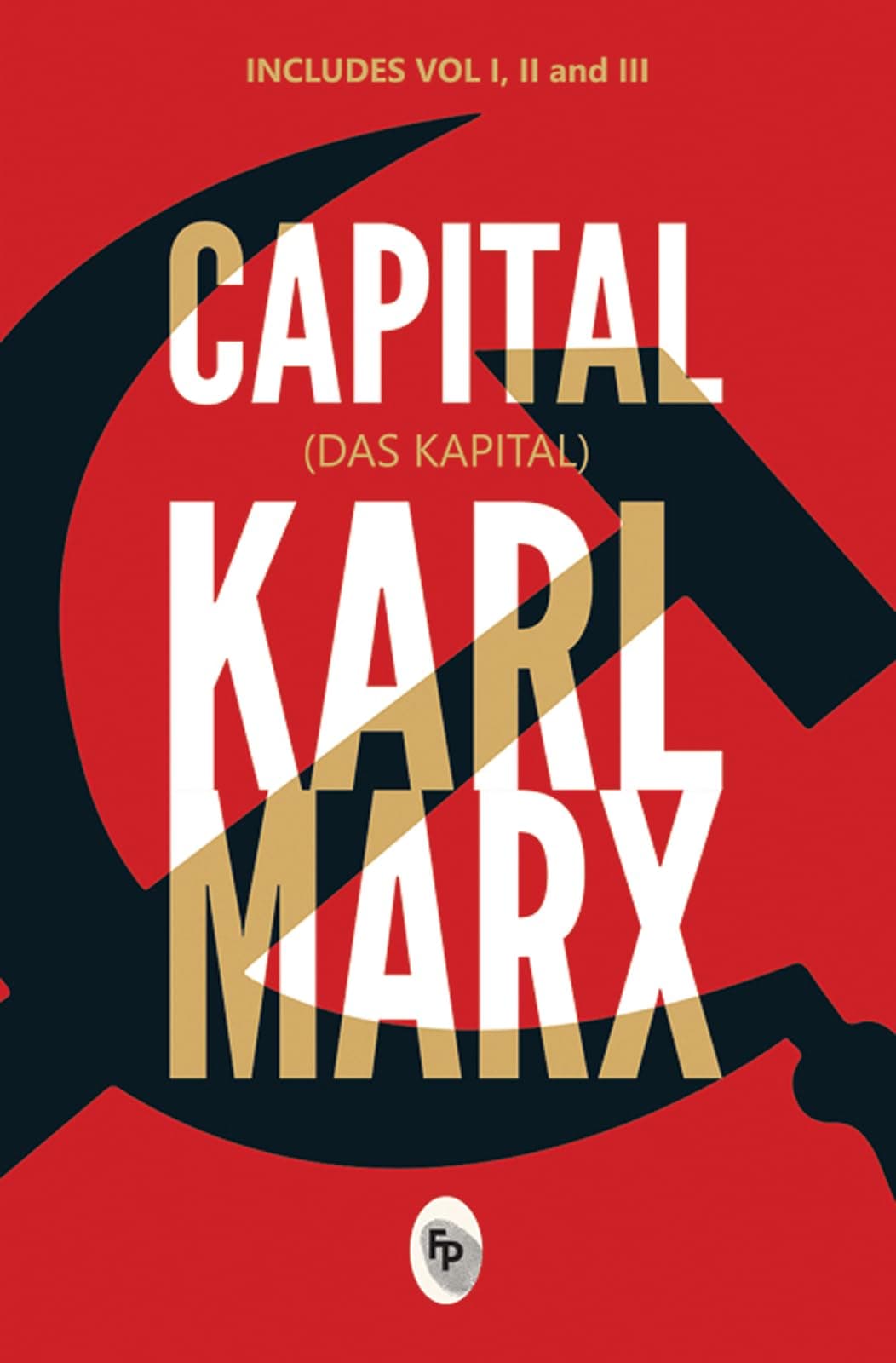
Das Kapital
“Capital is dead labor, which, vampire-like, lives only by sucking living labor, and lives the more, the more labor it sucks.”
Das Kapital Summary
Das Kapital presents Karl Marx's comprehensive analysis of the capitalist mode of production, beginning with the humble commodity and building outward to encompass the entire structure of industrial capitalism. The first volume, the only one Marx completed before his death, traces how the value of commodities derives from the labor required to produce them, how money transforms into capital through the exploitation of labor power, and how the accumulation of capital drives the relentless expansion of the system. Marx dissects the working day, the machinery of the factory, the process of primitive accumulation that dispossessed peasants to create a working class, and the tendencies within capitalism that he argues lead inexorably to crisis and transformation.
The work operates on multiple levels simultaneously: as an economic treatise deploying rigorous theoretical categories, as a historical narrative drawing on parliamentary reports and factory inspections to document the human cost of industrialization, and as a philosophical argument rooted in Hegelian dialectics about the nature of social change. Marx's analysis of commodity fetishism, in which social relations between people assume the fantastic form of relations between things, remains one of the most influential concepts in modern social thought. Whether one agrees with Marx's conclusions or not, Das Kapital is an inescapable text for understanding the modern world. Its categories of analysis, including surplus value, alienation, class struggle, and the contradictions of capital, have shaped every subsequent debate about economics, politics, and social justice, making it one of the most consequential intellectual works ever produced.
Why Read Das Kapital?
Regardless of your political convictions, engaging seriously with Das Kapital is essential for understanding the intellectual foundations of the modern world. Marx's analysis of how capitalism works, how it transforms human relationships into market transactions, and how it generates both extraordinary wealth and profound inequality provides a framework that continues to shape debates across economics, sociology, philosophy, and political science. Ignoring this text means missing one of the most powerful attempts ever made to explain the system within which we all live.
What surprises many first-time readers is the vividness of Marx's writing. Far from being a dry economic treatise, Das Kapital is filled with historical detail, literary allusion, savage irony, and passages of genuine rhetorical power. The chapters on the working day, drawn from factory inspectors' reports, document human suffering with an indignation that remains moving today. Whether you emerge as a critic or a convert, wrestling with Marx will sharpen your thinking about labor, value, power, and the kind of society you want to live in.
About Karl Marx
Karl Marx (1818-1883) was born in Trier, Prussia, to a middle-class family of Jewish descent that had converted to Protestantism. He studied law and philosophy at the universities of Bonn and Berlin, where he encountered Hegelian philosophy, and earned his doctorate with a dissertation on ancient Greek atomism. His radical journalism led to exile from Germany, and he lived successively in Paris, Brussels, and finally London, where he spent the last three decades of his life in often desperate poverty, supported financially by his collaborator Friedrich Engels.
Marx's intellectual output was vast and varied, encompassing journalism, political pamphlets, philosophical treatises, and economic analysis. The Communist Manifesto (1848), co-written with Engels, became one of the most influential political documents in history. Das Kapital, his magnum opus, occupied him from the 1850s until his death; only the first volume was published in his lifetime (1867), with the second and third volumes edited and published posthumously by Engels. Marx's ideas sparked revolutionary movements across the globe, inspired the formation of labor unions and social democratic parties, and fundamentally altered the course of twentieth-century history. His intellectual legacy remains fiercely debated, but his influence on economics, sociology, philosophy, and political science is beyond dispute.
Reading Guide
Ranked #323 among the greatest books of all time, Das Kapital by Karl Marx has earned its place in the literary canon. Originally written in German and published in 1867, this very high read from Germany continues to resonate with readers today.
This book belongs to our Philosophy & Faith collection, where you can discover more books that share its spirit and themes.
If you enjoy very high reads like this one, you might also like The Sound and the Fury, War and Peace, or The Brothers Karamazov.
From the Philosophy & Faith Collection
If you enjoyed Das Kapital, discover more masterpieces that share its spirit.
 #11View Book
Crime and Punishment
Fyodor Dostoevsky
High•20-25 hours #18View Book
The Bible
Various
Variable•60-80 hours #19View Book
The Brothers Karamazov
Fyodor Dostoevsky
Very High•35-40 hours #21View Book
The Stranger
Albert Camus
Moderate•3-4 hours
Browse more collections