Notes from the Underground
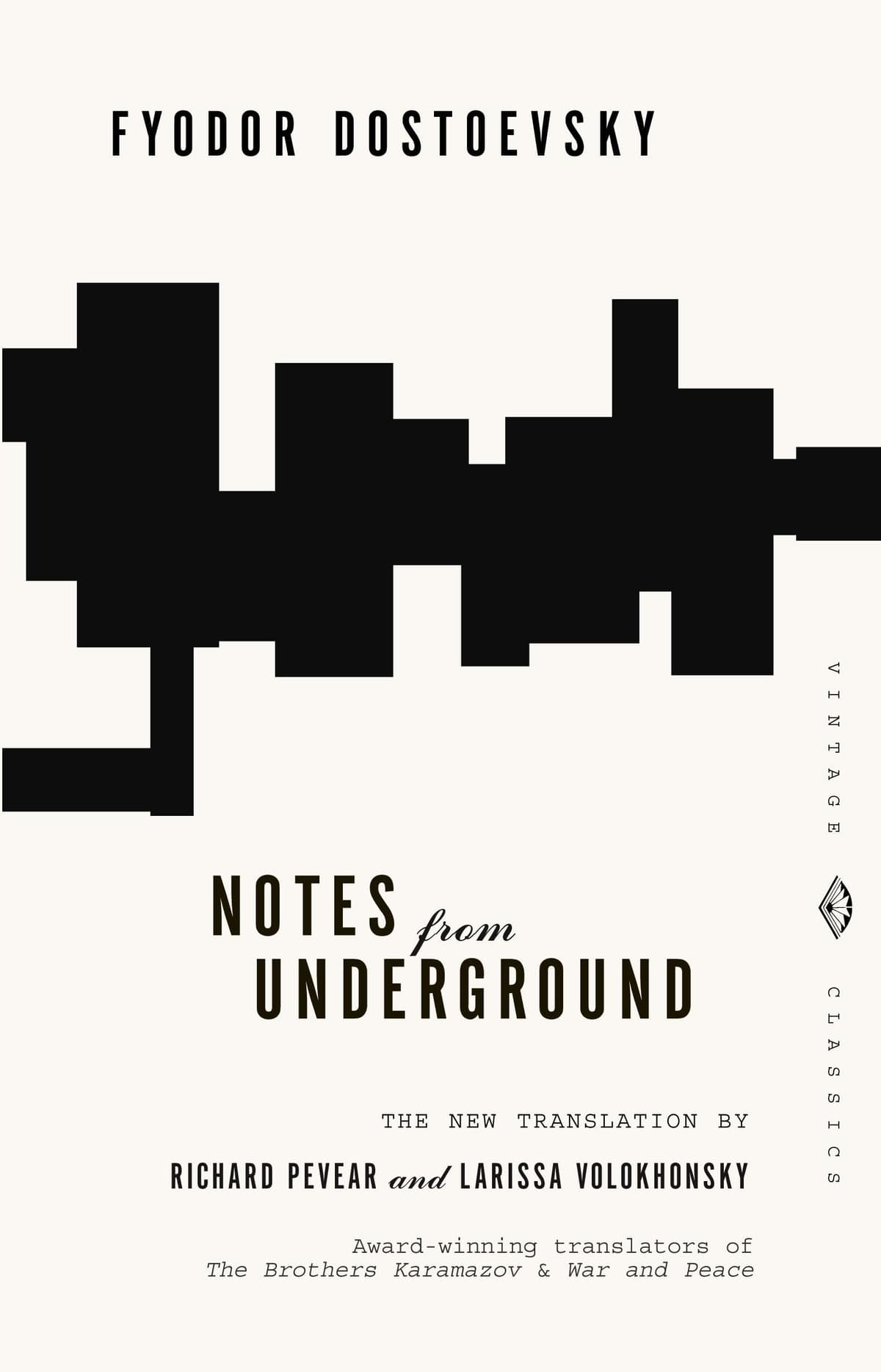
“I say let the world go to hell, but I should always have my tea.”
Notes from the Underground Summary
An unnamed narrator, a bitter, isolated former civil servant living in a wretched St. Petersburg apartment, delivers a scalding monologue from his self-described underground. In the first part, he rages against the rational egoism and utopian optimism of his age, insisting that human beings are fundamentally irrational creatures who will choose suffering and chaos over any crystal palace of engineered happiness. He is spite incarnate, a man who refuses to see a doctor out of sheer perversity, who takes pleasure in his own toothache, and who declares that twice two equaling five is sometimes a far more attractive proposition than twice two equaling four. In the second part, set sixteen years earlier, the Underground Man ventures into the world and fails spectacularly: he crashes a dinner party of former classmates who despise him, oscillating between desperate attempts at dominance and abject humiliation, then visits the prostitute Liza, to whom he delivers an eloquent sermon on virtue before revealing himself as petty and cruel.
Dostoevsky's slender, venomous novella is widely regarded as the first existentialist novel and one of the most important precursors to modernist literature. The Underground Man's voice, by turns brilliant and repulsive, self-aware and self-deceiving, anticipates the alienated narrators of Kafka, Camus, and Ellison. The work dismantles the prevailing rationalist philosophies of the 1860s with a ferocity that remains startling, arguing that consciousness itself is a disease and that the irreducible human need for free will makes any utopian project impossible. Its psychological acuity, philosophical depth, and corrosive humor make it one of the essential texts of Western literature.
Why Read Notes from the Underground?
Notes from the Underground will unsettle you in ways that few books can. The Underground Man's voice is so raw, so uncomfortably honest about the contradictions of human consciousness, that reading him feels less like encountering a fictional character than like overhearing the thoughts you have never dared to articulate. Dostoevsky wrote this novella as a direct attack on the idea that human beings are rational creatures who will choose happiness when shown the way, and his argument, delivered through a narrator who is simultaneously repellent and piercingly insightful, has lost none of its force in over a century and a half.
This is the book that made existentialism possible. Without the Underground Man, there is no Kafka, no Camus, no Sartre, no Invisible Man. In barely a hundred pages, Dostoevsky invented a new kind of literary consciousness: self-aware to the point of paralysis, brilliant to the point of madness, and so deeply human in its contradictions that it still reads as though it were written yesterday. If you want to understand where modern literature's fascination with alienation, irrationality, and the divided self began, this is where you start.
About Fyodor Dostoevsky
Fyodor Mikhailovich Dostoevsky was born in 1821 in Moscow, the son of a doctor at a hospital for the poor. His early literary success with Poor Folk was followed by a catastrophe that defined his life: arrested in 1849 for participating in a liberal intellectual circle, he was subjected to a mock execution before being sentenced to four years of hard labor in a Siberian prison camp, followed by compulsory military service. This experience shattered his health, deepened his Orthodox faith, and gave him an unparalleled understanding of human suffering.
Dostoevsky's major works, produced in the two decades following his return from exile, constitute one of the supreme achievements in world literature. Crime and Punishment, The Idiot, Demons, and The Brothers Karamazov explore the depths of the human soul with a psychological penetration that anticipated Freud and a philosophical ambition that engaged the greatest questions of faith, freedom, and morality. A compulsive gambler who wrote under relentless financial pressure, Dostoevsky transformed his personal agonies into art of universal significance. He died in 1881 in St. Petersburg, mourned by thousands who lined the streets for his funeral procession.
Reading Guide
Ranked #347 among the greatest books of all time, Notes from the Underground by Fyodor Dostoevsky has earned its place in the literary canon. Originally written in Russian and published in 1864, this moderate read from Russia continues to resonate with readers today.
This book belongs to our Russian Soul and Philosophy & Faith collections, where you can discover more books that share its spirit and themes.
If you enjoy moderate reads like this one, you might also like One Hundred Years of Solitude, Nineteen Eighty-Four, or Wuthering Heights.
From the Russian Soul Collection
If you enjoyed Notes from the Underground, discover more masterpieces that share its spirit.
 #10View Book
Anna Karenina
Leo Tolstoy
High•30-35 hours #11View Book
Crime and Punishment
Fyodor Dostoevsky
High•20-25 hours #14View Book
War and Peace
Leo Tolstoy
Very High•40-50 hours #19View Book
The Brothers Karamazov
Fyodor Dostoevsky
Very High•35-40 hours
Browse more collections