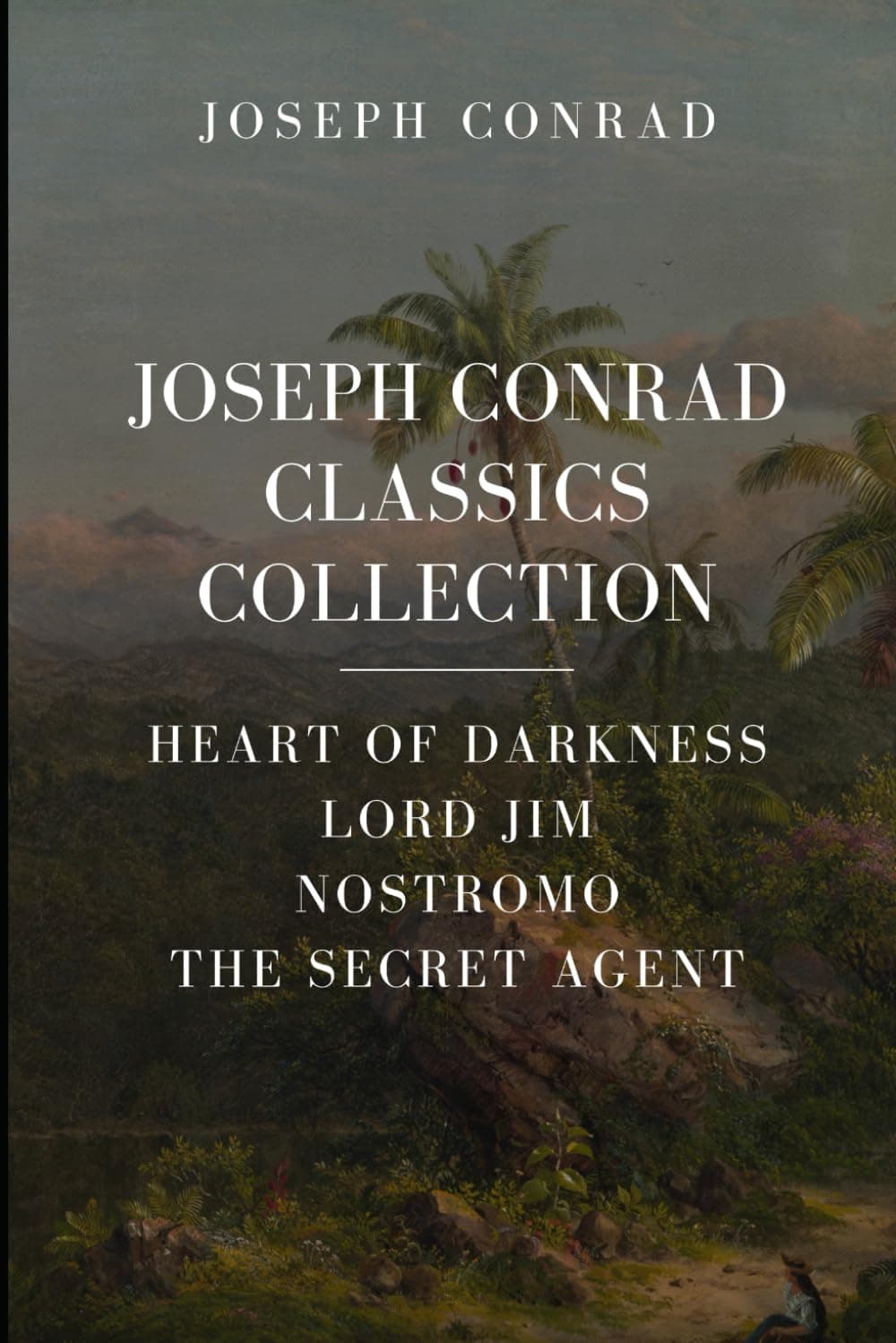
Nostromo
“There is no peace and no rest in the development of material interests. They have their law, and their justice. But it is founded on expediency, and is inhuman.”
Nostromo Summary
Set in the fictional South American republic of Costaguana, Nostromo follows the intertwined fates of a country, a silver mine, and the people whose lives are consumed by both. Charles Gould, an idealistic Englishman, operates the San Tome silver mine with the conviction that material prosperity will bring stability and justice to a land plagued by revolution and corruption. His wife Emilia watches as the mine gradually devours her husband's humanity, turning his idealism into a cold obsession. The novel's title character, Gian' Battista Nostromo, is an Italian-born foreman of the dockworkers, universally admired for his courage, reliability, and incorruptible reputation. When a revolution threatens the mine's silver shipment, Nostromo is entrusted with the task of sailing a lighter loaded with treasure to safety. In the darkness of the Golfo Placido, circumstances force him to hide the silver on a deserted island, and the secret possession of this hidden treasure begins to corrode the one thing Nostromo valued most: his reputation as a man of the people. Around these central figures, Conrad arrays a vast cast including the journalist Martin Decoud, whose corrosive skepticism leads to a devastating isolation, and Dr. Monygham, a broken man seeking redemption through loyalty.
Nostromo is Conrad's most ambitious and politically penetrating novel, a panoramic examination of how material interests corrupt individuals, institutions, and entire nations. The nonlinear narrative, shifting between past and present, revolution and aftermath, creates a mosaic portrait of a society in which every ideal, whether political, romantic, or moral, is tested and ultimately compromised by the gravitational pull of silver. The novel's vision of economic imperialism, political instability, and the moral cost of development anticipated the dynamics of twentieth-century Latin America with remarkable prescience, making it one of the most prophetic political novels ever written.
Why Read Nostromo?
Nostromo is one of the great political novels in any language, a book that does nothing less than trace how the pursuit of wealth corrodes every human value it touches. Conrad constructs an entire fictional country with such convincing detail that Costaguana feels more real than many actual nations in fiction, populating it with characters whose ambitions, loyalties, and compromises form a devastating portrait of how power actually works. If you have ever wondered why idealism so often fails in the face of material interests, this novel offers an answer more complex and honest than any treatise.
The novel demands patience: its fractured chronology and large cast require attentive reading. But the rewards are immense. Conrad's prose achieves a dark magnificence, particularly in the sequences set on the lightless waters of the Golfo Placido, where the physical darkness mirrors the moral blindness of characters who believe they can possess wealth without being possessed by it. Nostromo remains startlingly relevant to any age in which nations are shaped by resource extraction, foreign investment, and the gap between the rhetoric of progress and its human costs.
About Joseph Conrad
Joseph Conrad was born Jozef Teodor Konrad Korzeniowski in 1857 in Berdychiv, in what is now Ukraine, to Polish parents living under Russian Imperial rule. Orphaned by the age of eleven after both parents died in political exile, he went to sea at sixteen and spent twenty years in the merchant marine, eventually earning his British master mariner's certificate. He did not begin writing fiction in English, his third language after Polish and French, until he was in his thirties, publishing his first novel, Almayer's Folly, in 1895.
Conrad became one of the greatest novelists in the English language, producing a body of work that includes Heart of Darkness, Lord Jim, The Secret Agent, Under Western Eyes, and Nostromo. His fiction is distinguished by its psychological depth, its moral complexity, and its innovations in narrative technique, including the use of multiple perspectives and disrupted chronology that influenced the development of literary modernism. He was a profound analyst of imperialism, isolation, and the moral ambiguities of human action. Conrad became a British citizen in 1886 and lived in England for the rest of his life, dying in 1924 at the age of sixty-six in Bishopsbourne, Kent.
Reading Guide
Ranked #283 among the greatest books of all time, Nostromo by Joseph Conrad has earned its place in the literary canon. Originally written in English and published in 1904, this challenging read from United Kingdom continues to resonate with readers today.
This book belongs to our Society & Satire collection, where you can discover more books that share its spirit and themes.
If you enjoy challenging reads like this one, you might also like Ulysses, Moby-Dick, or Lolita.
From the Society & Satire Collection
If you enjoyed Nostromo, discover more masterpieces that share its spirit.
 #9View Book
Don Quixote
Miguel de Cervantes
High•35-40 hours #12View Book
Pride and Prejudice
Jane Austen
Accessible•10-12 hours #22View Book
Madame Bovary
Gustave Flaubert
Moderate•12-15 hours #30View Book
Middlemarch
George Eliot
High•30-35 hours
Browse more collections