Memoirs of Hadrian
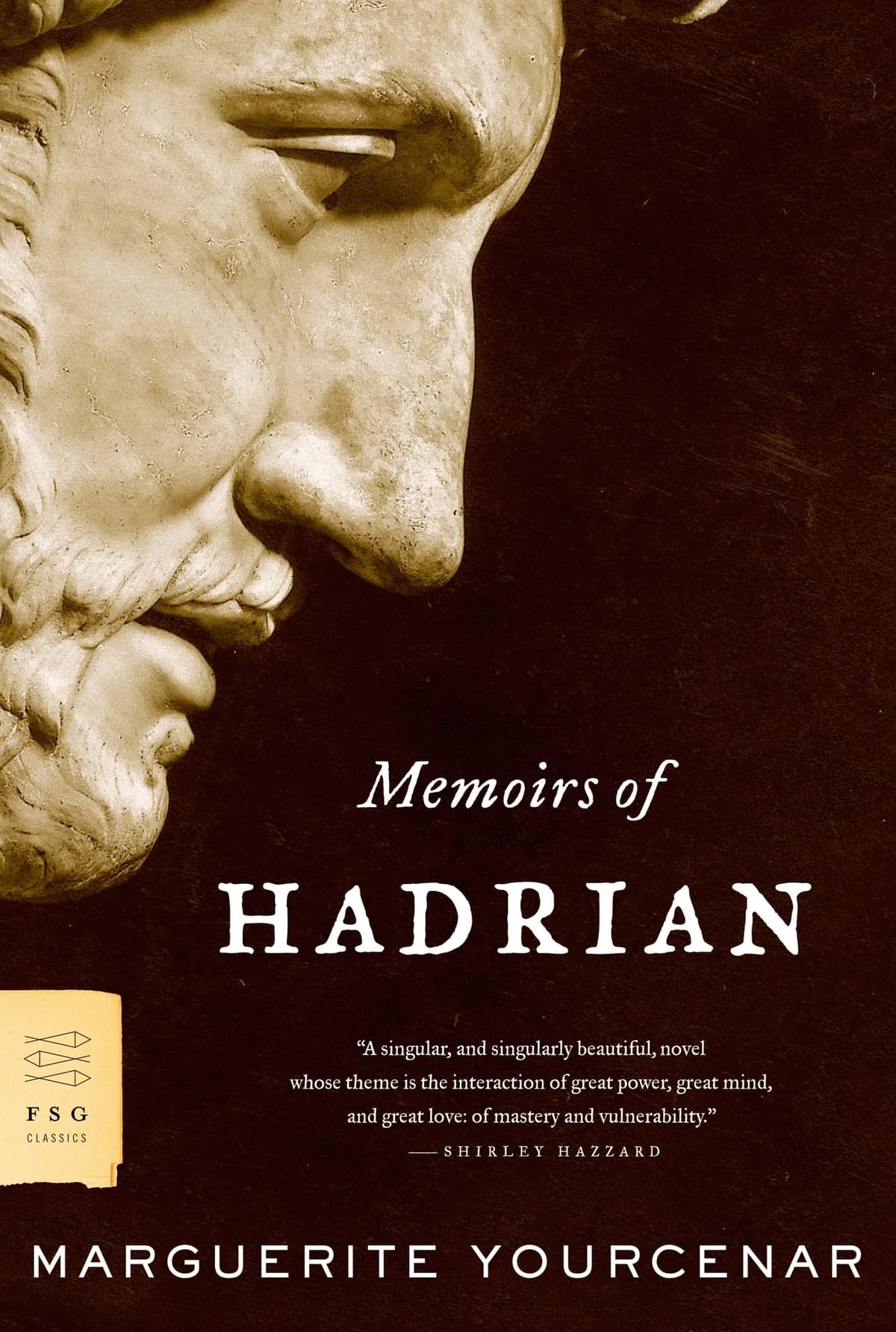
“Like everyone else I have at my disposal only three means of evaluating human existence: the study of self, which is the most difficult and most dangerous method, but also the most fruitful; the observation of our fellow men, who usually arrange to hide their secrets from us; and books.”
Memoirs of Hadrian Summary
An aging Roman emperor, feeling the approach of death, sits down to write a letter to his young successor, Marcus Aurelius. What unfolds is not a conventional autobiography but a meditation on power, love, the body, and the passage of time. Hadrian recounts his rise through the ranks of Roman military and politics, his consolidation of an empire stretching from Britain to Mesopotamia, and the great building projects—the Pantheon, his villa at Tivoli, the wall across northern England—that were his attempts to impose order on chaos.
But the emotional center of the book is Hadrian's love for the beautiful Greek youth Antinoüs, whose mysterious drowning in the Nile becomes the wound from which the emperor never recovers. Yourcenar's prose is lapidary, measured, classical—each sentence polished like marble. She achieves something extraordinary: she makes a man who has been dead for nearly two thousand years breathe, think, grieve, and speak with an intimacy that feels like confession.
Why Read Memoirs of Hadrian?
Memoirs of Hadrian is perhaps the greatest historical novel ever written—not because of its meticulous research, though Yourcenar spent decades preparing, but because it achieves the impossible: it makes you believe you are reading the actual words of a second-century Roman emperor. Every sentence carries the weight of a mind that has governed millions, waged wars, built cities, and loved deeply—and now must face the one adversary it cannot defeat.
Yourcenar's triumph is one of radical empathy. She crosses every boundary—of time, gender, culture, language—to inhabit a consciousness utterly foreign to her own, and she does it with such authority that the seams never show. The result is a novel about mortality that is itself strangely immortal, a book that teaches you what it means to hold power, to lose what you love, and to face the end with your eyes open.
About Marguerite Yourcenar
Marguerite Yourcenar (1903–1987) was born Marguerite de Crayencour in Brussels and spent much of her life as a self-imposed exile, eventually settling on Mount Desert Island in Maine. In 1980, she became the first woman elected to the Académie française in its 345-year history—a recognition of her status as one of the great prose stylists of the French language.
Yourcenar worked on Memoirs of Hadrian for over twenty-five years, beginning in her twenties, abandoning the project, then returning to it in middle age with the depth of experience needed to inhabit an emperor's dying mind. She was a writer of fierce intellectual discipline and emotional reserve, and her masterpiece reflects both qualities—classical in form, devastating in feeling.
Reading Guide
Ranked #138 among the greatest books of all time, Memoirs of Hadrian by Marguerite Yourcenar has earned its place in the literary canon. Originally written in French and published in 1951, this moderate read from France continues to resonate with readers today.
This book belongs to our Philosophy & Faith and Epics collections, where you can discover more books that share its spirit and themes.
If you enjoy moderate reads like this one, you might also like One Hundred Years of Solitude, Nineteen Eighty-Four, or Wuthering Heights.
From the Philosophy & Faith Collection
If you enjoyed Memoirs of Hadrian, discover more masterpieces that share its spirit.
 #11View Book
Crime and Punishment
Fyodor Dostoevsky
High•20-25 hours #18View Book
The Bible
Various
Variable•60-80 hours #19View Book
The Brothers Karamazov
Fyodor Dostoevsky
Very High•35-40 hours #21View Book
The Stranger
Albert Camus
Moderate•3-4 hours
Browse more collections