Homage to Catalonia
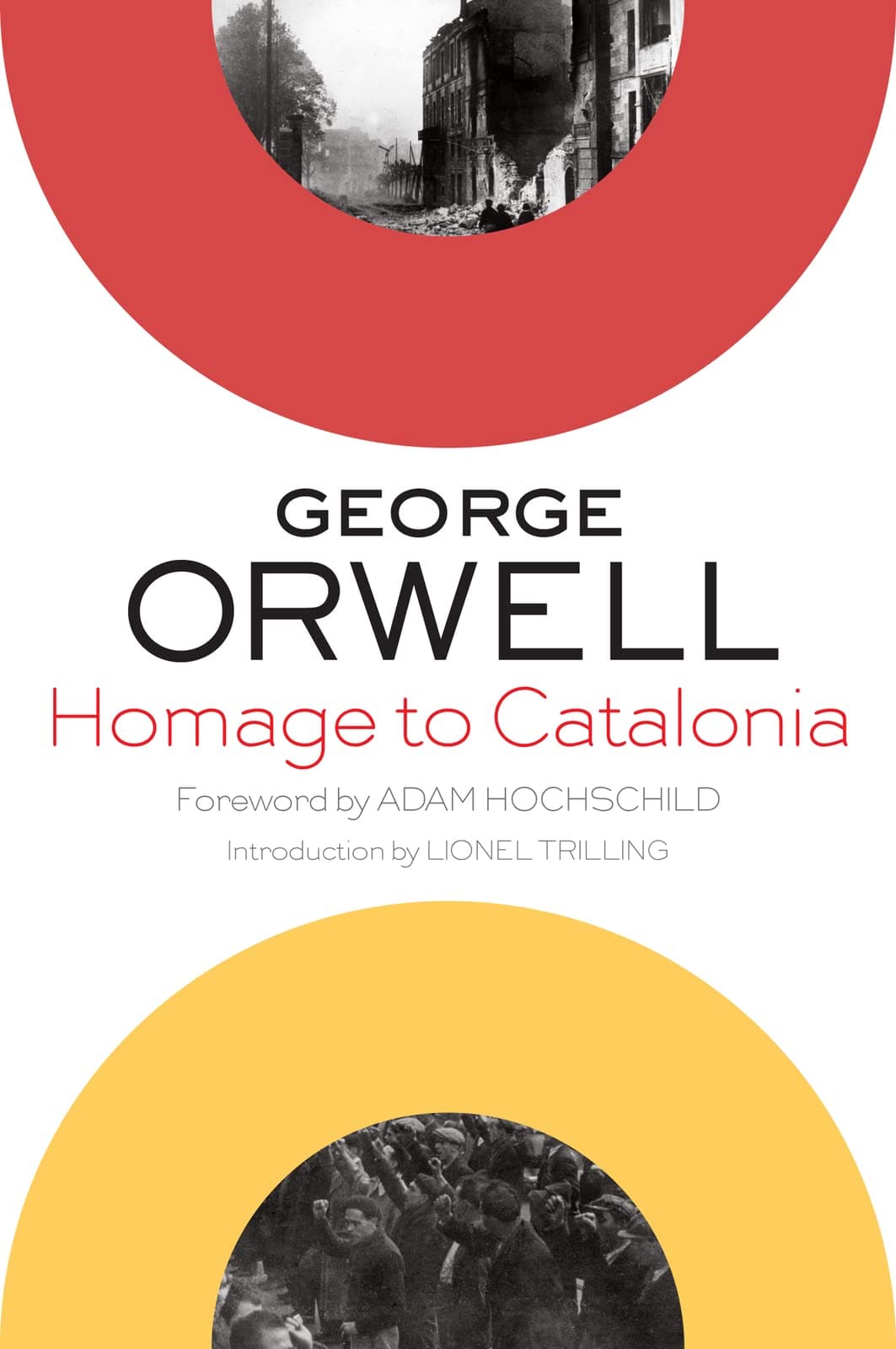
“One of the most horrible features of war is that all the war-propaganda, all the screaming and lies and hatred, comes invariably from people who are not fighting.”
Homage to Catalonia Summary
In December 1936, George Orwell crossed the Pyrenees into Spain to fight against Franco's Fascist forces, and Homage to Catalonia is his raw, honest account of what he found there. Arriving in Barcelona, he encounters a city transformed by revolution: workers' militias patrol the streets, churches have been gutted, and every wall is splashed with hammer-and-sickle slogans. He enlists with the POUM militia and is sent to the Aragon front, where he discovers that war is mostly boredom, cold, and lice, punctuated by moments of sudden terror. The front lines are shambolic, the weapons are antiques, and the trenches are so close that insults are shouted more often than bullets are fired. Then Orwell is shot through the throat by a sniper, and the war becomes terrifyingly personal. Returning to Barcelona to recover, he finds the revolutionary city he loved now gripped by Communist-orchestrated street fighting, as Stalin's agents move to crush the independent left. Orwell and his wife barely escape Spain with their lives.
Orwell's memoir is one of the great works of political witness, distinguished by its fierce clarity, its refusal of propaganda, and its willingness to record confusion, contradiction, and moral ambiguity. What makes the book endure is not just its historical importance as an account of the Spanish Civil War, but its deeply personal voice: Orwell writes as a man who went to Spain full of idealism and returned with his illusions shattered but his commitment to truth and decency intact. The book is a devastating critique of the way totalitarian movements betray their own ideals, and its insights into political language, institutional lying, and the manipulation of history prefigure the concerns of Nineteen Eighty-Four and Animal Farm.
Why Read Homage to Catalonia?
Homage to Catalonia is the book that made George Orwell into George Orwell. Before Spain, he was a talented writer; after Spain, he was a man who had stared into the machinery of political deception and come away with an unshakeable commitment to telling the truth, no matter how inconvenient. This memoir is electrifying because it refuses every temptation of heroic narrative. Orwell writes about war with the same unflinching honesty he brought to poverty in Down and Out in Paris and London: the lice, the freezing nights, the absurdity of firing a rifle that hasn't been cleaned since the previous war. And then, suddenly, a bullet through his throat, and the world narrows to the struggle to breathe.
But the real power of Homage to Catalonia lies in what happens after the fighting. Orwell's account of the Communist suppression of the POUM, of the way a revolution was betrayed from within by the very forces that claimed to defend it, is one of the most important pieces of political writing in the English language. It is the seedbed of everything that followed: Animal Farm, Nineteen Eighty-Four, and the moral clarity that made Orwell's name synonymous with truth-telling. Read this book to understand not just the Spanish Civil War, but the anatomy of political betrayal itself.
About George Orwell
George Orwell was born Eric Arthur Blair in 1903 in Motihari, Bengal, during the twilight of British imperial rule in India. Educated at Eton on a scholarship, he rejected the conventional path of the English upper-middle class and served as a colonial police officer in Burma, an experience that filled him with a lasting hatred of imperialism. He returned to Europe determined to become a writer, deliberately immersing himself in poverty in Paris and London to understand the lives of the dispossessed. His early works, including Down and Out in Paris and London and The Road to Wigan Pier, established his reputation as a fearless observer of class and injustice.
The Spanish Civil War transformed Orwell. Shot through the throat while fighting with the POUM militia, and hunted by Communist secret police in Barcelona, he emerged with the political convictions that would define his greatest works. Animal Farm (1945) and Nineteen Eighty-Four (1949) are among the most influential novels of the twentieth century, their warnings about totalitarianism, propaganda, and the corruption of language woven into the fabric of modern political thought. Orwell also produced some of the finest essays in the English language, works of crystalline prose and moral seriousness. He died of tuberculosis in 1950 at the age of forty-six, leaving behind a body of work that has made his name an adjective: Orwellian, meaning the manipulation of truth by power.
Reading Guide
Ranked #430 among the greatest books of all time, Homage to Catalonia by George Orwell has earned its place in the literary canon. Originally written in English and published in 1938, this accessible read from United Kingdom continues to resonate with readers today.
This book belongs to our Society & Satire collection, where you can discover more books that share its spirit and themes.
If you enjoy accessible reads like this one, you might also like The Great Gatsby, The Catcher in the Rye, or Pride and Prejudice.
From the Society & Satire Collection
If you enjoyed Homage to Catalonia, discover more masterpieces that share its spirit.
 #9View Book
Don Quixote
Miguel de Cervantes
High•35-40 hours #12View Book
Pride and Prejudice
Jane Austen
Accessible•10-12 hours #22View Book
Madame Bovary
Gustave Flaubert
Moderate•12-15 hours #30View Book
Middlemarch
George Eliot
High•30-35 hours
Browse more collections