Germinal
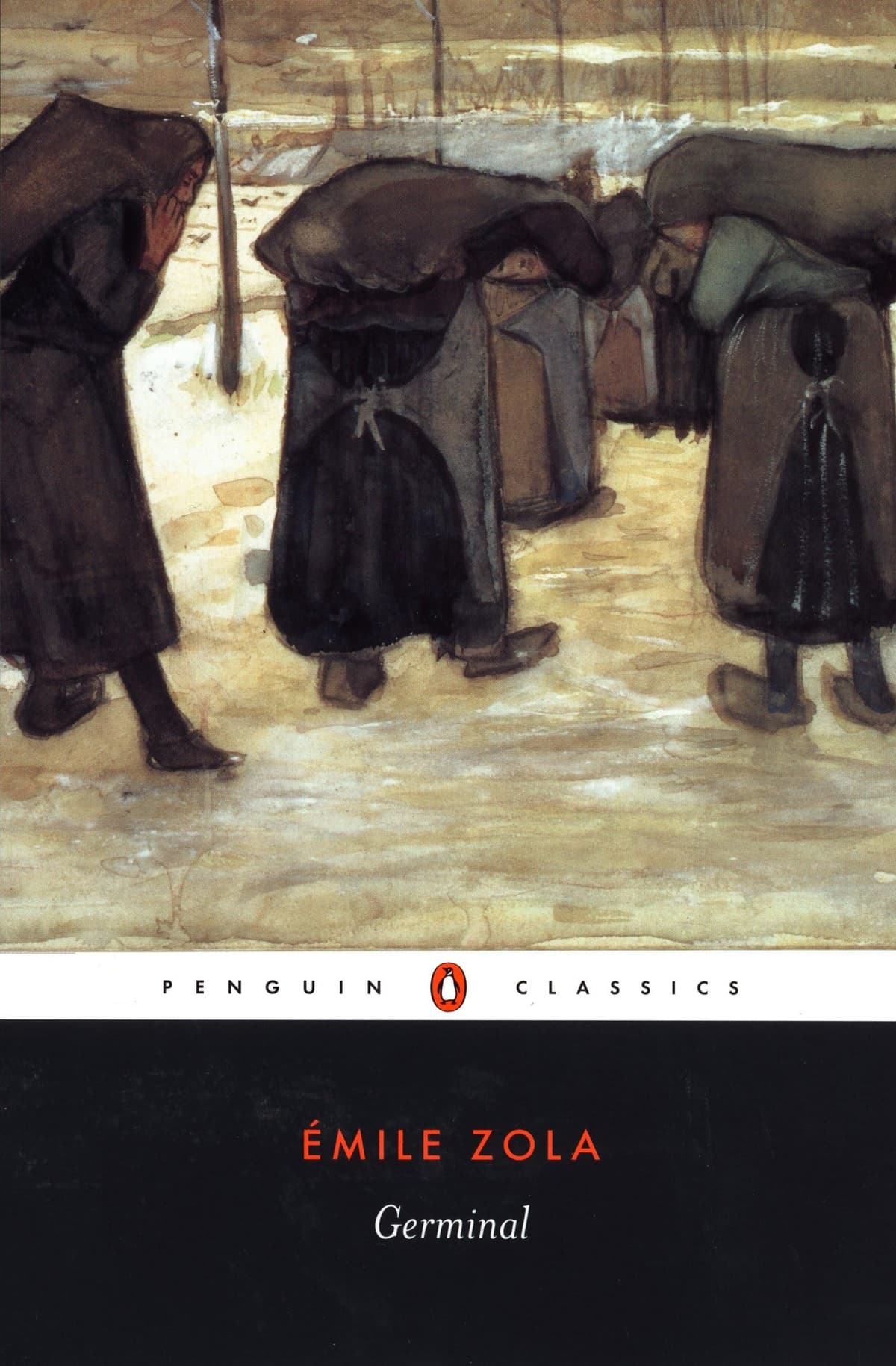
“The fire was dying, and the great cold crept in through a crack under the door.”
Germinal Summary
Deep beneath the coal fields of northern France, Etienne Lantier descends into the Voreux mine and discovers a world of almost unimaginable suffering. Miners work in cramped, sweltering tunnels, their bodies broken by labor that begins in childhood and ends in premature death. Families of eight crowd into company-owned hovels, surviving on starvation wages while the mine owners grow fat in their chandeliered drawing rooms. Etienne, an unemployed railway mechanic radicalized by socialist pamphlets, takes a job hewing coal alongside the Maheu family and gradually becomes the leader of a strike that will convulse the entire mining region. Zola renders the underground world with extraordinary sensory power—the darkness, the heat, the groaning of the earth, the constant drip of water—and tracks the strike from its exhilarating early solidarity through its slow, agonizing collapse under the weight of hunger, betrayal, and state violence. The final catastrophe, a mine flooding that entombs workers in the bowels of the earth, is one of the most harrowing sequences in all of fiction.
Germinal is the thirteenth novel in Zola's monumental Rougon-Macquart cycle and widely considered his masterpiece. It is the great novel of labor, a work that made visible an entire class of people whom bourgeois literature had largely ignored. Zola's naturalist method—exhaustive research, unflinching depiction of bodily suffering, a quasi-scientific interest in heredity and environment—reaches its fullest expression here, but what elevates Germinal beyond documentary is its mythic power. The mine itself becomes a living beast, devouring human bodies; the earth is both tomb and womb, and the novel's title promises that from this buried suffering, something new will germinate. Its influence on protest literature, from Steinbeck to Ken Loach, is immeasurable.
Why Read Germinal?
Germinal will take you underground in every sense. Zola immerses you so completely in the world of the miners—the suffocating darkness, the constant danger, the bone-deep exhaustion—that you emerge from the novel feeling as if you have lived through a strike yourself. No writer has ever depicted physical labor with such visceral power, and no novel has ever made the case for economic justice with such overwhelming force. The Maheu family, whose members are crushed one by one by a system designed to extract maximum labor at minimum cost, will break your heart and make you furious in equal measure.
But Germinal is not merely a political tract dressed in fiction. It is a novel of immense dramatic power, with a plot that builds toward catastrophe with the relentless pressure of the earth itself pressing down on the tunnels. Zola writes with a mythic grandeur that transforms a regional labor dispute into a universal story of human endurance and resistance. The final pages, in which Etienne walks away from the devastated mining country hearing the sound of new life stirring beneath the soil, achieve a poetry that transcends naturalism entirely. This is one of the essential novels of the nineteenth century, and its fury and compassion have lost nothing in a century and a half.
About Émile Zola
Emile Zola was born in Paris in 1840, the son of an Italian engineer who died when Zola was seven, leaving the family in poverty. He failed his baccalaureat twice, worked as a clerk at the publishing house Hachette, and began writing with a fierce determination to create a new kind of fiction—one grounded in scientific observation rather than romantic idealism. His breakthrough came with Therese Raquin in 1867, followed by the twenty-novel Rougon-Macquart cycle, which traces a single family across multiple generations and social classes in Second Empire France.
Zola became the most prominent literary figure in France and one of the most controversial. His naturalist novels—L'Assommoir, Nana, Germinal, La Bete Humaine—shocked readers with their unflinching depictions of poverty, addiction, sexuality, and violence, but they also sold in enormous numbers and transformed the possibilities of the novel. In 1898, he risked his career and freedom by publishing J'Accuse, his famous open letter defending Alfred Dreyfus, the Jewish army officer falsely convicted of treason. Zola was convicted of libel and briefly fled to England. He died in 1902 of carbon monoxide poisoning, in circumstances that remain suspicious. His funeral drew enormous crowds, and Anatole France declared that Zola's life embodied a moment of the conscience of humanity.
Reading Guide
Ranked #379 among the greatest books of all time, Germinal by Émile Zola has earned its place in the literary canon. Originally written in French and published in 1885, this moderate read from France continues to resonate with readers today.
This book belongs to our Society & Satire collection, where you can discover more books that share its spirit and themes.
If you enjoy moderate reads like this one, you might also like One Hundred Years of Solitude, Nineteen Eighty-Four, or Wuthering Heights.
From the Society & Satire Collection
If you enjoyed Germinal, discover more masterpieces that share its spirit.
 #9View Book
Don Quixote
Miguel de Cervantes
High•35-40 hours #12View Book
Pride and Prejudice
Jane Austen
Accessible•10-12 hours #22View Book
Madame Bovary
Gustave Flaubert
Moderate•12-15 hours #30View Book
Middlemarch
George Eliot
High•30-35 hours
Browse more collections