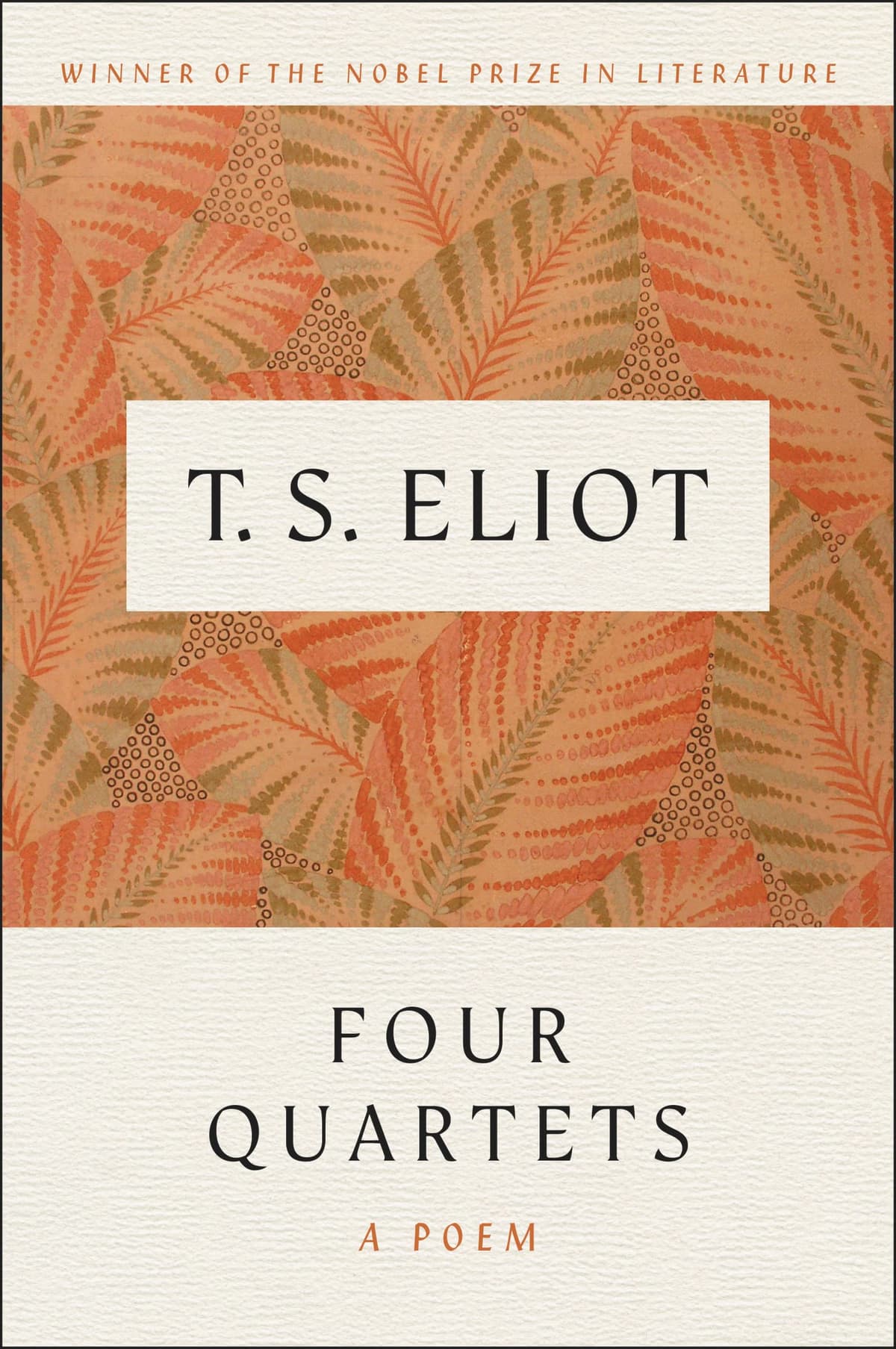
Four Quartets
“We shall not cease from exploration, and the end of all our exploring will be to arrive where we started and know the place for the first time.”
Four Quartets Summary
Four Quartets consists of four interconnected long poems, each named for a place of personal or spiritual significance: Burnt Norton, a Gloucestershire manor house; East Coker, the Somerset village from which Eliot's ancestors emigrated to America; The Dry Salvages, a rocky formation off the Massachusetts coast where Eliot sailed as a boy; and Little Gidding, a seventeenth-century Anglican community in Huntingdonshire. Each quartet is structured in five movements that echo the form of a musical composition, weaving together philosophical meditation, sensory description, lyrical passage, and moments of almost unbearable spiritual intensity. The poems circle obsessively around the relationship between time and eternity, exploring how human beings, trapped in the flow of temporal experience, can nonetheless glimpse the timeless through memory, suffering, art, and prayer.
Four Quartets represents the culmination of Eliot's poetic career and is widely regarded as one of the supreme achievements of twentieth-century literature. Written during and about the experience of World War II, the poems confront the destruction of European civilization with a hard-won faith that refuses easy consolation. Eliot's Christianity here is not dogmatic but experiential, rooted in the recognition that spiritual understanding comes not through intellectual certainty but through surrender, patience, and the discipline of attention. The poems' formal structure, with its repetitions, variations, and returns, enacts the very process they describe: the movement of consciousness through time toward moments of illumination that redeem the waste and suffering of ordinary existence. The language achieves a transparency and authority unlike anything else in Eliot's work, moving from the colloquial to the incantatory with an ease that conceals extraordinary craft. Four Quartets is that rarest of literary accomplishments: a work of profound spiritual seriousness that is also a triumph of artistic form.
Why Read Four Quartets?
If you are searching for a work of literature that addresses the deepest questions of human existence with both intellectual rigor and emotional power, Four Quartets may be the most rewarding poem you will ever read. Eliot writes about time, memory, suffering, and redemption with a precision and beauty that make abstract concepts feel as vivid as physical experience. These are poems you can return to at every stage of life and find new meaning: what strikes you as a young reader will be entirely different from what moves you in middle age or old age. The poems do not offer easy answers, but they offer something better: a way of thinking about the hardest questions that is itself a form of grace.
You should read Four Quartets because it demonstrates what poetry at its highest level can achieve. Eliot synthesizes philosophy, theology, personal memory, and musical structure into a unified work of art that is at once demanding and deeply consoling. The famous passages are genuinely famous for a reason: they articulate truths about the human condition with a precision that prose cannot match. But the poem also rewards the reader who attends to its quieter moments, its hesitations and qualifications, its willingness to confess ignorance and begin again. Reading Four Quartets is not an exercise in literary appreciation; it is an experience that can genuinely change how you understand your own life in time.
About T. S. Eliot
Thomas Stearns Eliot was born in 1888 in St. Louis, Missouri, into a distinguished family with deep roots in New England Unitarianism. He studied philosophy at Harvard, the Sorbonne, and Oxford before settling permanently in England in 1914. His early poems, including "The Love Song of J. Alfred Prufrock" and The Waste Land, revolutionized English-language poetry and established him as the leading figure of literary modernism. He worked for many years as an editor at Faber and Faber, where he championed the work of younger poets, and he became a British citizen in 1927, the same year he was baptized into the Church of England. His conversion to Anglo-Catholicism profoundly shaped his later work, including Four Quartets, which he composed between 1936 and 1942.
Eliot was awarded the Nobel Prize in Literature in 1948 and the Order of Merit, and he remained the dominant figure in English-language poetry until his death in 1965. His influence is virtually immeasurable: he redefined the possibilities of poetic form, transformed literary criticism through essays that introduced concepts like the "objective correlative" and the "dissociation of sensibility," and demonstrated that poetry could engage with the full complexity of modern intellectual and spiritual life. Four Quartets is generally considered his masterpiece, a work that moved beyond the fragmentation and despair of The Waste Land toward a vision of wholeness achieved through faith, suffering, and the redemptive power of art. Eliot's legacy is contested, particularly regarding his personal failings and political views, but his stature as one of the defining poets of the twentieth century is beyond serious question.
Reading Guide
Ranked #463 among the greatest books of all time, Four Quartets by T. S. Eliot has earned its place in the literary canon. Originally written in English and published in 1943, this very high read from United Kingdom continues to resonate with readers today.
This book belongs to our Philosophy & Faith collection, where you can discover more books that share its spirit and themes.
If you enjoy very high reads like this one, you might also like The Sound and the Fury, War and Peace, or The Brothers Karamazov.
From the Philosophy & Faith Collection
If you enjoyed Four Quartets, discover more masterpieces that share its spirit.
 #11View Book
Crime and Punishment
Fyodor Dostoevsky
High•20-25 hours #18View Book
The Bible
Various
Variable•60-80 hours #19View Book
The Brothers Karamazov
Fyodor Dostoevsky
Very High•35-40 hours #21View Book
The Stranger
Albert Camus
Moderate•3-4 hours
Browse more collections