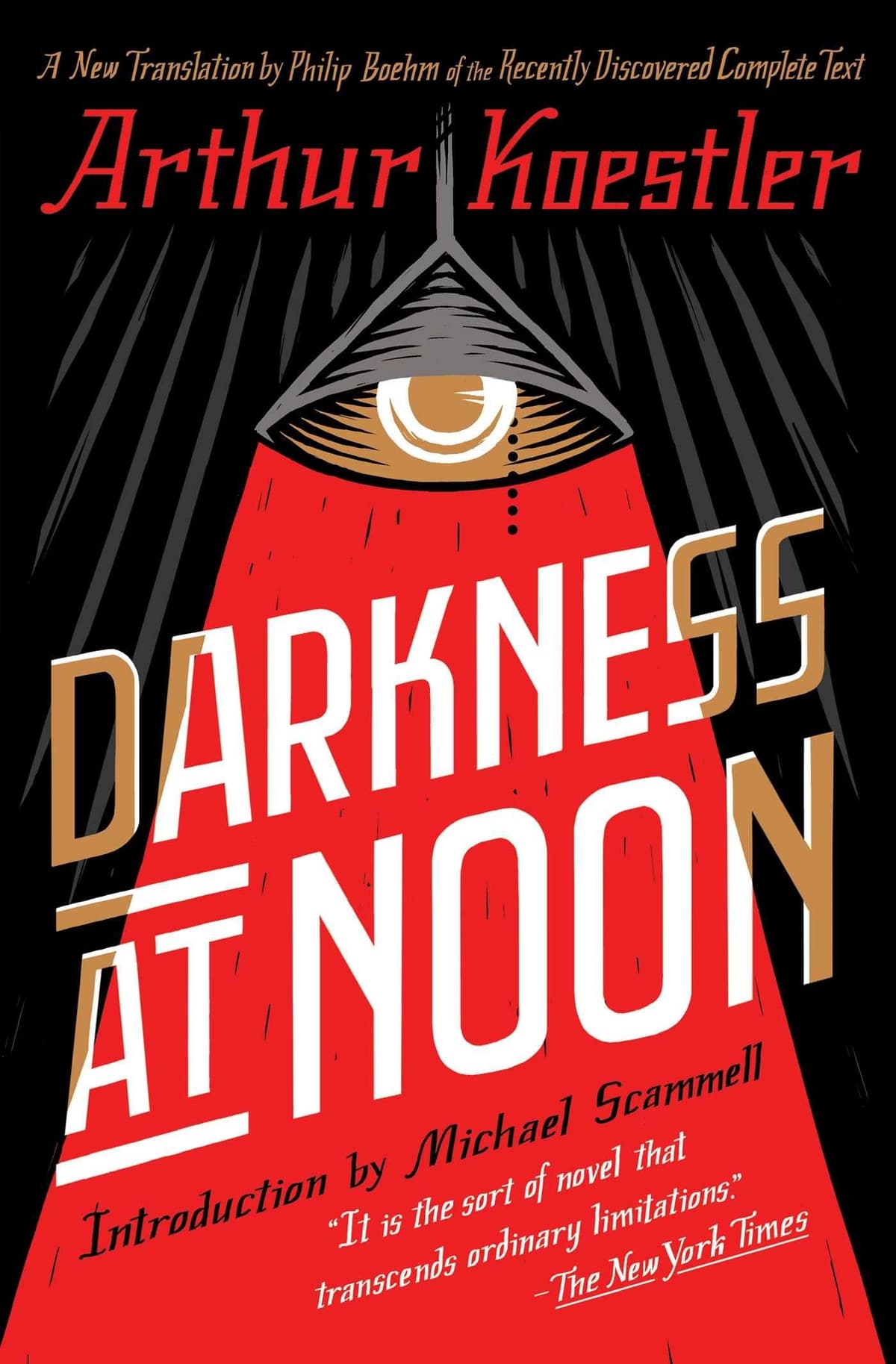
Darkness at Noon
“There are only two conceptions of human ethics, and they are at opposite poles. One of them is Christian and humane, declares the individual to be sacrosanct, and asserts that the rules of arithmetic are not to be applied to human units. The other starts from the basic principle that a collective aim justifies all means, and not only allows, but demands, that the individual should in every way be subordinated and sacrificed to the community.”
Darkness at Noon Summary
Rubashov, a veteran Bolshevik revolutionary and former commissar, sits in a prison cell awaiting interrogation by the regime he helped create. Through a series of brutal questioning sessions—conducted by Ivanov, an old comrade who still believes in dialectical reason, and Gletkin, a younger functionary who knows only the logic of the party—Rubashov is forced to confront the moral catastrophe of his own life. He remembers the people he sacrificed for the revolution: a loyal secretary he denounced, a lover he abandoned, a dissident he betrayed. The party demands that he confess to crimes he did not commit, and the terrifying question is not whether he will break, but whether the logic of his own beliefs requires him to.
Koestler's novel is a searing dramatization of the Moscow show trials of the 1930s, in which old Bolsheviks publicly confessed to absurd charges before being executed. But its reach extends far beyond any single historical moment. Darkness at Noon is the definitive literary exploration of totalitarian logic—the idea that the individual is nothing before History, that the end justifies any means, and that to oppose the party is to oppose the future of humanity itself. Rubashov's internal debate—between the 'grammatical fiction' of the first person singular and the collective 'we' of the revolution—is one of the great psychological dramas in modern fiction. Koestler writes with the cold precision of a philosopher and the burning conscience of a man who has looked into the abyss of ideology and recoiled.
Why Read Darkness at Noon?
If you want to understand how intelligent, idealistic people can commit atrocities in the name of a better world, Darkness at Noon is the essential text. Koestler does not caricature his protagonist—Rubashov is brilliant, cultured, and genuinely devoted to human progress, and that is precisely what makes his complicity so devastating. The novel forces you inside the mind of a man who has rationalized murder and betrayal as historical necessity, and it asks you to reckon with the possibility that the road to utopia passes through the interrogation room.
Written on the eve of World War II, this novel remains one of the most powerful warnings against ideological absolutism ever composed. It strips bare the mechanisms by which regimes demand not just obedience but belief, not just compliance but confession. Rubashov's tragedy is not that he is punished by the revolution—it is that the revolution's logic, which he accepted and enforced, leaves him no ground on which to resist. Read it as a political thriller, a philosophical argument, or a study of conscience under pressure—it is devastating on every level.
About Arthur Koestler
Arthur Koestler (1905-1983) was born in Budapest to a Hungarian Jewish family and educated in Vienna. He worked as a journalist across Europe and the Middle East, joined the Communist Party in 1931, and covered the Spanish Civil War, during which he was captured by Franco's forces and sentenced to death—an experience that profoundly shaped his understanding of political terror. His disillusionment with Stalinism, culminating in his formal break with the party in 1938, provided the raw material for Darkness at Noon.
The novel, published in 1940, became one of the most influential political works of the twentieth century, helping to turn Western intellectual opinion against Soviet communism. Koestler went on to write widely on science, philosophy, and politics, including The God That Failed and The Ghost in the Machine. His later years were marked by controversy and restless intellectual exploration. Though his reputation has been complicated by revelations about his personal life, Darkness at Noon endures as a masterpiece of political fiction—a novel that George Orwell called 'brilliant' and that remains indispensable to any serious reckoning with the moral legacy of totalitarianism.
Reading Guide
Ranked #204 among the greatest books of all time, Darkness at Noon by Arthur Koestler has earned its place in the literary canon. Originally written in German and published in 1940, this challenging read from United Kingdom continues to resonate with readers today.
This book belongs to our Philosophy & Faith and Speculative Futures collections, where you can discover more books that share its spirit and themes.
If you enjoy challenging reads like this one, you might also like Ulysses, Moby-Dick, or Lolita.
From the Philosophy & Faith Collection
If you enjoyed Darkness at Noon, discover more masterpieces that share its spirit.
 #11View Book
Crime and Punishment
Fyodor Dostoevsky
High•20-25 hours #18View Book
The Bible
Various
Variable•60-80 hours #19View Book
The Brothers Karamazov
Fyodor Dostoevsky
Very High•35-40 hours #21View Book
The Stranger
Albert Camus
Moderate•3-4 hours
Browse more collections