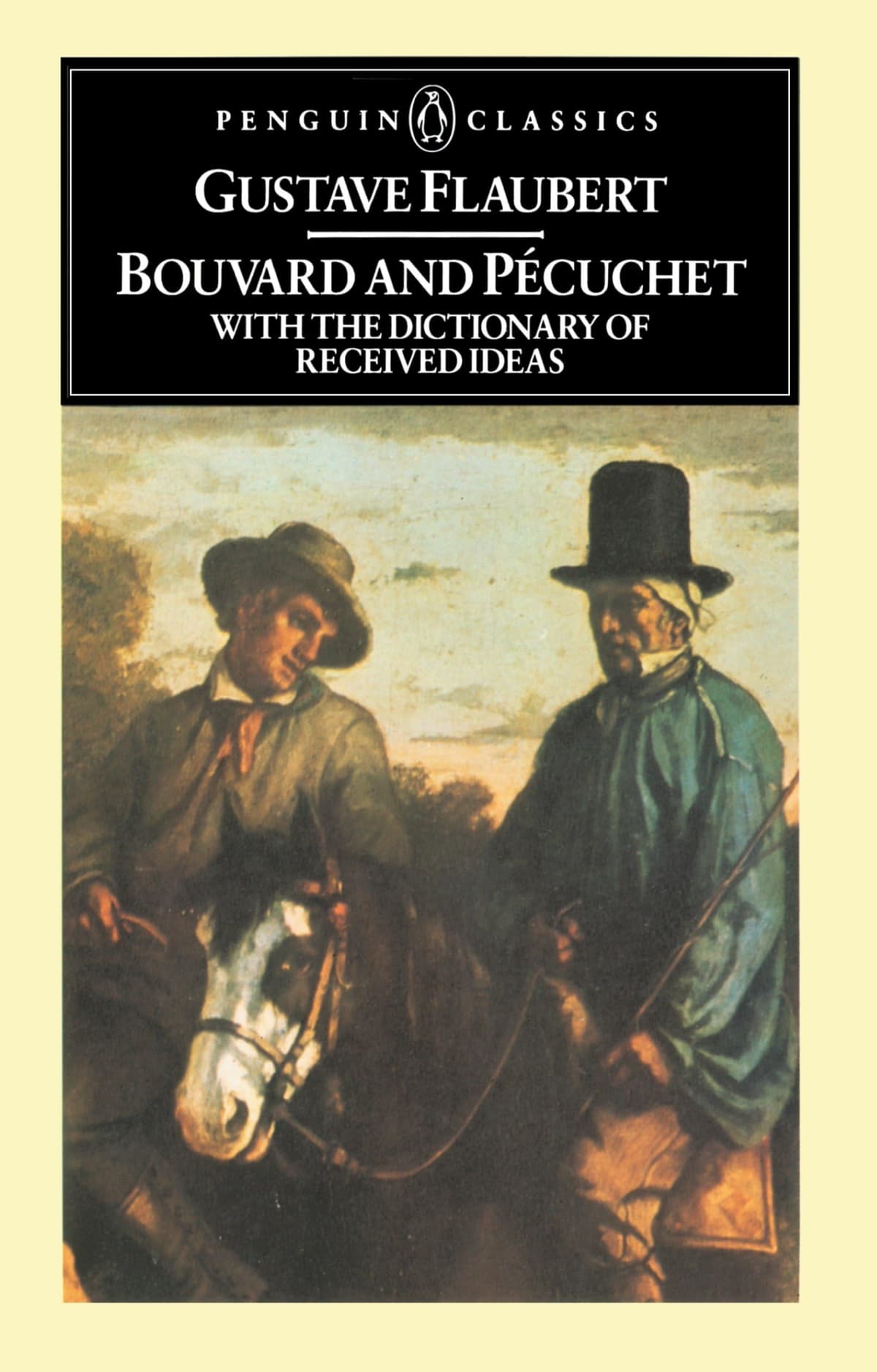
Bouvard et Pécuchet
“The faculty of criticism denigratory in all men.”
Bouvard et Pécuchet Summary
Two Parisian copy clerks, Bouvard and Pecuchet, meet by chance on a bench along the Canal Saint-Martin and discover an immediate affinity. When Bouvard inherits a fortune, the pair retire to the Normandy countryside to devote themselves to the systematic pursuit of knowledge. What follows is an encyclopedic odyssey through virtually every field of human intellectual endeavor: agriculture, chemistry, anatomy, archaeology, history, literature, philosophy, religion, politics, education, and more. In each discipline they follow the prescribed methods, consult the authorities, and apply themselves with earnest diligence, only to meet with spectacular failure, contradiction, and confusion at every turn. Their garden produces nothing, their scientific experiments cause explosions, their historical research yields only conflicting accounts, and their philosophical inquiries leave them more bewildered than before. Eventually, defeated by the impossibility of mastering any subject, they resolve to return to their original occupation of copying.
Flaubert's unfinished final novel is a monumental satire of human intellectual pretension and the limitations of systematic knowledge. The book is simultaneously a comedy of errors and a deeply pessimistic philosophical statement about the futility of the encyclopedic project that defined Enlightenment thought. Each chapter functions as a self-contained demolition of an entire discipline, revealing the contradictions, circular reasoning, and arbitrary foundations upon which human knowledge rests. Yet Flaubert's sympathy for his protagonists prevents the novel from becoming merely cynical; Bouvard and Pecuchet are foolish but never contemptible, their dogged persistence a testament to the inextinguishable human desire to understand the world. Left incomplete at Flaubert's death in 1880, the novel was intended to conclude with a vast compendium of human stupidity, making it a fitting capstone to the career of literature's greatest enemy of received ideas.
Why Read Bouvard et Pécuchet?
If you have ever embarked on a new hobby or intellectual pursuit with boundless enthusiasm only to discover that mastery is far more elusive than the instruction manuals suggest, you will find kindred spirits in Bouvard and Pecuchet. Flaubert spent his final decade researching this novel, reading over fifteen hundred books to ensure that his characters' failures were grounded in real scientific and philosophical contradictions. The result is a comedy that grows funnier the more you know, each chapter a perfectly orchestrated catastrophe of misapplied learning.
You should read this because it is one of the most ambitious satirical projects ever attempted, a book that tries to encompass the entirety of human knowledge in order to demonstrate its absurdity. Flaubert's prose, even in translation, is extraordinarily precise, and his ability to find comedy in the gap between aspiration and achievement is unmatched. The novel anticipates postmodern concerns about the instability of knowledge and the impossibility of objective truth by nearly a century. It is challenging, yes, but it rewards patient readers with a vision of human intellectual endeavor that is simultaneously devastating and oddly heroic.
About Gustave Flaubert
Gustave Flaubert was born in 1821 in Rouen, France, the son of a prominent surgeon. He began writing as a teenager and briefly studied law in Paris before a nervous collapse in 1844 led him to abandon his legal studies and devote himself entirely to literature. He lived most of his life at his family estate in Croisset, near Rouen, supported by family money and later plagued by financial difficulties. His first published novel, Madame Bovary, appeared in 1857 after five years of agonizing composition and immediately provoked an obscenity trial that made Flaubert famous. He never married, though he maintained a long correspondence with Louise Colet and other literary figures.
Flaubert is regarded as the father of literary realism and one of the most influential novelists in Western literature. His obsessive devotion to finding "le mot juste" -- the exact right word -- set a new standard for prose craftsmanship that influenced every subsequent generation of fiction writers. His major works include Madame Bovary, Salammbo, A Sentimental Education, and Three Tales. His correspondence, which fills several volumes, constitutes one of the great documents of literary theory and practice. Writers as diverse as Maupassant, James, Proust, Kafka, and Nabokov have acknowledged their debt to his example. He died of a cerebral hemorrhage in 1880, leaving Bouvard and Pecuchet unfinished.
Reading Guide
Ranked #475 among the greatest books of all time, Bouvard et Pécuchet by Gustave Flaubert has earned its place in the literary canon. Originally written in French and published in 1881, this challenging read from France continues to resonate with readers today.
This book belongs to our Society & Satire and Philosophy & Faith collections, where you can discover more books that share its spirit and themes.
If you enjoy challenging reads like this one, you might also like Ulysses, Moby-Dick, or Lolita.
From the Society & Satire Collection
If you enjoyed Bouvard et Pécuchet, discover more masterpieces that share its spirit.
 #9View Book
Don Quixote
Miguel de Cervantes
High•35-40 hours #12View Book
Pride and Prejudice
Jane Austen
Accessible•10-12 hours #22View Book
Madame Bovary
Gustave Flaubert
Moderate•12-15 hours #30View Book
Middlemarch
George Eliot
High•30-35 hours
Browse more collections