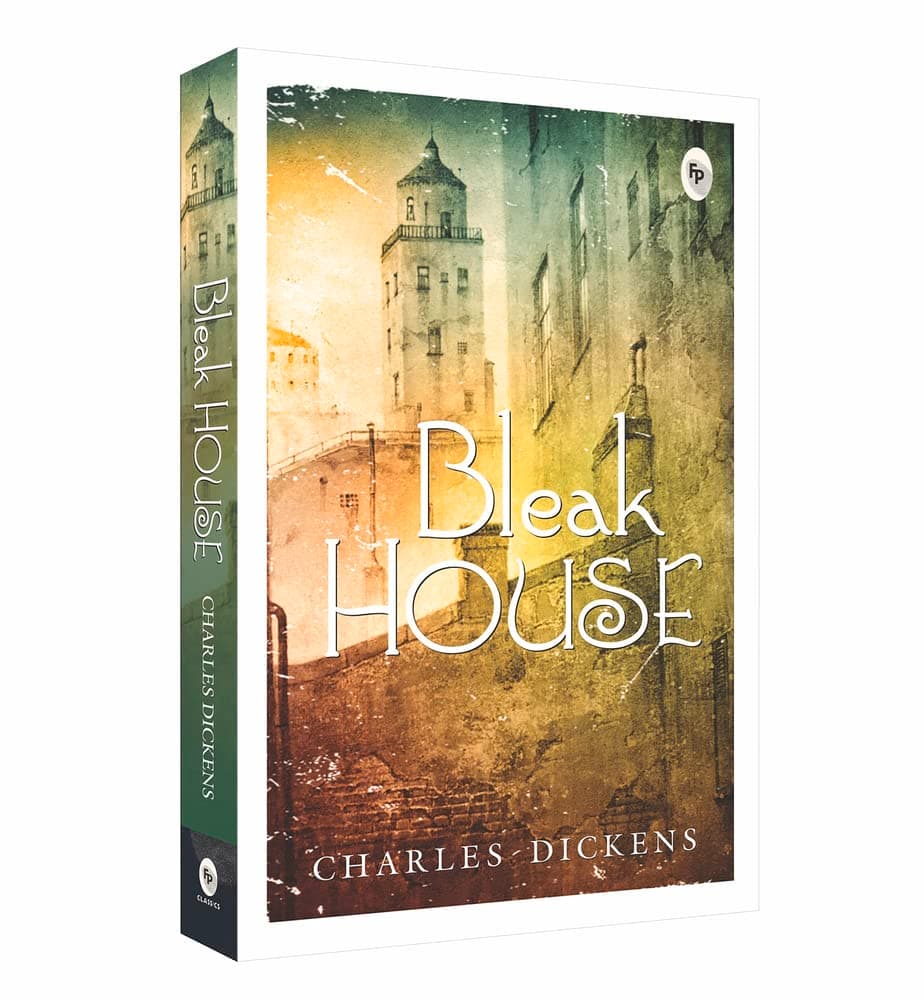
Bleak House
“Fog everywhere. Fog up the river, where it flows among green aits and meadows; fog down the river, where it rolls defiled among the tiers of shipping.”
Bleak House Summary
London, the 1850s. A fog so thick it seems to ooze from the very pages envelops the opening of Charles Dickens's most architecturally ambitious novel—a fog that is both literal weather and moral metaphor for the Court of Chancery, the monstrous legal machine at the book's center. The case of Jarndyce and Jarndyce, a lawsuit over a contested will, has ground on for so many generations that no one can remember what it is about, and everyone it touches is destroyed by hope, delay, or madness. Around this black hole of litigation, Dickens spins a galaxy of interconnected stories: Esther Summerson, an orphan who narrates half the novel with quiet grace; Lady Dedlock, an aristocrat hiding a devastating secret; the street urchin Jo, who knows nothing and is known by no one; and dozens more characters—from the ridiculous to the sublime—whose lives are knotted together by law, charity, disease, and coincidence.
Bleak House is Dickens at his most panoramic and his most modern. The novel's dual narration—Esther's intimate first person alternating with a sardonic, present-tense omniscient voice—was revolutionary for its time and anticipates techniques that novelists would not fully exploit for another century. The fog, the mud, the spontaneous combustion, the smallpox, the labyrinthine plot: everything serves Dickens's furious indictment of a society that lets its institutions devour the people they were designed to protect. It is at once a mystery, a love story, a social panorama, and one of the greatest novels in the English language.
Why Read Bleak House?
If you have never read Dickens at his full power, Bleak House is the place to begin. It contains everything he does best—unforgettable characters, savage humor, social outrage, and a plot so intricate it could be mapped like a city—marshaled in service of a single devastating argument: that institutions built to serve justice can become engines of cruelty. The Court of Chancery grinds lives to dust with perfect legality, and Dickens makes you feel every grain.
But Bleak House is far more than a legal polemic. It is a novel of extraordinary tenderness and suspense, anchored by Esther Summerson's gentle narration and driven by one of the great mysteries in Victorian fiction. Dickens weaves together high society and the lowest slums, showing how disease, poverty, and secrets connect every rung of the social ladder. You will emerge from its eight hundred pages feeling that you have lived in Victorian England—and that its injustices have not entirely vanished from our own world.
About Charles Dickens
Charles Dickens (1812–1870) was born in Portsmouth, England, the second of eight children. When his father was imprisoned for debt, the twelve-year-old Charles was sent to work in a blacking factory—a humiliation that haunted him for life and fueled his lifelong crusade against poverty and injustice. He rose from parliamentary reporter to the most famous novelist in the English-speaking world, publishing his works in serialized installments that kept millions of readers in suspense.
Dickens's output was prodigious: fifteen major novels, countless stories, journalism, and public readings that drew enormous crowds on both sides of the Atlantic. His characters—Scrooge, Pip, Oliver Twist, Miss Havisham—have entered the language itself. Beyond entertainment, Dickens helped change laws and public attitudes toward the poor, the young, and the imprisoned. He remains the supreme example of a novelist who was both a popular entertainer and a moral force, and Bleak House stands among his most accomplished achievements.
Reading Guide
Ranked #149 among the greatest books of all time, Bleak House by Charles Dickens has earned its place in the literary canon. Originally written in English and published in 1852, this challenging read from United Kingdom continues to resonate with readers today.
This book belongs to our Society & Satire and Epics collections, where you can discover more books that share its spirit and themes.
If you enjoy challenging reads like this one, you might also like Ulysses, Moby-Dick, or Lolita.
From the Society & Satire Collection
If you enjoyed Bleak House, discover more masterpieces that share its spirit.
 #9View Book
Don Quixote
Miguel de Cervantes
High•35-40 hours #12View Book
Pride and Prejudice
Jane Austen
Accessible•10-12 hours #22View Book
Madame Bovary
Gustave Flaubert
Moderate•12-15 hours #30View Book
Middlemarch
George Eliot
High•30-35 hours
Browse more collections