The Words
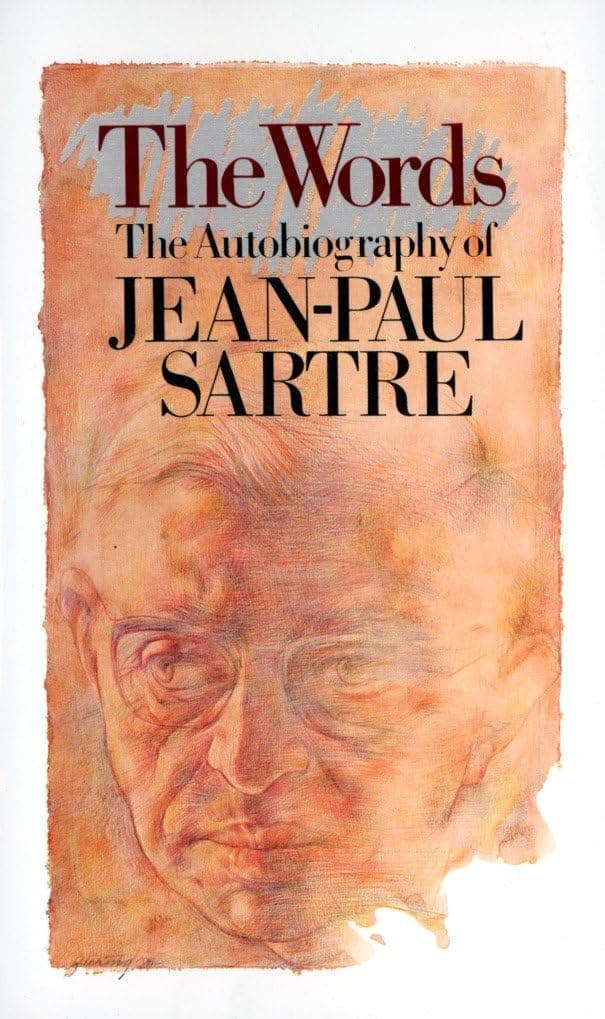
“I began my life as I shall no doubt end it: among books.”
The Words Summary
In this slim, glittering autobiography, Jean-Paul Sartre turns his philosophical apparatus on his own childhood to produce a memoir unlike any other. Born in 1905 and raised in the household of his maternal grandfather, Charles Schweitzer—a commanding Alsatian patriarch and professor of German—young Jean-Paul grows up fatherless, pampered, and performative, discovering early that he exists primarily as a role played for adoring adults. The child becomes intoxicated with words, first as a voracious reader lost in his grandfather's library, devouring adventure stories and encyclopedias with equal greed, then as a writer producing wild, derivative adventure tales in school notebooks. Sartre dissects with merciless wit how this precocious boy convinced himself that literature was his destiny, that writing would justify his existence, and that he was, in essence, already posthumously great. The memoir ends around age twelve, but its subject is nothing less than the birth of a writer's consciousness and the self-deceptions that nourished it.
The Words is Sartre's most accessible and personally revealing work, a dazzling performance in which the philosopher of radical freedom and bad faith applies those concepts to his own formation. The prose sparkles with irony, self-mockery, and an almost cruel lucidity about the mechanisms of self-mythologizing. Divided into two sections—"Reading" and "Writing"—the memoir traces how a bookish, fatherless child constructed an identity out of language and how that construction became both his liberation and his trap. It is simultaneously a love letter to literature and a devastating critique of the illusions literature fosters, written by a man who understood both sides of that paradox more deeply than anyone.
Why Read The Words?
The Words is Sartre at his most human, most funny, and most devastatingly honest. Strip away the forbidding reputation of existentialist philosophy and you find here a writer of extraordinary charm dissecting the most universal of experiences: how a child falls in love with books and decides to become a writer. But Sartre being Sartre, this is also a ruthless philosophical investigation of self-deception, showing how even the purest-seeming devotion to literature can be an elaborate form of bad faith—a way of avoiding the terrifying freedom of existence by hiding behind a predetermined role. You will recognize yourself in these pages, whether you are a writer or not.
This is also one of the finest memoirs ever written about childhood. Sartre captures the texture of a bourgeois Parisian household at the turn of the century with novelistic vividness: the domineering grandfather, the compliant mother, the absent father whose early death freed the boy from the burden of paternal authority. The prose is witty, precise, and endlessly quotable. If you have ever wondered why you read, why you write, or why you tell yourself stories about who you are, The Words will illuminate those questions with an almost uncomfortable brilliance.
About Jean-Paul Sartre
Jean-Paul Sartre was born in 1905 in Paris and raised in the household of his maternal grandfather after his father's early death. He was educated at the prestigious Ecole Normale Superieure, where he met Simone de Beauvoir, who would become his lifelong intellectual partner and companion. After teaching philosophy in Le Havre and experiencing a formative year in Berlin studying Husserl and Heidegger, he published his philosophical novel Nausea in 1938, followed by the monumental treatise Being and Nothingness in 1943.
Sartre became the most famous intellectual in the world during the postwar decades, a public philosopher who engaged passionately with politics, literature, and the questions of human freedom. His works span an extraordinary range: the novels of the Roads of Freedom trilogy, the plays No Exit and The Flies, the literary criticism of What Is Literature?, and the massive biographical studies of Baudelaire, Genet, and Flaubert. In 1964, the same year The Words was published, he was awarded the Nobel Prize in Literature but famously declined it, stating that a writer should not allow himself to be turned into an institution. He was a central figure in existentialism, Marxism, and the anti-colonial movement. Sartre died in 1980 in Paris; fifty thousand people followed his funeral procession through the streets.
Reading Guide
Ranked #390 among the greatest books of all time, The Words by Jean-Paul Sartre has earned its place in the literary canon. Originally written in French and published in 1963, this moderate read from France continues to resonate with readers today.
This book belongs to our Philosophy & Faith and Modern Mind collections, where you can discover more books that share its spirit and themes.
If you enjoy moderate reads like this one, you might also like One Hundred Years of Solitude, Nineteen Eighty-Four, or Wuthering Heights.
From the Philosophy & Faith Collection
If you enjoyed The Words, discover more masterpieces that share its spirit.
 #11View Book
Crime and Punishment
Fyodor Dostoevsky
High•20-25 hours #18View Book
The Bible
Various
Variable•60-80 hours #19View Book
The Brothers Karamazov
Fyodor Dostoevsky
Very High•35-40 hours #21View Book
The Stranger
Albert Camus
Moderate•3-4 hours
Browse more collections