The Notebooks of Malte Laurids Brigge
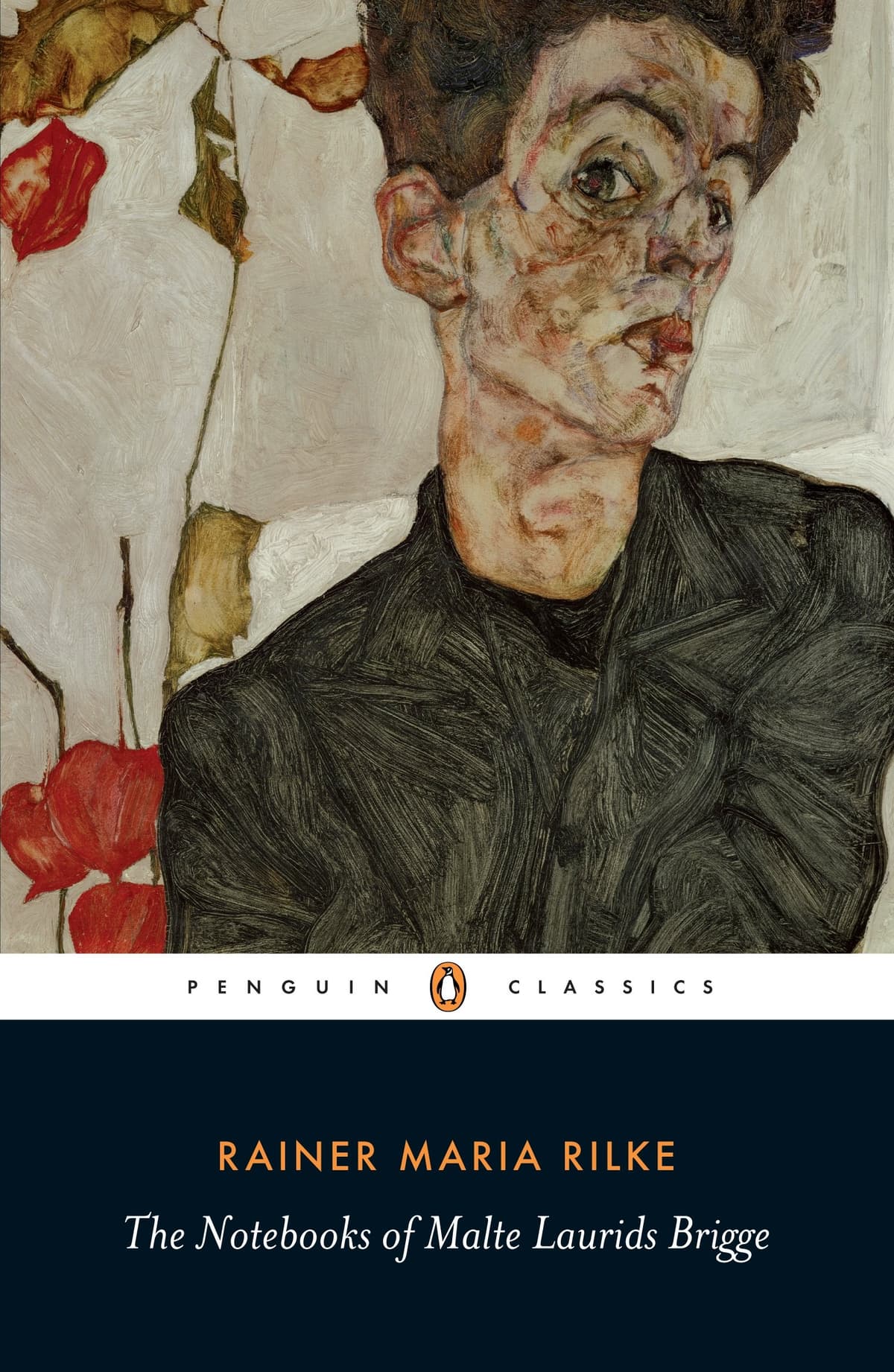
“For the sake of a single poem, you must see many cities, many people and things.”
The Notebooks of Malte Laurids Brigge Summary
A young Danish nobleman named Malte Laurids Brigge arrives alone in Paris at the turn of the twentieth century and is immediately overwhelmed by the city's assault on his senses. The streets teem with the sick, the dying, the destitute; the walls of his rented room seem to harbor the residue of previous tenants' suffering; the hospitals process death with industrial efficiency. Malte, hypersensitive and increasingly unmoored, records his experiences in a series of notebook entries that oscillate between precise observations of Parisian poverty and hallucinatory memories of his aristocratic Danish childhood—of his mother's ghost stories, his grandfather's slow death, a fever-dream episode involving a mysterious hand reaching from beneath a table. As the notebooks progress, the boundary between present and past, observation and imagination, self and world dissolves entirely, and Malte's entries become meditations on fear, solitude, the nature of seeing, and the parable of the Prodigal Son, whom he reimagines as a figure fleeing not sin but the unbearable weight of being loved.
Rilke's only novel is one of the great works of literary modernism, a book that anticipates the existential anxieties of Kafka and Sartre while maintaining a poet's attentiveness to the texture of experience. The fragmented notebook form allows Rilke to juxtapose urban desolation with aristocratic memory, philosophical reflection with sensory immediacy, creating a portrait of consciousness under extreme pressure. The prose has the compressed intensity of poetry, each sentence weighted with observation and feeling. The Notebooks of Malte Laurids Brigge is a profound meditation on what it means to truly see—to open oneself to the full spectrum of human suffering and beauty—and the enormous cost that such seeing exacts upon the self.
Why Read The Notebooks of Malte Laurids Brigge?
The Notebooks of Malte Laurids Brigge is one of those rare books that permanently alters your capacity for perception. Rilke writes about seeing with such intensity—the face of a dying man in a Paris hospital, the particular quality of light on a crumbling wall, the way fear lives in the body—that after reading him, you notice things you never noticed before. This is not a novel you read for plot but for the extraordinary quality of attention it brings to every moment of existence, however painful or beautiful. Each notebook entry is a small revelation, and together they compose a portrait of what it costs to be fully alive and fully aware.
Rilke wrote this book during a period of genuine crisis in Paris, and that biographical urgency saturates every page. Malte's experience of the city as a place of overwhelming sensation and anonymous suffering anticipates the alienation that would become the central theme of twentieth-century literature. But this is also a book about memory, about childhood, about the aristocratic past dissolving into modern chaos. If you love Rilke's poetry, this novel reveals the prose foundations of his vision. If you have never read Rilke, this is an extraordinary place to begin—a book that teaches you how to see.
About Rainer Maria Rilke
Rainer Maria Rilke was born in 1875 in Prague, then part of the Austro-Hungarian Empire, to a family that imposed on him a childhood of stifling expectations—his mother, mourning a lost daughter, dressed him as a girl in his early years, and his father sent him to military academies he detested. He escaped into poetry, publishing his first collection at twenty-one, and soon embarked on the restless, peripatetic life that would define his existence: Munich, Berlin, Russia (where he met Tolstoy), the artists' colony at Worpswede, and finally Paris, where his encounter with the sculptor Rodin transformed his understanding of artistic labor and where he wrote The Notebooks of Malte Laurids Brigge.
Rilke is widely regarded as one of the greatest poets of the twentieth century in any language. The Duino Elegies and the Sonnets to Orpheus, both completed in a legendary burst of inspiration in 1922, are among the supreme achievements of modern poetry. His Letters to a Young Poet remains one of the most beloved works of literary counsel ever written. Rilke spent his life dependent on the patronage of aristocratic admirers, moving between castles and rented rooms across Europe, producing work of extraordinary spiritual depth and formal beauty. He died of leukemia in 1926 in Switzerland at the age of fifty-one, leaving behind a body of work that continues to shape how we understand solitude, beauty, and the inner life.
Reading Guide
Ranked #393 among the greatest books of all time, The Notebooks of Malte Laurids Brigge by Rainer Maria Rilke has earned its place in the literary canon. Originally written in German and published in 1910, this challenging read from Germany continues to resonate with readers today.
This book belongs to our Modern Mind collection, where you can discover more books that share its spirit and themes.
If you enjoy challenging reads like this one, you might also like Ulysses, Moby-Dick, or Lolita.
From the Modern Mind Collection
If you enjoyed The Notebooks of Malte Laurids Brigge, discover more masterpieces that share its spirit.
 #1View Book
Ulysses
James Joyce
Challenging•35-40 hours #2View Book
In Search of Lost Time
Marcel Proust
High•100+ hours #8View Book
The Sound and the Fury
William Faulkner
Very High•12-15 hours #13View Book
Lolita
Vladimir Nabokov
Challenging•12-15 hours
Browse more collections